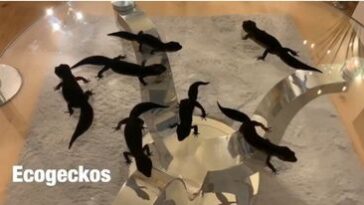


Video: Tokay gecko saves fellow tokay from a snake
We don’t usually post video updates or short blog posts but this video was too good not to share. I hope you enjoy!
Read More »We don’t usually post video updates or short blog posts but this video was too good not to share. I hope you enjoy!
Read More »Over the last two weeks we have discussed Namibia, and a gecko that hails from that region. This week I’d like to share my experience importing P. rangei from Germany to the United States.
Read More »“Perhaps the most remarkable Gecko of the South African geckoes is the web-footed Palmatogecko from the Namib desert.“ Brain (1958) formulated it very accurately in his description of one of the characteristic species from Namibia’s coastal deserts.
Even though P. rangei counts among the well known species it is still a rare sight in our terrariums.
Namibia is located on the Atlantic coast between South Africa and Angola, and for five years my fellow instructors and I from The University of Arizona have been taking 8 – 13 undergraduate and graduate students from a variety of different majors to Namibia as part of a six-week conservation biology class. Why Namibia?
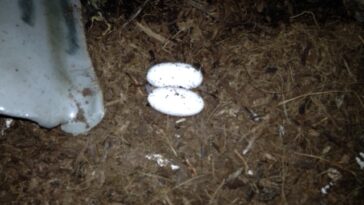
Read More »It’s hard to believe but one full year of breeding is now under my belt and as usual things didn’t go as planned, but they were fun. At this point I thought I would have 2 full racks of hatchlings, a couple of sales and be setting up for my first show.
Read More »Why do we keep geckos? Paint? Write lyrics? Or poetry? Why do we have this compunction to have hobbies? The answer is not that simple, but one writer, Thomas Moore, has given me some insights I’d like to share with you. If you don’t want to take this philosophical journey, and this IS a philosophical journey, abort this mission now.
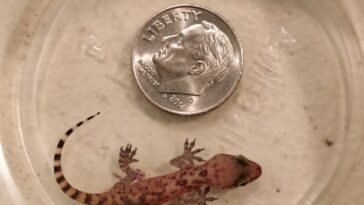
Read More »Originally known as Teratolepis fasciata, the genus Teratolepis was abolished due to the fact that the whole genus consisted of only two geckos: Teratolepis fasciata and Teratolepis albofasciatus. Teratolepis was originally established by Gunther in1869 because he considered them to have a ‘bizarre scalation’. Recently, in 2008, they were reclassified by Bauer as Hemidactylus imbricatus commonly called the “viper gecko”.
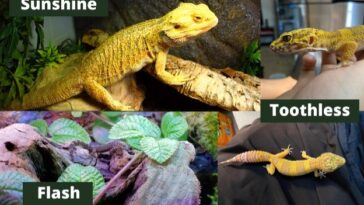
Read More »As the autumn winds blow, leaves begin to fall and temperatures gradually change. Bright orange pumpkins of all sizes begin to line residential neighborhoods; black and orange decorations fill department stores and shops- all marking the fast-approaching Halloween holiday. . . Arriving in my gecko room, I smile to myself as I carefully slide open a plastic sweater box to reveal a brightly colored orange reptile.
Read More »So far all my hatchlings have come from the Sunglow by Superhypo pair and for the most part the hatchlings look the same. That was until this past Saturday when I found a present in the incubator.
Read More »Are you practicing good biosecurity? Maybe you are only vaguely familiar with the term. Most herpetoculturists I talk to are ill prepared to meet the bio threats that can devastate their collections. The threat is real; all reptile collections are at risk. The threat is any type of infectious agent–viral, bacterial, fungal, or parasitic.
Read More »