

 Bob Watson
[ad#250]
As a leopard gecko breeder and an animal lover, one of the things that I do all the time is scan Craigslist’s pets ads for gecko posts. More often than not, I find breeders selling babies, which is all well and good by me. But every once and a while, I find that someone is trying to get rid of a sick gecko, and when I find that, I always offer myself up as a rescue. I’ve had more than my fair share of deaths when I rescue leopard geckos, since I sometimes arrive just a little too late, but I’ve also had a good number of successes. I wanted to write this article so I could describe some of the things that I do, and which you can do, to keep a leopard gecko happy and healthy in your own home.
[ad#sponsor]
Ideally, you’ll want to go to a vet and get antibiotic treatments. Unfortunately, as I’ve seen far too often, many gecko owners don’t budget for this, and can’t afford to take their geckos in, or simply don’t have a reptile veterinarian anywhere near them. If you fit that profile, then this is really a guide for you more than anybody else, since I’m not going to rely on having a fecal test or any other medicines.
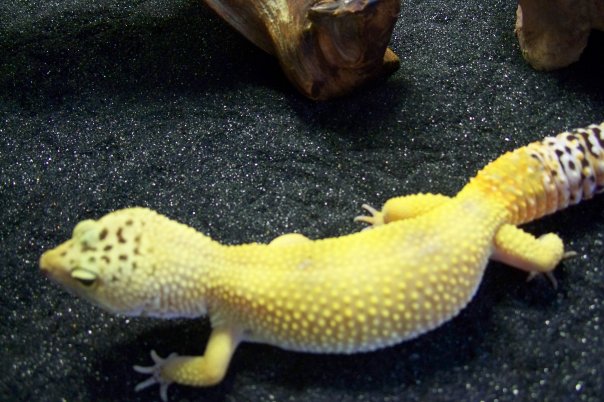
I’m going to be referring to my latest rescue throughout this article. She’s not quite out of the woods yet, but “Bubbles” as her previous owner named her, has started the road to recovery quite well. This is a picture that the owner gave me of Bubbles before she started to decline, and the second picture is a picture of Bubbles when I first brought her home.
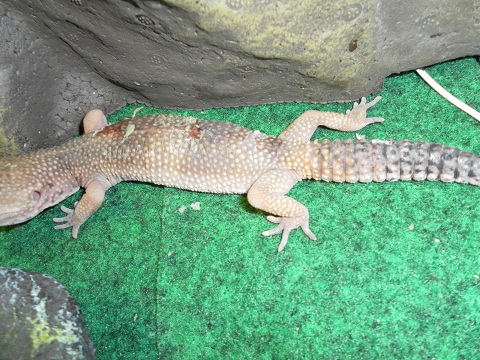
To those who are unused to the appearance of leopard geckos, I want to point out a few things that tell me that this is one troubled creature. First, notice the dark color of her entire body, but particularly her tail. That’s a sure sign of stress, and pretty constant stress at that, if not a bigger problem like Cryptosporidiosis. Also notice that she didn’t really complete her shed very well on her own, and that her tail is fairly skinny. All of these signs point to a severely troubled gecko. According to her previous owners, she was also fairly lethargic, much moreso than normal.
So I had to start the recovery process quickly. When it comes to dealing with sick geckos, I immediately assume parasites is the issue, because in my experience, nine times out of ten, that’s the problem. I thoroughly cleaned out a ten-gallon aquarium for her, added paper towels (easy to ensure that they’re clean), and added some clean new fixtures to her new home, which I made out of tupperware. I moved her in quickly, double checked the temperature, and let her be.
Then it came time to clean her old home. I wanted to move her back in as soon as possible so that she wouldn’t be as stressed out from moving homes. If parasites is, in fact, the problem, then you need to get rid of the parasites wherever possible, so I did a thorough cleaning of her old home, and everything in there. As you can see from the “before” picture above, her previous owners used sand as a substrate. I cannot stress it enough that with sand, it’s not a matter of “if”, it’s a matter of “when” it’s going to kill your pet. Obviously, removing the sand was priority number one, and I then took a bleach soaked rag to the entire inside of the tank. I took all of her old aquarium furniture and hides, and submerged them in a 50/50 bleach/water solution for two hours, then took them out and allowed them to dry in front of a fan. Before even thinking of putting anything back together, I scrubbed it all with soap and water, rinsed off everything, tank included, and let it sit overnight. That should thoroughly kill any and all bacteria and parasites that may have infested the aquarium itself, and it provided a nice clean start for Bubbles in a place that’s fairly familiar to her. The only difference was that the sand was gone, replaced by tile, which is impossible for the geckos to eat, and also a good conductor of heat.
The next day, I put Bubbles back in her old aquarium, and did the same scrub routine with her new tank. There’s a lot less work to it this time with paper towels and tupperware hides, which can all just hit the trash.
Now to treat the gecko itself. I always provide clean, filtered water daily, and for particularly skinny geckos, I like to provide a small dish of mealworms at all times in hopes of getting her to eat when she’s hungry. Otherwise, I hand feed. I think it’s harder for them to ignore the food when it’s right in front of their faces, and if they’re feeling lethargic, then it’s going to be tough for them to catch crickets, even if the crickets are hobbled. Make feeding a simple process, and use large food, that way they get more calories with less effort. I use superworms, heavily dusted with calcium powder, held out with tweezers. Another must at this stage is the use of Reptaid (http://www.reptaid.com/), which is an organic vitamin compound that is made with lots of anti-parasite ingredients, which should be injected into the worm before feeding. I keep a bottle on-hand all the time, and I’ve found that small doses over time are usually enough to get them better without the use of veterinary medicine.
If, like Bubbles, they aren’t shedding, I take one extra step. Using a cheese grater, I take a human adult multivitamin and grate it over the coarse side, reducing the material to dust. Licking my finger helps me gather a little bit on the tip of my finger, and then I just touch the reptile’s mouth with it. They can’t help but lick it when it’s right in their face, and that way you can give them a little vitamin supplement. Some people don’t think that this is necessary, and it may not be, but it’s always worked for me. The logic is that if they’re not shedding completely, they’re missing out on some of the vitamins that they would normally get from eating their skin. Why a human adult vitamin instead of an already prepared reptile vitamin? If the logic holds, as I believe it does, that leopard geckos need to eat their skin to get different vitamins than they get anywhere else, then they would have stopped eating their skin in captivity. All adult multivitamins that I’ve ever seen give calcium, plus a variety of other things that may help them get healthier. As I stated, this may help, or it may not. I did this originally based on what I read about the skin being shed, and so far, the only geckos to have gotten worse, or died under my care have been far too sick to begin with.
As long as they’re eating something, you should be OK to simply let the process run its course. When it comes time for them to shed, give them a warm bath once per day, and don’t disturb them much throughout the course of their recovery. When I have a sick gecko, I actually like to set it up in my closet, because that’s the one place where I know that it won’t be bothered by the light or noise. Alone, it can sometimes calm down and de-stress, which is one of the most important parts of getting your gecko back on track.
Bubbles isn’t back to 100% yet, but a few days into it, she’s already looking a lot better. I think she’ll come out of it all just fine, and I might even end up using her for breeding some day. All it takes is a little know-how, and you can save almost any leopard gecko.

Wonderful things you are doing Bob. Do not hesitate to contact me if you need help with rescues. Keep up the good work, they need you.
Wow, great job with rescuing her, she looks great! It’s very kind of y ou to rescue these neglected geckos that could be having perfectly happy lives with a little bit of care.
When you first mentioned the cheese grater, I was afraid you were going to say to grate the skin off with it! 😛 But the grated human vitamins seem to be a better use for it 🙂
Amazing difference! Kudos to you, Bob! What a lovely gecko.
Hi I was wondering what substrate your using in the last picture? Looks like black sand?
It’s actually a big piece of aquarium furniture I found at my local pet store that’s kind of like those “Universal Rocks” things that cost way too much. Basically, it’s a large piece of plastic that looks and feels like a rock, but weighs less than a pound. It does have sand particles on it that give it the texture and real-life appearance, but they’re very stable, so no impaction risk.
my leopard gecko is fat too but, her tail is a little skinny but not to to skinny and her vent keeps comming out when there’s no sand in her tank! i don’t get how she becomes impacted when there’s no way how! my mom, aunt and uncle are helping me out because we’re looking for a exotic vet that’s nearby in St. J, V.T. i’m soooooooooo worried about her because i love her and i only had her for a few months… she acts fine, though. so… can you help me out??????? please? for my little leopard gecko??????????????
She’s a real bueat. How much was she.
I bred learpord geckos to but none got sick yet would you mined if one gets sick could you try to help
Hi Bob, I’m wondering if you may be able to help me with our leopard gecko named Niko. We’ve had him for just over a year, and he has never truly thrived, he’s not a whole lot bigger than when we first got him, his tail is super skinny and seems to be getting even more thin lately. I’m thinking he’s got a parasite. He has also began getting lumps on his joints. I feel like he may not make it through the next week, but my husband recently lost his job and we just can’t afford a vet visit. Do you know of anything I can buy over the counter or online to help him?
Hello,
My name is Heather and I have two Leopard Gecko’s and one one them wont eat. His name is muogen and he is a Mack Super Snow Albino. I tried hand feeding him meal worms he only eats two a day, he won’t take anymore than that. I did have Replite carpet in the tank, I took it out b/c the two Leopard gecko’s I have, kept getting there nails caught in it. I put down toilet paper for time until I’m able to get paper towels. Maybe it’s the toliet paper i layed down? The other Leopard gecko is doing great on eating, drinking fresh water, roaming around at night, being very active, and lovable. Muogen on the other hand is somewhat active but one of there stools say other wise. It’s not normal I did my reasearch and I figured you could help me out. Please if anyone can help, e-mail me at;
[email protected]
Also I can give you more information at my e-mail /c im multitasking on other things as well as Muogen. Even though I sound very busy do not pause to e-mail me. Here it is again.
[email protected]
I adopted/rescued two female leopard geckos in March, they are approx 1 ½ – 2 y/o. They were both really rough when we got them and severely overweight. When the vet saw them she was concerned that they had eggs that had been in there for a long time. Well come to find out they didn’t have eggs and only had yeast infections. Since they were housed together at the time the vet only took one fecal sample to test for parasites and said that if there were parasites they would both have them from being housed together. Well Ariel is doing awesome, is healthy and a very active leopard gecko. As for my poor Erica, she is not doing well at all. Since we got her in March she barely eats. For a little a few weeks she would eat wax worms only and not very many. Vet recommended Repti-Boost since she wasn’t eating. She has lost a lot of weight, tail is getting thinner and she has very little energy. The Vet saw her this morning and said that she fears it is too late to do anything but took blood and fecal to have tested. Do you have any recommendations? I love my little cool blooded children (I have a total of three leos).
I am very OCD about their tanks, heat, hides, etc.
Temps are 90-95 on warm side and 72-75 on cold side (sometimes a little warmer). Two humid hides, one on the cold side, one on the warm side. Her rock hide has a small water dish built in and she has a corner water dish. Haven’t been using the heat lamp since it has gotten warmer but she does have a UTH. We use a day UVB lamp during the day. She has a bowl with at least 4 meal and one wax worm at all times. She is housed alone and has been in her own tank since at least April. I do soak her in lukewarm water about once a week and plan to increase to every day.
Any Tips for helping her get better? The vet is talking about putting her down…. I do not want her to suffer but I also don’t want to give up hope! My male (Sebastian) was worse off than she is now (size wise) and he is as healthy as can be now. Please… Any advice?
Hi i have a leopard gecko 2 weeks ago she escaped in the basement i recently just found her and she got really skinny i also fed her and she threw up all her food i am new to having leopard geckos and i have no idea what to do i do not live near a vet so i cant go get her checked
If she’s really skinny, she isn’t used to eating much so she probably ate too much and threw up for that reason. Make sure she has something to drink and then just feed her a little and see if she can keep that down. Gradually increase how much you feed her and see how she does.
Well i have alot of insects in my basement maybe she was just full i put food in the tank for the other lizard because i have two and she went and ate herself i did not force feed her i always have fresh water in the tank for them but is it possible she could have got parasites from being in my basement for 2 weeks?
Hi i am new to leopard geckos and 1 of my leopard geckos toes are turning black and he has already lost one i bought a leopard gecko book and did as instructed by the book, thanks
Hi, my name Is Heather and I’ve been helping people with leopard gecko problems and concerns for there pet/pets. From person to person each one is helped with te respect for them and there pet. 🙂 if you need help or have any concerns about your leopard gecko, I will be more than happy to help you out.
My email is below;
[email protected]
If you can mark important. Ty 🙂
I need help with my gecko. She is not eating, not shedding properly around her eyes therefore she cannot see. Please email me.
Meghan,
I have had my fair share of sick rescues. I’d be more than willin to help give you some advice. Feel free to email me. [email protected].
I have sick leopard gecko because she barely eats meaning today she just ate 1 cricket that was powered with calcium. I have 2 cricket roaming around and she hides in her cave. The reason I think she is sick because her tail is very small. I don’t have sand in tank just use paper towel to clean. She is very young we had her 4 a month. I we bought her from another person that was moving. I am using black heat lamp at night and day heat lamp. Day heat lamp is on one side of tank. I also have wet spot on the cool side if she needs help with shedding. Pet store told me mealworm are only for fatting them up and currently out. After research I put a cap of calcium for her to eat if needed. Also has bowl of water and temp is 80-90%. Anything else I can do? Please email me [email protected]
It is really good that you are helping these leopard geckos! If someone could help me with mine i have one question. I just cant seem to get the heating up alot in my tank, i have a night heat lamp that has bluish light that i keep on all the time, and a good sized heating pad under the tank. What should I do?
It depends on where you’re measuring the temperature. The temp needs to be in the low 90’s on the floor, not in the air. If you use a digital thermometer with a probe on the floor and your temp isn’t hitting the low 90’s you’ll need to check your under tank heater (ideally with a watt meter) to make sure it’s putting out the amount of heat it’s supposed to be. If not, you’ll need a new under tank heater since a working heater should heat the floor at least to the low 90’s, if not higher.
I’ve had that issue with my heating pads before and I bought some gorilla duct tape and taped it on the bottom good (it kept falling off) and now they heat like a charm!
Hi wondering if u can help me. I have two geckos in the same tank. One is doing great, the other not. Shes got energy, when she sees me comes to me, drinks regularly. The only thing is her appetite. She just doesnt want to eat. Shes never had a proper appetite but now its vanished.she also lost her tail.. How can i pinpoint her issue? Do u know if its injection, bacterial, viral….or should i just load her with Meds for everything?
The first and most important thing to do is to separate your geckos. There’s a very high probability that one is bullying the other and may have even caused the tail drop. If the gecko still doesn’t do well after a few weeks in her own enclosure, you will need to find a reptile vet.
We have a Mack Snow Spotted Leopard Gecko. We spent approximately $250 making sure we had all of the appropriate materials before we purchased the gecko. My son researched how to care for a gecko (he is 10 years old). I noticed our gecko is sluggish and his tail has shrunk considerably. It is now very thin. I need help! I have researched a variety of things on the internet. What could be the possible reasons to his poor health???? My son will be devastated if Titan does not make it, and I am not equipped with the knowledge of geckos to make an educated guess as to why he is “ill.”
Where did you get him from? This is a clear cut case where you need to take him to a reptile vet. The best way to find a vet is here:
http://arav.allenpress.com/arav/findavet
I agree with the previous poster. You should really contact an exotic vet. It could be something simple like a parasite or as bad as crypto. I have personally dealt with both and neither is fun. I swear by carnivore care to help My rescues gain weight, I actually got my first bag from my vet. You can buy it on amazon and keep it in the frezer to keep it fresh longer. However, it is not a cure and he should still be seen by a vet since there is something underlying casing the issue. My vet also recommends luke warm baths/soaks (distilled water) 2-3 times a day for 15 minutes to help hydrate the gecko. I used a Tupperware container and there should be enough water to almost reach his tummy, do not leave him alone and keep a close eye on him because they do not like baths. Sending happy thoughts! I hope he pulls through.
what if i cant get my gecko to eat? i followed all the recommendations from the article but she refuses to eat and lethargic… there isn’t a vet for her anywhere around me and i really dont want her to suffer/die. any advise?
how do i get her to eat? she refuses and is lethargic
Sometimes it just takes a vet to diagnose. To be sure there is no vet near you check this site:
http://arav.allenpress.com/arav/findavet
Also check our archive (http://geckotime.com/archives/) for our articles about getting geckos to eat and a more recent Q and A with the “leopard gecko advisor” on our site
I have two leopard geckos, there are no vets near me. The one thats ill used to eat a bunch for me, now refuses any food and i have to guide it to the water for it to drink. I feel its too late for a recovery, i have them separated and keep clean water and a bowl of meal worms dusted with calcium. The leopard gecko is still active and will drink when guided. I dont know what to do
Has the gecko lost weight (is the tail thinner)? Will the gecko eat if you hold it and gently poke a worm or cricket into its mouth? If it hasn’t lost weight, it just may be on a hunger strike, which happens sometimes.If you truly can’t find a reptile vet near you, the best you can do is keep it hydrated, try to feed it and see how it gets on. Good luck.
If they wont eat…is there any good way to “force feed”?
You can hold the gecko gently in one hand, gently poke a feeder at the mouth and see if they bite it. This is gentler than shoving a feeder down the throat, which would not be a good idea. You can also make a “puree” of feeder guts and drop some on the gecko’s nose. It should lick it off.
My leopard gecko recently lost her tail. I have been feeding her meal worms, and some waxworms here and there, dusted with supplements. I have been applying betadine to her wound every few days. Her terrarium is all lined with warm, moist paper towels that I have been changing 2 times a day. Right before she lost her tail, she had a very bad shed. I soaked her in warm water 10 minutes everyday. Her back right leg and foot is still not looking too well, and her tail is definitely infected. I haven’t been able to take her to a vet yet and I don’t know when I can. I’m extremely worried because I’m afraid I might not be able to take her in time. What have I done wrong? What can I do now? Should I have covered up her wound with something? This is my first leo so I don’t have a lot of experience. If there is anything I can do for her, please inform me. Thank you.
I’m sorry you and your gecko are having problems. Any idea why or how she lost her tail? Was it because of a bad shed? Usually a gecko will lose its tail because of a direct trauma, like having something dropped on the tail, or some kind of distress. As far as the wound goes, normally there is no special care needed. The bleeding is minimal to non-existent since the gecko is designed to drop the tail if necessary and the wound heals easily on its own. If you’re seeing signs of infection, it’s very important to get the gecko to a reptile vet for 2 reasons:
a. An infection needs to be treated with antibiotics or it will get out of control
b. Unless there was a direct trauma, you need to figure out why the gecko lost its tail because it may be a symptom of other problems.
Most likely, if your care is correct (floor heat on hot side in low 90’sF, no sharp substrate like ground walnuts) you didn’t do anything wrong and the gecko may just have a problem that developed independently of what you did.
Good luck with her.
hello i have a leo gecko she has stoped eating she use to be a very large happy gecko but the poast 4/5 days she is doing every thing u have described except the shed on her eyes are not comming off im very concerned can u please help me i love my gecko and it breaks my heart watching her do this and i cant afford a vet please help lizzythe gecko
It’s very important to try some way to get the shed off her eyes. You can gently wet her eyes and then pull the shed off. You can even use a tweezers. While her eyes are covered with shed, she will not be comfortable and happy and will probably not eat. Once you get the shed off, if she still doesn’t want to eat, hold her gently and poke a feeder into her mouth. Hopefully she will bite it and eat it. Remember that it’s not unusual for some geckos to refuse to eat for days, weeks or (in some cases) even months and as long as they seem active and the tails aren’t getting much thinner, they are probably fine. If her eyes are swollen or have pus in them, she needs to see a vet whether or not you can afford it. Sorry.
Hi, My daughter has a leopard gecko, named Bean. He shed his skin two weeks ago and had a very large dropping after he ate the skin. He then became very lethargic and will not eat. I brought him to a reptile vet, 3 times where he received fluids, antibiotics and vitamins. The vet is 45 mins from home and the costs are above what I can afford. The last visit to the vet they fed him, it took Bean 5 days to have a dropping. He still is lethargic and will not eat. Is there anything you can do to help?
If the vet couldn’t help, I don’t know that I can. If you really feel he’s impacted you can try putting a drop of mineral oil on his nose for him to lick off. You can also try putting some feeder guts on his nose for him to eat.
HELP my leo percy is about a month or two old but he refuses to eat and looks sickly weve tried hand feeding he wont eat his tail is dangerously small and hes not looking great but i cant get him to eat please help me i dont want him to die on us
At this point your best bet is to take him to a reptile vet. He may not have been healthy when you got him, especially if you got him from a big pet store. Here’s how to find a reptile vet: http://arav.site-ym.com/search/custom.asp?id=3661
Hi my name is Emily. I am twelve, and I got a leopard gecko from my neighbor who didnt want him early last year. I dont know how old he is, but he is quite old. He has not eaten for over 3 months. He has done this before, but not for as long. Last time, we took him to the vet, who gave us CAT LAX, a cat hairball eliminator, to help him digest. I think that was from him eating sand or having trouble digesting the cricket shells. I started hand feeding him crickets so he wouldn’t get a mouthful of sand while eating, but I kept the sand. Is that bad? This time, the same vet gave us Nutri-Cal, a vitamin supplement for cats and dogs. I hand feed him this every other day by putting it on my finger and having him lick it off. It has worked well, he seems normal and his tail is very fat. He is pooping normally, other than the fact that he is only pooping the goo. I am going on vacation next month, and I’m not sure I can find someone who is willing to offer him crickets, then hand feed him the Nutri-Cal. A few days ago, he ate a cricket, but spat it back out. Just today, I was cleaning out his aquarium. I found many tiny bugs all over his water bowl. I think they might be parasites. Does anyone have suggestions? Do I need to take him to the vet again?
Hi Emily,
I’m glad you’ve been able to keep your leopard gecko pretty healthy. Here are some suggestions:
Sand: I do think it would be best to get rid of it. Dump the sand, clean the cage very well to get rid of the bugs and then put one of the following on the bottom of the cage: paper towel, reptile carpet (from the pet store), ceramic tile (from the Home Depot type store). Be sure not to get the under tank heater wet when you clean the cage
Bugs: they are probably not parasites. They are probably some kind of bug that likes the sand. They may be grain mites or, if you left crickets in there for awhile, baby crickets
Feeding: The nautical is sustaining him, but it would be great if you could get him to eat crickets or mealworms. When you’re home, try holding him and gently poking a feeder at his mouth. He may not like it at first because he’s used to the other stuff, but hopefully he’ll eventually start eating solid food.
Vacation: How long are you going away for? If it’s a week or so, he may do just fine if you can get someone to make sure his water bowl is full. That’s what his fat tail is for. Feed him as much as you can before you go.
Let me know if you have any more questions.
PLEASE HELP!!!!!
my leopard gecko dropped its tail 2 weeks ago and she is now acting like she has no energy. She is not losing weight, but her legs seem bowed up and stiff and the joints of legs appear to have an extra lump on them that were not there before. Does this mean she is dying??? what can i do to help or save her? She is barley able to crawl. I can be reached at [email protected]
I come home 2 nights ago on my leopard gecko is not like walking right he can barely lift himself up I’d like to know what’s going on with him and see what I can do to help him because I love this little guy please reply back to me thank you
Sorry to say, I’m not a reptile vet and your description isn’t enough to tell me (even as a non-vet) much. If you haven’t been giving your gecko calcium with vitamin D3, it may have a condition called “metabolic bone disease” (MBD) where the bones get soft and then the gecko can’t raise itself up. I highly recommend you take your gecko to a reptile vet (find one here: arav.org).
Hi we have a very sick young gecko. We have taken her to the vet and he suspected parasites and gave her medicine. Its been 5 days now and she still is not eating well. She is dangerously skinny. We used to giver her mealworms but stopped because she wasn’t digesting them well. We give her crickets now and “hobble” them, but she still doesn’t go for them. However she did go for wax worms. Is it okay to give her some wax worms now to get her eating even though they are so fatty? Are they healthy enough? Any other suggestions?
Thanks
I don’t think waxworms are as terrible as people make them out to be. However, you also don’t want to get into a situation where she will only eat waxworms. It’s not unusual for geckos to lose their appetites when they’re on oral medications. One thing you could try is to squish up a cricket, hold her and gently encourage her to eat some of the cricket guts. You can also get a recipe for a puree food (people call it a “slurry”) that sometimes works for sick geckos: http://www.goldengategeckos.com/info.html
Hi I’m in desperate need of help…
My leopard gecko lost his vivarium friend a couple of weeks ago and I was away at uni when this happened… My family failed to inform me of this so they spent time together while she was deceased… Once I returned I removed her straight away and also took my other gecko to my partners… Now she is not eating, she had crickets with calcium dust but only ate three which she regurgitated… I gave her wax worms to see if she would keep them down and just when I thought she had, she brought those back up too…. I tried mealworms which she has not touched… She’s got so skinny and fragile her tail is losing its fat. I really don’t know what to do. Please help.
I’m sorry for your loss. Since you don’t know why the other gecko died, there’s no way to know if this gecko has the same problem or not. Consistent regurgitation could indicate that something serious is wrong. This gecko really needs a vet visit. There is a list of American reptile vets and limited international vets at arav.org. Good luck with your gecko.
Hi I need help with my Leo I believe he has a prolapse I caught it fairly early is there anything I can do I can’t afford a vet . Please help. He was a rescue I will get into detail later …..
Thanx
We inherited 2 young, skinny geckos about a year ago. The owners didn’t know how old, but thought around 1 1/2 years. They have both done really well in our care, and have thrived. Unfortunately, a few days ago, my young daughter took one of the geckos out to show her cousin, and hey forgot to put him back in his home. We found him after many hours, and he was extremely cold. We warmed him up, and got him to drink, but ever since, he has been very lethargic and won’t eat by himself. We have been hand-feeding him, and noticed a small bump on his top lip.
We don’t have a reptile vet in our area, and are hoping for some help to know what we can do for our buddy, Griz. Thanks for your help!
First, you have to make sure it’s really a prolapse. If it is, there should be either a pink or back protrusion. If there is a black protrusion, the blood supply has already been cut off and the gecko needs the vet to do an amputation. I understand you can’t afford it, but that’s what he needs and the only thing that’s going to save him. Maybe they can do a payment plan. If the protrusion is pink, there is still a blood supply. He needs a soak to that area in one of the following things: Preparation H (yes, the stuff that humans use for hemorrhoids) OR karo syrup (a very thick sugar syrup –you can find it at a supermarket) OR a very thick sugar and water mixture that you can make yourself. These substances reduce the swelling and hopefully the hemipenis will go back in by itself. If you can’t get it in, once again, the gecko needs a vet regardless of what you can afford.
Now, if what is protruding is white or pale yellow, it isn’t a prolapse at all, it’s a sperm plug. In that case, just pull it out. It’s dried sperm that clogs up the duct.
Glad you found him. Keep him warm, keep offering him food and give him some time to recover. They can go for awhile without food. Check out the article in Gecko Time called “Found!” which is about one of my geckos that was loose in the house for 2 years!
I found this gecko a few days ago, the previous owners were evicted and left him behind. I feel so bad for it. I’ve never had anything like this kind of pet before. I’m a dog owner, my only pet is a dog who doesn’t know it. Is he too skinny to be saved I’ve never seen one with the tail this skinny and pictures I tried to feed it some crickets he ate five or six two days ago I couldn’t just leave him to die I’m trying to read everything I can to getting healthier please tell me if it looks too late
How to send pic of it. Thanks for any help. I just want to cry, how can someone do this to a living creature who depends on them for survival
Looking for some tips.
We are about to pick up (2) 7-8 month Leos that we found on craigslist. They came from Petco and the owner was given no instructions . That being said they did a pretty good job and on the surface they seem to be pretty healthy by the pics (full tail, clear eyes, posture/stance looks ok, nothing I can see wrong on the skin). They have been handled 3+ times a week, they were fed every 3 days bowl of mealworms from various big box pet stores and have never had calcium, it looks like they just have some type of heat and humidity lamp? but the have a thermometer they check not completely sure if they have an undertank. it’s a 20 gallon tank half filled with repti sand the other half reptile carpet (but it actually looks like astroturf). They report no health issues and have had them from babies.
My son is a very responsible and educated gecko owner and wants to take them in and improve there living conditions. Our geckos all have their own 10 gallon tank, we use ECO earth coconut substrate for all but (1) who didn’t do well with it so she’s just on kitchen roll, Moist hide, warm hide and a small cool hide, temp is controlled and primary heat is under tank, he checks the temps hot and cold side daily and weighs them every (2) weeks. They are fed primarily a gut-loaded cricket diet daily (dusted 3x a week) and has bowl with a little available and he makes sure not to leave more than 1 or 2 crickets roaming around after they finish hunting…
Is there any symptoms of health issues we should be looking for with the (2) we are taking in or anything special outside of what we are doing with ours we should do? Biggest concern is the possibility of MBD or impaction from the sand they were living in … how likely is it that one of these issues will come up since the have lived for about 7 months with calcium and on sand? We fully expect they may have issues and do not plan to introduce them to our very healthy guys for quite some time and possibly not at all. Just looking for some insights so we are prepared and know what to watch for…
My little Leo is very lethargic she is still little but she has been losing a lot of weight we have all the tempatures in her tank right but we did catch her eating her shed in her humid hide that had eco earth and think might have eaten some we have been soaking her the last few days and feeding her with a dropper with blended calcium roaches and meal worms to see if it will help but she still isn’t active she just lays there. We can’t afford a vet but i have also done some reading that there is a possibility of parisites if so I’m not sure how to tell and what could i give to her to help get her to surviveshe is our baby and I am not sure what to do. I do have 2 other Leo’s and havent had any problems with either one of them…please help I don’t want her to die
How long have you had this one and where did you get her from? There are some things that really can’t be addressed without a vet. The vet would need to look at a stool sample to see if there are parasites and which ones they are so they can prescribe the correct dose of the correct medication. There just isn’t any other way to do it. If you got her recently from a big pet store, they sometimes have vet services and may be willing to see her. Please keep me posted.
It sounds as if you have a pretty good idea of what a leo needs (though in general I would suggest a 20 gallon long for even a single leopard gecko, but the 10 can be OK). I agree that one thing to watch for is MBD. Look for difficulty chewing the feeders and difficulty walking around with the body off the ground. Geckos with MBD tend to commando crawl. Obviously, you will be starting appropriate supplementation right away. Check their droppings. See if they are sand covered (and watch them until they no longer are). If they are eating but not pooping try a warm soak and if that doesn’t help, try a drop of mineral oil on the nose that they can lick off. If their bellies are not obviously distended, don’t do any of those treatments (even if they don’t poop) until it’s clear that they are comfortable win their new environment and are eating. Good luck with them!
I have a lizard that has gone to stick tail and I can’t afford to bring her in for treatment. What can I use to get her back to par.
If she won’t eat to the point that her tail is that thin, there’s obviously something wrong with her. I understand that you don’t have the funds to take her to a vet, but sometimes that’s the only way to find out what’s wrong. See if there’s any way you can get her to eat a little, even if it means mashing up crickets and feeding her a kind of cricket puree. If she’s with another gecko, separate them. Often by the time a gecko gets to that point, there may not be a way to get her up to par, but by hand feeding her (rub some on her nose and see if she’ll lick it off), there’s at least a chance she’ll get some nutrition.
How did you get her colour back? My gecko is not doing well and is really pale like the first picture of bubbles.
I don’t know whether the author of this article will see the article and respond. I do think, though, that there’s probably no way to compare one gecko to another in this situation. It would be good to have more information about what’s wrong with your gecko besides “not doing well” and maybe we can make some guesses about what to do (though it’s likely your gecko will just have to go to the vet). To begin, you can make sure you have the correct temperatures (low 90’s on the floor of the hot side) and supplementation (calcium and vitamin D3 approximately at every other feeding).
Hey I have a 4 or 5 year old Leopard gecko… he has stuck shed on his face. This happens a lot and he usually gets it off on his own. But it’s been stuck through him shedding three times, and is just getting thicker to wear he can’t see now. Since he can’t see he won’t eat. He looks horrible and is starting to become very very thin. I’m not sure what to do. Also he has always been super afraid of people no matter how much I have tried to tamarin him. So I can’t really pick him up. Unless I get lucky that I find him in his humid hide. So I can’t pick him up to give him a bath. Please help
You’re right that the shed really needs to come off. Get a thin towel and wrap it around him to pick him up. Keep him securely wrapped in the towel and apply a warm paper-towel compress to his face for about 30 seconds. Then use your fingernails to peel off the shed. You can pull it fairly aggressively, but it does need to come off. If you just can’t manage it, you will have to try to transfer him to a smaller container and take him to the vet. Good luck with him.
Hi, I have a gecko that isn’t eating. His tail is fat and he seems really healthy, but he hasn’t eaten in weeks. Ive been offering him food every other day and keeping his water full. Also, he has shedding around his face, so he can’t see. He stopped eating last year, and I didn’t know that geckos slow down and partially hibernate during winter. I took him to the vet, then started feeding him Cat Lax and a nutrient paste. I’m really worried about him. I have a heating pad in his cage. Should I give him more heat, feed him nutrient paste, or let him hibernate? Also, should I take the shedding off his face? Thanks!
I think the most important thing is to take the shed off his face. Get it wet and peel off what you can. You may find that he will eat more when he’s more comfortable and can see. I have geckos that don’t eat for months in the winter. If he’s not losing weight, then keep offering and don’t worry about it. As long as the heat on the floor is correct (low 90’s F)and he has access to food, water and supplements as tolerated, things are probably OK.
URGENT HELP NEEDED! My leopard gecko is severely sick. She is skinny to the bone, shaking horribly, and will not eat. She sleeps all of the time and has muscle spasms. I had another gecko with her that was sick and I soon took it away from her and had to get rid of it. I currently feed her superworms and try to force feed her but she does not let me. Her skin is also duller than usual. I don’t have the money for a vet and I don’t know what to do. I have her on top of my dresser and she has all of the things she needs. It doesn’t look like I have much time before she passes. Please help me.
I wish there was something I could suggest. I imagine that she must have caught a disease from the other one that’s sick. I’m not a vet and can’t see your gecko but I can tell you that there is a disease called cryptosporidiosis (there’s some information about it here: http://geckotime.com/cryptosporidium-in-leopard-geckos/) which has symptoms of diarrhea, weight loss and death. It’s incurable and contagious. I know this personally because pretty much all my geckos tested positive for this disease (you can read about that here: http://geckotime.com/plague-house-breeders-nightmare/). If you have any other reptiles, there’s a good chance they may have this disease as well (of course I have no way to know if even the sick one has it, but if she does, it’s very contagious). The most important thing now is to make your gecko as comfortable as you can. You can try to drip some water on her nose and you can try rubbing some superworm or cricket guts on her nose to see if she’ll lick it off. Don’t get any new reptiles as long as you have any of the reptiles you have now. If she passes and you want to get a new leopard gecko (assuming you don’t have any other reptiles), throw away all her cage furniture. Take the cage outside, scrub it out with ammonia and let it sit outside and air dry until all the ammonia evaporates. Get new cage furniture. Sorry I can’t give you something to do that will cure her.
@Aliza, OK thank you!
I’m treating a leopard gecko for a lost digit from not losing her shed and constricting the back toe. I’m giving daily bath and burn ointment provided by vet. Last, 2 different liquidmedications daily. I learned that she’ll open her mouth if I rub the side (I wish I found this site sooner). My concern is that I put it in the back of her mouth and she immediately blew it out her noes. Should I be worried this will cause respiratory harm or with her nostrils? I freaked thinking she might die from not being able to, definitely never something I’ve done in the 10 years of owning her. Second, she stopped eating, which I’ve only ever fed her crickets and a pinky every now and then as a treat. Does not like super worms or meal worms. Is she ok? Tips and tricks? I am using a type of grass rug like pad, not substrate. I have a 30 gal tank I need to pull out, but keep her in a 10 gal during winter to help with holding heat. I appreciate any recommendations.
I’m a speech therapist in my other life so I can tell you that there’s a connection between the nose and the mouth and if something goes in the mouth and comes out the nose it most likely didn’t get into the respiratory system which is in the other direction. I have had geckos lose digits, tails and, in one complicated case, a leg (this doesn’t happen very often, but I have a lot of geckos and it’s been a lot of years) and I have never done anything besides an occasional application of bacitracin and making sure there is no infection. Perhaps you are over treating her and she’s stressed? In my opinion as long as the cage is clean with a non-particle substrate she shouldn’t need anything else and she’ll recover fine.
Having the same problem with my little female leo.
Shes not eating worms or crickets, parts of her skin is very dry, and some beeding. Took her to the vet and they gave me baytril (antibiotics) for her which it would be the second vet visit for in the 3 weeks. It seems to work but after she sheds her skin gets all dry again. He says the humindity probably isn’t being kept at a good percentage. It’s usually at 40% trying to keep the humidity up is a hassel. I got her In December and she was fine until the beginning of February when I noticed she didn’t want to eat as much.She looks like the one in this article and she was a beautiful yellow color. My vet also recommended a human vitamin and her tail is also very skinny. So I’ve been feeding her turkey babyfood 3 time a week and she loves it. But the vet said hold her and wait for her mouth to gale open then just show a mealworm in her mouth. I tried that with a wax aworm today but I cut it in half becuz it was big just want her to be better ugh. But it makes no sense becuz her sister she is housed within perfeclty fine but she doesn’t eat worm anymore either but I was able to slip 2 was worms in her mouth that she ate. Her skin is great, her tail is nice and fat. It’s just weird why is one like this and not the other?
It’s difficult for me to really know what’s going on because I’m not there and I”m not a vet. I will tell you that sometimes a gecko is being bullied in a way that’s not obvious and one sign of stress is not eating and not shedding well. Sometimes the bullying looks like cuddling but actually the dominant gecko is sitting on the other one. I highly recommend that you at least temporarily separate the two geckos and make sure that the one you’re having problems with has a nice humid hide.
It has been day two since we returned from vet . Sam (our Leo) has been outbid on antibiotics, “Advil”, and is to be handfed . He has eaten, with some struggle but finished his mess both days . We have changed is substrate from sand (ugh) to repticarpet and completely cleaned his tank . His colour is coming back brighter . He seems to be doing okay but is staying in his hid . How quickly will the meds take to work ? Is he slow to move from not feeling well ? Is recovery quick ? Any help or information is appreciated . Thank YOU
Not sure what you mean by “outbid on antibiotics”. Is he taking them or not? Remember that antibiotics can depress appetite temporarily and also that it’s winter (assuming you’re in the northern hemisphere) and it’s not unusual for leopard geckos to be less active at this time of year.
My female leopard gecko is 10 1/2 years old, and I’m unsure whether she’s reaching the end of her life or just experiencing poor health. She has always been healthy until now. She still sheds but struggles to do so on her own. She is still eating and pooping; her belly is large but she looks thin, i.e. her bones are showing (shoulder blades, ribs and spine) and her tail is now thin. She has been looking poorly just recently, and I’m reticent to take her in to a vet only to hear that it’s old age; female leopard geckos, to my knowledge, live 6-10 years on average. I’m concerned about her well-being, old-age or not, and I would appreciate some advice. Thank you.
If your gecko has been breeding and/or laying eggs, it’s more likely that she will have a shortened lifespan. If not, in my opinion there’s no reason why she couldn’t live much longer. In my opinion, if nothing else in the gecko’s environment has changed, it really is a judgement call about whether to just make the gecko comfortable and see how much longer it lives as opposed to taking it to a vet. If you’ve gotten a new gecko recently and there’s any chance it is having health problems, this could affect your leopard gecko. If not, you’ll just have to decide which way to go with it. Just make sure she has the proper supplementation (calcium and vitamin D3 but not too much –dust feeders every other feeding and don’t leave it in the cage) and heat (low 90’s on the floor of the hot side).
She hasn’t been bred and she’s never laid any eggs. Supplementation and heat are good. She’s also not been in contact with another gecko. Nothing has changed for her in the past year; the weight loss is pretty sudden.
I think I may call around today to try to find a vet recommendation in the area. I’d hate to think there was something I could have done. She’s been such a sweet little gecko.
Thanks for your advice.
I have a gecko that went off food about 2 months ago, she only ate a few times. She lost 10g and at that point I took her to the vet, were we then had a 10 day coarse of antibiotic and force feeding. Now its been a week and she has yet to eat anything solid. Should I return the the vet of just continue to offer a varierty of things? I got some Black fly lave on order, Around the house I have meal worms, Horn worms and dubias
I have a number of geckos that don’t eat for that long but usually don’t lose much weight. It would be a good idea to find out some things from the vet: did the vet find an infection or prescribe the antibiotics because s/he couldn’t think of anything else? Was any testing done for parasites? Is there any more that the vet thinks s/he could do if the gecko came back for a follow-up?
Here are some other things to consider:
How much did the gecko weigh before the weight loss? If it weighed 80 grams, then a 10 gram loss is no big deal, but if it weighed 20 grams it’s obviously more of a problem.
Antibiotics can sometimes make a gecko lose its appetite. That could be a factor here as well.
There’s obviously a lot to think about. I hope this helped.
No testing was done, and No they never asked for a follow up.
weights, I owned her for a few moths prior to starting this:
8/26: 61g
9/8:5 58g
Started to notice lack of appitiate about this time.
11/10: 56g
11/19: 52g day before vet visit
12/9: 54g
She’s pooped about twice since the vet visit.
No lethargic behavior, only thing he recommended was a UVB light which did do a head and do. He said it was bacterial. But never went over what may have caused it.
I’m not a vet but I can’t figure out how a vet could know something was bacterial without testing. I had a fat tail gecko that was losing weight and when I took her to the vet, she decided that it was bacterial because she’d analyzed a fecal sample and said it was full of bacteria. I don’t know what else to tell you. If it were my gecko, I’d either go back to the vet and ask that a fecal be done, or I’d keep offering (you can even continue to gently force feed as you’ve been doing)and hope that things picked up. I have had geckos lose weight by not eating in the winter and then gain it all back when the weather gets warmer (and/or when there is more ambient light from the outside). I have also had geckos waste away and die because I have a crypto positive collection at this point.
Have you ever used rapsdy gel? I thought of trying that. I also was going to try different foods. I have black soldier fly larve on the way.
I have heard of it, generally called “grub pie” for reptiles and I haven’t used it because I don’t feel like doing any more “cooking”.
Hello Sir I have a leopard gecko named Nacho and she is very sick she won’t even eat and she keeps her eyes closed all the time I believe she has skin in them from not properly shedding. She has lost weight rapidly and I can’t take her to the vet and don’t know if we even have a reptile vet around. Pls help!!!
I’m not the person who wrote the article, but I’ll respond. If she has skin around her eyes, it needs to come off. Pick her up and take a good look at her to see if you really see any skin. You can gently wet the eyes. If you see even a tiny corner of skin use tweezers to get it out. That may make her more comfortable. I’m not a vet and even if I was, a vet can’t ethically diagnose an animal without seeing her. I recommend that you see if you can find a regular vet and ask if there’s a way they can see the gecko and maybe do a conference with a reptile vet to figure out what’s going on. It seems to me that even a regular vet could do a test for parasites. Good luck with her.
My gecko has an eye infection most likely due to the sand I had in the aquarium. I have now cleaned all that out and after each shed i soak the gecko and try and help with around the face since it wont shed correctly. It has been getting worse and harder for me to remove the skin around the eyes without causing the gecko stress. I bought eye drops and nothing seems to be helping. Anything else I can do? No vet around for me to see…
Consider wrapping the gecko gently in a soft towel (or in your shirt tail) and then use fingernails or tweezers to remove the shed. I have found that soaking and rubbing hasn’t really done the trick with removing stubborn shed. If you see signs of infection (swelling, red streaks, pus) then you’re going to have to get some kind of vet assist. In that case, I recommend you contact your local non reptile vet and perhaps they can do a telehealth call with a reptile vet to figure out appropriate antibiotic and dosage.