

 Heather Shutt
[ad#superworms]
OK here it is people: the BIG book on mealworms. I made it myself with all my photos. This is everything you need to know! my name is Heather and I have been breeding feeders for a few years including waxworms, superworms, silkworms,crickets and more! Meal worms however seem to be the biggest breeding group I have :D.
About Mealworms
Many people use them for reptiles and even other animals. Mealworms are fantastic feeders and there are many reasons why you might want to breed your own, since sometimes it’s hard to find mealworms at a local pet shop and when you do the prices are very high. After getting them you will be uncertain of how well they have been kept along with what they have been fed. Breeding your own mealworms can save you money and give you healthier, happier animals.
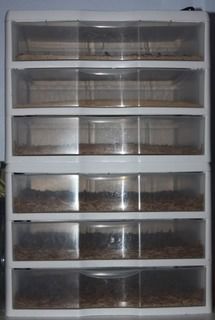
First you need a place to store your mealworms. Plastic bin multi-drawer units work very well for storing mealworms. There are many types of these plastic bins and they are just the thing for breeding mealworms. Now since you have your container we can talk about Mealworms!
5000 adult mealworms per drawer is a good number. However I do 10,000 because am running out of room! When choosing to breed mealworms you need to start with a hefty number of them so you can breed enough to feed your animals. 5,000 should be okay for someone with a rather small collection of animals. Remember breeding them takes a LONG time and months of work! It’s better to have extra mealworms to start with! Once you have your worms you need to store them in bedding. This will act as much of their diet and something for them to crawl around in. you can use wheat bran or rolled oats, along with many other forms of wheat and some cereals. There are also beddings made just for mealworms. I find that wheat bran is the best to use. It’s cheap and easy to find at local feed stores or even your own food store. Wheat bran is also tiny enough for your worms to eat and much easier to clean. Pour enough so there is an inch of wheat bran in your bin. 10,000 mealworms will eat just about a cup a day of wheat bran, so I usually begin with 3 cups and then replace it with new wheat bran every 5 days or so.
Cleaning
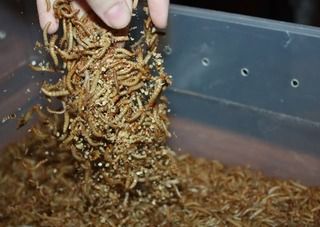
Your mealworm bins will need little cleaning. Bins should never ever be damp, grow mold, or have a moldy smell to them. Every so often you might need to replace bedding. Do this by taking the bin and 2 other empty bins to a table. Using a kitchen sifter,(this can be found in the kitchen supplies section at your local household store) place a small amount of worms and bedding at a time into the sifter and place it over one of the empty bins. Then shake and vibrate the sifter and you will notice the bedding falling in to the bin and keeping the worms in the sifter. Once cleared of all bedding, toss worms that remain in the sifter into the other empty bin. Repeat this step until all worms are in the other bin. Once you are done you can throw out the material you shook into the empty bin, which is actually poop left over by the worms. This is a good time to take the bin of worms and Hand pick out any food left behind, dead mealworms or pupa. Once the worms are cleaned, fill their other bin back up with New wheat bran then pour them back into their re-stocked bin.
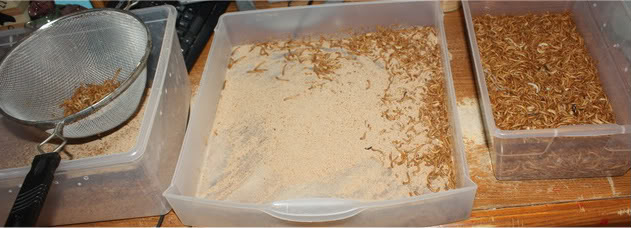
Cleaning the worms Right: The bin I use to clean and handpick stuff out before placing them back into the main bin Middle:the main mealworm bin Left: i use this to sift out the old bedding, or even baby worms.
They love their veggies
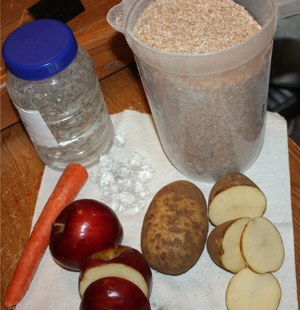
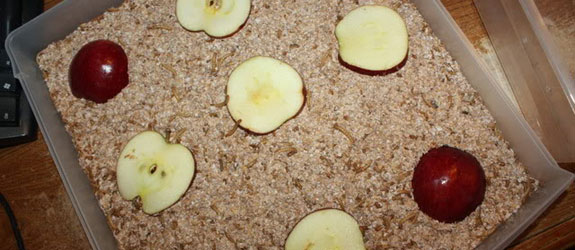
Many people try to give the best to their feeders since it will pay off when they give the worms to their animals, and that couldn’t be more true. You should use veggies that are fresh. The number one thing to use and one of my preferred choices are raw potatoes and apples. Many people use other veggies but I find these work best. Raw cut-up potatoes are cheap and easy to find. Just cut them up and share among bins. Keep in mind that if your bins ever seem moist you may have added too much vegetable material. The food can be replaced as often as you feel it is necessary. The least nutritional “food” you can give your mealworms are water crystals: they are great for giving water but do not compare the high amounts of vitamins and such that veggies already have in them.
You can really use a variety of different things, even some carrots or greens. However keep away from peppers, onions, garlic or anything else with a strong flavor.
My mealworms are changing!
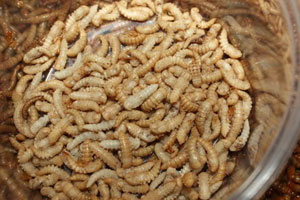
After a few months of doing this you will begin to see pupae. No don’t worry. Your mealworms are fine. This is a good thing really because it’s the first step towards breeding. See, when you start to see this it would be wise to store about a month’s worth of mealworms in the fridge if you will need some of these mealworms to feed your animals. This will keep them from turning into pupae and you will use this stock while you’re waiting for the next generation. Do not stick them in the freezer! Pick out the pupae when you clean the bins as noted before and place them in another clean bin with no worms. They do not need and food or water However, I place mine on wheat bran because in a week or so they will hatch out into beetles.
The evil scary (darkling) beetle
First off, NO they can’t hurt you. They almost never fly, only when they are starving will they try to fly out of the bin. And you love your beetles right? So let’s feed them. Anyway, the pupa will turn in to beetles. In about a week from there on that bin will be their new home. keep placing new pupae in the bin as the mealworms change over.. These beetles are harmless and even easier to care for. Just feed every so often, the same thing you feed the mealworms. Around week 5 or 6 you should see your first very small babies. If not, wait longer. This can take months. Once you do start seeing very small babies it’s time to clean the bedding like you do with the worms but this time don’t throw anything away. Keep the babies in a new bin and replace the beetles’ bedding with new wheat bran. You can clean their bins again in another 5 weeks. (You can choose to clean more often or even less; this is all up to you). Keep cleaning and feeding your mealworms, beetles, and baby mealworms. Remember, the smaller the better. So what if you can’t see the mealworms very well? They should be super small. This lets them drop through the sifter when you sort out the beetles. Any bigger and it will not work. After you’ve separated the beetles out and you only have baby mealworm in the bin, feed them like all the rest, but remember babies can take months to grow up. The more you feed them the better they will grow.. However it will still make you want to pull out your hair!
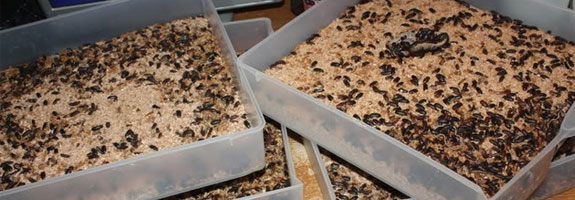
Yes that’s a lot of beetles and trust me I have lots more bins to clean….
To separate or to not separate that is the question
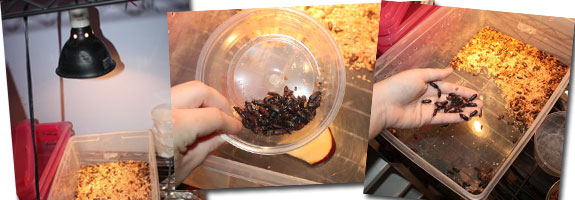
Between mealworms, pupae, and beetles things can become a bit harder when you do not separate them. Every life stage will pick the other and even kill no matter how much food you give them. You will have a high death rate on all sides! They will eat one another. Maybe not all… but enough for you to go “Oh my gosh what happened”. It’s better to hand-pick the stages away from other groups. Bedding will stay much cleaner and there will be less of a death rate for pupae. When bins seem too full of whatever it may be or high death rates of beetles it’s a good thing to cull off some or pick out a few good ones. This way you can throw out the dead ones but still have some alive left over. Take a large bin and have a few handfulls at a time on one side then just pick up the live beetles that crawl to the other side. It goes faster if you have a light over them, but not too close or you can kill them.
Be your inner squirrel
The whole life cycle of a mealworm is very long. Even after you have beetles it can take months more to even be able to use the babies. This is why it’s always handy to start off with a lot of mealworms when breeding and to store some mealworms in the fridge. They will go into a dormant state and not turn into pupae, and when you’re all out of mealworms then you can use these mealworms for feeding. So in the end be a smart squirrel and store your mealworms!
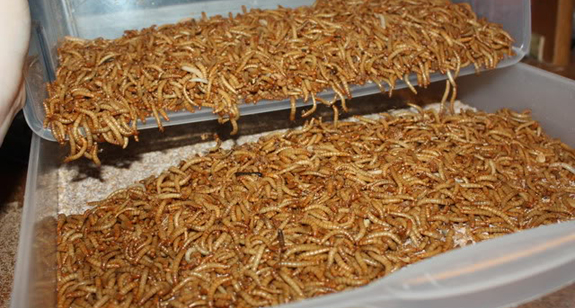
Babies! Are we there yet???
After all this time you should see your baby mealworms growing into nice adults Yes it’s been a long road for us all. We have had some very touching moments and are ups and downs but we made it. So let’s not waste any time and feed them to your reptiles!
I hope this helps everyone that would like to breed mealworms what more could you need to know!!!!! 😀
[ad#sponsor]

where do I store these bins? is the garage or outside too hot or too cold, do I need to store them indoors?
The warmer the worms are kept (probably below the low 90’s is preferred) the faster they will grow and develop and, correspondingly, the colder they’re kept (not below fridge temp) the slower. If kept at fridge temps they’ll go dormant and not develop at all. Unless you live in a warm climate like FL or southern CA, they need to be kept indoors. They don’t smell, so if you use discreet, unmarked bins it shouldn’t bother other family members too much.
so some of my meal worms have just turned into pupae I get that they will turn into beetles and then baby worms but for instance I have 12 pupae so I will eventually have 12 beetles and then from that point do I get a lot more baby worms that’s whats confusing me………. after the beetles what happens are there eggs or what?
Each (female) beetle lays lots and lots of eggs which will fall into the edible substrate they are on (the eggs are too small to see easily). 12 beetles will make a lot of baby mealworms. Just follow the sorting and sifting instructions above as your baby mealworms appear and grow.
good job on the website
what food should you give the meal worms ( Apple Potato Carrot ect
The information about what to feed the mealworms is in the article (grain based gutload; fruits and veggies for moisture).
Alot of my pupae are dark black are they dead? also the ones that have just turned into beetles are laying on their back they appear to be alive but are they dying for some reason? and if so what could the problem be?
Yes, black pupa are dead. If you’re not sure if one is dead, you can always pick it up or poke it gently. They will usually move if touched.
I have approx 40 beetles right now and they have been together for 3 weeks or so…I know the eggs will be too small for me to see. One website stated you should separate the beetles from their current substrate (wheat bran) every couple weeks to prevent beetles from eating their layed eggs…is this true? Also if I dumb the beetle substrate (with the supposed eggs in it) into my mealworm colony will the mealworms eat the eggs? Thanks, Kim
Yes, there will always be loses if you put babies or eggs with other beetles or worms, but you will still have some. its up to you either put them with nothing else or do
I have about 20 beetles or so and only 3 are alive why are all my beetles dying? I followed the guidelines exactly what could be the problem?
I was cleaning out my bin with the mealworms and I was scooping out some of the bedding and I noticed it was crawling it was the growest thing there are thousands of little bugs that look identical to the bedding crawling everywhere I never noticed it before what are these??? It look’s like my entire substrate is alive……….. these bins are in my closet in my house should I be concerned?
do we need to drill holes at the side of the bin for ventilation?
do we need to drill holes for the container if we put mealworms into the refrigerator?
this is great!!!!! five stars:D
When you separate the eggs from the beetles is it ok to move them to a different container or should I just leave them. And if I used wheat bran and moistened it will it mold at all???..
Thanks, Tim.
My pupae appear to die more often than live. When I discover them amongst the bran bedding of the worms they are usually dead.
Why is this? I notice you’ve been asked this question before, but I don’t see an answer posted.
Thanks for your great site. I’m just getting started with mealworms.
I have one leopard gecko and may get some more in the future. I have contemplated breeding mealworms but I am wondering if it is worth it because I only have one gecko, and if it is worth it how many should I start with to make sure the colony doesn’t get too large. Thanks
why does the beatles want to stay on their back
I have recently started breeding mealworms and I have a question for you. I was wondering at what size could I put the baby mealworms with the adult mealworms?
I have just startes to breed with meal worms and super worms , I was wondering dus it help putting stress on the worms to force the Papu stage?
I have a couple questions for you.
I have been breeding for a while and all of my babies look black but they are moving. They are not orange like yours. Am I doing something wrong?
I have a couple bins full of babies but a couple weeks after they are put in their, everything seems dead. I can’t see anything moving. What can I do so I DONT see that?
How often should I feed them? As soon as they eat a carrot should I put another one in their?
Thanks
Any help would be appreciated!
This info is really helpful, I just started breeding because I have a leopard gecko and some of my neighbors said they would pay me for some mealworms if I breed them myself. So anyways before I knew about breeding i got a whole bunch of larvae that turned into uber-creepy reddish white beetles that turned into the black ones. Is this normal?
Yes, that’s exactly what’s supposed to happen.
I have 2 bins of meal worms, I don’t clean or separate them. I’m afraid if i clean them I will loose the eggs and babies. I have mine in oats and corn meal. They seem to bread much faster then this site says though. I do remove the beadles to a different bin though.
I usually feed them apples and green beans.
I don’t need thousands but I do need the very small meal worms for my baby fence lizards.
My question is, Have I been doing this wrong for the past 5 yeas o so????
Love the site but running my web site fantasybeader takes so much time, plus having 3 kids
I am not able to spend time cleaning etc as much as this site says. But i don’t want 5-10k of them either.
Any advice?
This site is very helpfull thnx but i have a question i have a year old beardie ive been breeding my own worms for a few months now keep them in a small glas fish bowl only in crumbed weatbix and weat meel i have a lot of beetles but my worms dont populate they only get smaller by the number am i doing something wrong?
What do I do with all the beatles after they have reproduced? Can my leopard gecko eat them or not?
Your gecko will probably not eat them. Keep the beetles and let them reproduce until they die. They don’t live that long so your problem should solve itself.
thanks.. very helpful.. i also had it in mind, can my sugar glider eat the black beetle?
Those wishing more comprehensive (or at least more opinions! LOL!) info on mealies, head over to the Mealworm Farming thread over on BackYardChickens.com . Five hundred plus pages of relevant posts, some dead serious, others..well, they’ll get you grinning. 🙂
Highly recommended!
Lily: Look up ‘grain mites’ and ‘substrate heating’ in the mealworm thread I mentioned above. Best bet and good luck. Get the humidity down and do your best to containerize the problem–you may have to restart your colony. 🙁 This may also be part of your beetle survival issue.
Ventilation: In general, as long as there is no condensation within the container and the odor is not unpleasant, there is probably enough air. If in doubt, put a few square inches of metal screen mesh into the lid. When refrigerated, many open containers dry out–so watch your critters closely, take them out about once or twice a week and let them warm up and gnaw on a veggie for a few hours before re-storing. It will help, but they don’t live forever.
Mixing ages/developmental stages: In general, people tend to start with larva, which change to pupa, which then get moved to a safe place to hatch into beetles. The larvae can and will eat pupae as well as eggs, so if you don’t move them, you are going to lose some.
Lizard lover–if it gets you the product you need, it’s not ‘wrong’ in this case! More along the lines of ‘if it isn’t broken, don’t fix it.’ Enjoy!
Once matured from pupa to beetle, yes, many wind up on their backs. At first I will go through and flip them upright but most wind up the same way again, so I quit bothering. Between their wingcases and other beetles, they will eventually figure it out. I remove the beetles to their own new container, and stop adding beetles when it looks like there are enough in there, then I start a new beetle bin. These beetles can live for quite a few months, so about once a month (in summer) I simply move the beetles to a new container, where they breed and lay some more. (Hint: The more often you move them, the shorter a time frame it will take to hatch out aaallll the eggs in the container and your worms will be more uniform in size.)
The ‘old’ beetle box is now a ‘new’ larva box, set aside with a carrot or two to grow and completely ignored until the worms are the size I need or until they need fresh veggies. And then round and round it goes. 🙂
Hard lesson learned: ALWAYS, ALWAYS WEAR A MASK WHEN WORKING WITH MEALWORMS! The dust and microscopic fragments of bug can provoke severe respiratory issues. No joke, at ALL. I’m permanently on an inhaler now, so please learn from my experience, and anyone working around the mealies, especially including kids, mask up!
I also moved mine outdoors ASAP, which helped considerably.
Good luck everyone!.
I start running my mealworms breeding. I’ve been feeding them every three days (potatoes, carrots and bread) … Their temperature has been between 70 to 85… depending if its night time or day time.
Since i got them, i’ve been pretty careful about controling everything, and there’s one thing that is happening,,, every day i’ve been having almost 20 to 30 death mealwomrs (they look dark and dry)… I really don’t understant what’s going on…. i’ve been taking out all the death ones daily …. It is ok???
Is the temperature what is killing them??? I got them on my reptile room, cause don’t have any other worm place for them… but i have a termometer to control it.
Please answer to me ASAP 🙂
Thanks so much!!!
I’m not the author, but I’ll venture some guesses. Are you sure you’re feeding them enough? Is there any chance the bread is stuffing them up? I used to make my own gutload by getting seeds and grains from the organic store and putting them in the blender. The mealworms started dying because the stuff I was using was too oily and it stuffed their mouths up (I guess). If you’re giving them chunks of stuff, they may not have enough places to bury themselves. Consider grinding up some unsweetened cereal and oats (or buying pre-made gutload), giving them about 1/2″ of it on the bottom of the enclosure and putting the chunks of veggies on top and see if that helps.
Great information . Many thanks .
Around half of my beetles are hatching with deformed / shrunken wing cases . Could it be because I am keeping the pupae too dry ? They are bedded in porridge oats with nothing to add moisture .
It’s possible–might try splitting up your pupae, one with a carrot in there and one without…see what happens. Or take all the bedding out–they don’t need it…a very small amount is all that’s needed until you get the hatched beetles moved out. Suggest you check the backyard chickens thread for more ideas. 🙂
Now on a large scale, let’s say 50,000 beetles. How often would you want yo sift them to achieve the highest number of eggs? I’m afraid that the beetles eat their eggs if not sifted in time. Also how many containers should you divide the 50,000 beetles in to? It would be great if I could talk to you over the phone because I have a lot of questions regarding to mealworm breeding. E mail Mr and let me know of what u can do please. (937) 789-3310
Ani, I currently have about 40,000 mealies growing and pupating–and I’ve got them in about a dozen large flat Sterilite (28 qt, 24x16x6 inches) containers. I probably should have them in a few more, as the death rate is a bit higher than I like to see.
Once they pupate, I tend to run about…oh, 500 to 1,000 beetles per square foot of space (about 2 inches deep in wheat bran)…and I move them to new quarters as soon as I see any signs of hatching (moving bran, usually).
I suspect that as long as the beetles are well fed and provided with sufficient moisture, they are not likely to consume many eggs–it surely doesn’t seem so in my very limited experience, anyway. 🙂
Some people prefer to run the beetles in coarser substrate, such as rolled oats, on a screened bottom over another tray–they never get moved out or stressed, the eggs and tiny hatchlings just drop through into the new tray. I intend to try this with about half of my current ‘herd’, and see if there is a noticeable difference in hatchling density.
I would really strongly suggest that you go to the mealworm raising thread over on backyard chickens; there are folks there with a LOT more experience in a lot of very different setups, so thus a lot more information to answer your questions. 🙂 🙂
Thanks. have learned a lot. Have been breeding them for some time, but cook, and eat the worms. Have no lizards. Try before you say Yuck.
Okay, I’ll go for ‘Ew!’ instead :)…but as my dog, rabbits and chickens adore them so much, I’ll give you credit for liking them :). Just not quite something I’m ready for as yet! Have heard they are quite nutty and supposedly tasty. *shudder* To each their own! 🙂
Nice detailed article, Thank you. I have been buying mealworms to feed bluebirds and they are expensive. I was search around to find out how to breed mealworms when I found your site. I appreciate all the detailed information.
Michael
Very helpful comments, information and questions, thank you will be back sometime to keep up and hopefully start breeding (have one pupa so far!) \\\\\\would like to see a closeup photo of the black beetles.
Awesome, I already have quite a few pupae myself :3
2 questions: those containers and the shelf you store them in is perfect where could I buy something like that. 2: I have 500 worms and would like to start a business. Should i get thousands and I may be in operation in 4 months?
Mitch, look around and see what you can find at yard sales, etc–sometimes the darndest appropriate cabinets and racks show up! I just got a bread-tray rack that happens to fit my Rubbermaid trays very nicely at one.
As for starting with 500 and being in business in four months…probably not. It takes some time to get the hang of keeping these guys happy and breeding; I know it took me some six months to get them working smoothly. Your experience may be quite different, but I’d hate to tell you to count on it. If you started with more worms, perhaps…but again, try it and make sure it works for you and that you aren’t allergic to them or the substrate you use first….and I HIGHLY recommend a mask at all times when working with them due to the potential for allergic reactions from the dust and castings. Good luck!
Thanks heaps for your response. So far their growing at different stages so theres beetles, pupae and mealworms. And so far very few fatalities and it turns out I have around 800.. I bought a 6 compartment drawers cheap on ebay to start me off. I keep them in my room. 6 months sounds good roughly how many do you have and did you start selling them here and there? I have heard about the mask thing I’ll take your advice! My goal is to sell them all throughout Australia and to freeze dry some to send overseas. I had the business name and logo in my head in one thought, imagination is a crazy thing! One important question: in order to do good I would probably have to rent out a storage garage once there’s too many of them? Does organic really make a difference long term?
how long do the pupea live for please?
Hello,
My case is very minor… But i found a mealworm in my yard. I want to breed it but i only have one… I need a ton more i think. But will it survive. He keeps berying himself in the oatmeal. What hould i do?? Mylocal petshop doesnt sell any.. I want to breed them
xoxo
Chantelle
It’s supposed to bury itself in the oatmeal. If you’re near a Petco or Petsmart they will sell them. You need more to breed them. You should also make sure it really is a mealworm if you found it outside.
Hello,
I have a bin of mealworm beetles, not sure how many, but they aren’t laying eggs, and even if they were the corn flakes I put in there as substrate I can’t sift, so the babies will never come. If someone could shed some light that would be wonderful.
The eggs are so small, you probably wouldn’t know whether or not they’re laying eggs. If you leave everything alone, most likely in about 4-6 weeks you’ll be able to see tiny mealworms if you look closely. The alternative is to take the beetles out, put the cornflakes in the blender and powder them and then you’ll be able to sift them.
Great information and composed as such that is easy to understand and kind of amusing too! We have have a Tiger salamander who has a veracious appetite so breeding our own mealworms might be a good course of action one day.
I was also intrigued by the crazytailreptiles.com website though. When I was deployed to Iraq one of the highlights were the Sand geckos (I’m pretty that’s what kind they were.) I caught one and kept it in a small tote until I left on R&R when I let him go. He was awesome, but anyways, the website didn’t work and doing a search didn’t offer any more success. Where is it?!? Thanks
Reptile breeders come and go and so do their websites. I guess this one went.
The best post about mealworms I read upto now. I’m growing mealworms for about six months now. Upto now I’ve only been busy getting my number of beatles up but this week it’s harvest time. Do you have some tips about harvesting them? I now let them climb up a few pieces of paper and at the end of the paper, they fall into a small container. This way I get really clean mealworms but it’s a slow process.
I seperate the different life stages too and I found out that this is the way to go. You say you only move the beatles every 5 weeks or so. I tried three weeks, two weeks en one week and I found that you get much, much more baby worms when you move the beatles every week. Another great advantage is that all the mealworms you harvest are about the same size. It takes up a lot of space because you’ll need a lot of containers but I seriously reccommend this way.
I tried putting a screen underneth the beatles so the eggs can fall trough. This works fine but I find it easier to sift al the beatles out every week with a big seive. I take a new container and sift all the bedding with the eggs through and then fill the old container with wheat bran and some flower. After that I put the beatles back in. This takes me about a minute per container. I store new eggs in a warm place (32C or 90F) and after a week or two you can see tiny movement in the container. That’s the time I start feeding them and move them to a cooler place of 28 degrees Centigrade or 80 Fahrenheid.
May I know how long the adults live? There are varying answers online. Some webbies said a few months, some said a few years?
Also, do the adults start mating as soon as they are adults?
Thanks
In my experience, adult beetles live for up to several months, possibly less. I have no idea when they begin to mate since it’s not something I’ve ever observed. I would imagine that they are essentially adults as soon as they emerge as beetles and should be capable of mating.
My experience is about the same as Aliza’s. I’d say they live about two months, maybe a bit longer. A cycle from eggs to a full grown mealworm takes about nine weeks. I didn’t add new beatles in the first cycle and more than half of them had died by the time the first new beatles were ready. Now I leave a few hundred mealworms every week to pupate, so I have fresh beatles all the time.
Thank you soooo much for not just your very prompt reply but also such very clear answers Aliza n Arjan! ♡
I am writing a young adult novel that takes place in 1950. There is a small scene where the two characters take care of meal worms. I have used your info here to construct that scene, but since I know nothing about mealworms, I’m not sure I’ve written it correctly. Would you be willing to read it and see if I’ve represented it correctly? If so, could you reply to me via email? Thank you so much!
I just wanted to say that I have been breeding mealworms for about 5 months and I separate all the life stages. I was wondering and I see other people are wondering also if the beetles start breeding right away or not and I can say I know for sure that they DO since I check my pupae container daily and sometimes I skip one day but no more and a couple weeks ago I noticed I had babies in with them so they had to breed right away for this to be possible. So I hope this helps and Thank you too!
Dear all once again,
How long do you think the adults will live without moisture eg water or fresh vegetables especially in hot climate? I be going away for a month but not sure if I should be keeping any adults during that time when temperature can soar to 40 to 45 degree Celsius for almost the whole month I be away? I mean I can feed them fresh veg on the day before departure but they be without water for one whole month in that temperature. Will they even survive?
Thanks again
If you have a basement you could put them in there. Otherwise, it seems you have nothing to lose, so give them some veggies, go away, and see what you have when you come back.
I just want to tell everyone that is trying to give it mealworms water or moisture without all the issues that come with the gel and stuff, I use newspaper and get a NEW spray bottle that has a fine mist I find the smaller ones have a finer mist than the large ones, and then once or twice a day depending on how hot and dry the conditions are spray them on the paper not the bedding and they go crazy for it and sometimes they will even eat all the wet paper if they r very thirsty. I also found that this helps with molting and prevents them getting stuck in there skin. They also grow ALOT faster with moisture. Give it a try and let me know how it works for u!!!
I just want to tell everyone that is trying to give it mealworms water or moisture without all the issues that come with the gel and stuff, I use newspaper and get a NEW spray bottle that has a fine mist I find the smaller ones have a finer mist than the large ones, and then once or twice a day depending on how hot and dry the conditions are spray them on the paper not the bedding and they go crazy for it and sometimes they will even eat all the wet paper if they r very thirsty. I also found that this helps with molting and prevents them getting stuck in there skin. They also grow ALOT faster with moisture. Give it a try and let me know how it works for u!!!
If u or anyone u know needs mealworms in the everett wa area let me know. Text 425-418-4700
Why do mealworms like bran? apart from the fact that they can burrow? what nutritional values does it have?
If you look up the nutritional value of bran, you’ll see that its biggest value is the fiber and carbohydrate. It does have some protein, magnesium, protein and iron. It’s not that the mealworms love bran so much, it’s that the places that produce and provide the mealworms find bran to be cheap, easy to acquire and easy to put through a strainer when separating the bran from the mealworms. I keep my mealworms in a multi-grain gut load which I think is much better for them and much more nutrition for the geckos.
Wheat bran is cheaper and easier and it doesn’t mold as easily as the oatmeal or corn flakes… I have been breeding them for almost a year and I have been thru a lot so if u need any more help u can message me on Facebook my name is Amanda parham! Goog luck!
Mmm, I don’t quite agree with Aliza. Wheat bran is cheap, easy to acquire and easy to put through a strainer when separating the bran from the mealworms. So far so good. After experimenting for over a year with lots of different foods I found out that wheat bran is by far the best en easiest food you can give them. But that there’s more to it. I found out that micro organisms are the most important factor in the diet of mealworms and not so much the brans you feed them.
The worms aren’t all that picky about their food but what they eat makes a big difference in how fast they will grow. I’ve tried lots of things like carrots, horse food, different brans, sugar beet pulp, rabbit food.. Even soaked paper and saw dust. And guess what: I had the best results with soaked wheat bran. And as I said earlier. It’s not so much the type of bran you feed them but wheat bran can hold a ton of water and it won’t mold. So that’s one of the reasons I think it’s perfect.
I read somewhere that mealworms live in rotting wood in their natural environment. That got me thinking. The nutricial value of wood is very little but there is a huge amount of micro organisms in it. So I started experimenting with sour dough. There are lots of micro organisms in sour dough and I tried it for a while. The worms just loved it. They grew like crazy and didn’t pupate as quickly, so I got bigger worms.
The thing about sour dough is, that it’s a bit sticky and it will dry out quite hard. Sometimes when I feeded the mealworms too much, they would get stuck in the dried lumps of food. So I kept on experimenting. I started mixing chicks meal with soaked wheat bran and a bit of dextrose to get things going faster. This was a big step forward. The corn meal doesn’t stick as much as flour so I haven’t had any mealworms “frozen” in their food anymore but the sour dough just wasn’t as good as it was before.
I’m not done experimenting yet but the last couple of weeks I’ve been making some kind of sour dough, sour mash like thing. Every day I feed half of the food to my mealworms and the rest of the food, I mix with fresh water, dextrose and wheat bran and let it ferment over night. The next morning it smells like cheap wine. The mealworms love it and I’m sure that’s got something to do with the alcohol produced in the mixture. I’m not sure if this is the way to go but the base of my food is still wheat bran after all this time.
Not being a nutritionist or having experimented to the extent you have, I bow to your greater experience!
Hi Aliza,
No need to bow, I’d rather have people disagreeing with me because I usually learn a lot from a good discussion. If we all agree with each other, there’s noting to talk about, really.
I’m always experimenting with things because I know that when I think I found the best way to do something, there’s always a better way. I hope there’s somebody out there, who will pick up from where I stoppend and help us all by sharing his or her experience.
okay heres my question i have a couple hundred left but i feed my geckos (i have ten leos) every 3 days or so heres my question can i use the left over baby oatmeal (its got lots of nutrients and my daughter has outgrown it shes on big people foods now) and could i expect a good outcome atleast a doubling up if i were to say put 30 of my current mealworms and all pupae i find(i keep mine in the fridge currently) i mean im feeding around 70 every 3 days so they go quick and i really need to get the numbers up i assume keeping them warm(I LIVE IN MOBILE ALABAMA RAINIEST CITY IN THE U.S.but its warm) increases there transitioning i mean i rarely add any extra food other than the oatmeal i currently use(i add a potato for 3 days once a month) thats normal dollar for a lil barrel stuff i add a bit of calcium powder each time i return my dusted worms to the bin but if i let 30 or so turn and feed them only the best nutrient rich baby oatmeal and keep them loaded down with fresh taters could i expect atleast 100 out of them i mean if i can make a years worth of work end up within a steady flow that doesnt dwindle below 1000 usable worms its worth it
The oatmeal should be OK. You can add leftover veggie peels like cucumber peels, broccoli stalks, etc. Follow the directions in the article and you will do well with 30 beetles to start out. The newly hatched worms will be very small at first and you may not see them but trust they’re there and they’ll get bigger. You may be able to produce enough to feed all your geckos. I am usually feeding upwards of 30 hatchlings during the summer and I can’t keep up with them, so I buy mealworms to supplement.
Ok i got meal worms,now i have pupa, one beatle. My question is do i put pupa and bealtes together and do i feed pupa? Do i put oatmeal in beatles and do i feed beatles the same as mealworms
Pupae don’t need to eat. If you put them in with the beetles (remember the “Beatles” is a rock group from the 60’s) the beetles will eat them. I keep pupae, beetles and mealworms separate as much as possible.
Hi there knowledgeable ones,
So we have geckos and they came with some meal worms. A cousins suggest I breed the worms to save costs on buying… great! So I’ve read up and have got pupae, I’ve separated them into a separate container from the meal worms and thought I was going great… reading that the darker each stage is the closer it is to the next… until I read that if pupae go black – they’re dead (enter sad face) – is this true? What am I doing wrong – help!!!
Are they all black? It’s not unusual for some portion to turn black, it happens to me all the time. They don’t exactly get darker and darker, they just get a bit darker and less “squishy”. Keep trying and if every single one turns black then maybe there’s a problem with the temperature or the humidity.
Thanks Aliza,
No not all are black – but I have lost track at which ones are older / newer. Hopefully I gain some viable beetles soon!
I’ll keep you posted. I’m only a week into this mealworm breeding thing 😉
It takes time. It should work out but you’re not going to have anything to see for a few months.
When I purchased my meal worms they were moving more than they are now. They seem sluggish even though I have them in a warm place and give them carrots for moisture. What is the temperature and humidity level suppose to be?
Just before mealworms are ready to morph into their pupae form (often called “aliens” because they look kind of like ET) they stop moving. I found out recently that they are in the pre-pupal stage where they’ve taken in enough nutrients to morph and are just waiting for the right time. If you keep them in a warm place, they will grow faster and get to this stage faster. They can live at refrigerator temps, though they go dormant at those temps. The warmer they are, the faster they develop. Too much humidity isn’t good because the gut load can start to clump and obstruct their airways and also higher humidity seems to result in a grain mite infestation.
Thank you, that’s good information about the humidity. I started them in our bathroom but think the humidity from the shower may have been too much, so I removed them to our dark closet but they still seem like they are dying. If I purchased them from a pet store and they were kept in the fridge before I bought them are they likely to die when I put them in a farm?
I bought two different sizes so I would have different timing on the stage but both stages are acting sluggish. I don’t see any parasites on them so I don’t think that is the problem. Any ideas as to why both stages (small and large) are acting like they are dying?
Had pupa today. That must have been part of the problem. I still don’t know about the younger stage but I’m sure time will tell. Thanks for your help!
What kind of bedding are you keeping them in?
Quick Oats. It’s Western Family. Would that matter? I put carrots in with them but they perked up when I took them out of the humid room and took the carrots away. I’ll give them some more in a few days, but for now I think they needed to dry out a bit. Do you think this is right?
If it’s working, go for it!
Hi. I’m new at this, and just a dozen mealworms have recently hatched into beetles…one was newly hatched and light brown when I found it, and then turned dark. I’ve separated them and put them into their own place as soon as discovered, with food, watersponge, etc.. But I think they’re dead. They don’t move at all, except at first to go hide under a banana peel. Since then, nothing. What could be wrong? I bought the mealworms from a petshop a week ago, the mealworms seem fine. Are the beetles simply hiding quietly, or is this the end of them? The newly hatched one moved a lot as I moved him in with the adults, but now…black and immobile.
I wish I could help. They do die after about a month or so, and if they all hatch at about the same time, they die at the same time, so it looks like a plague, but a week isn’t that long. What are you feeding them?
Susie, is it warm or cold where you have them? Cool areas will see beetles and larva that don’t move around too much and develop pretty slowly; hotter areas can be good, but too hot will fry ’em. 🙁 A lot of times I find beetles which are completely intact (dead ones tend to be lighter weight and have broken antennae), completely immobile, but with a little shake and a minute or so seem to ‘wake up’ and wave their antennae, then move around.
Hiding is rather their default mode–try a sheet of newspaper over the surface of the bin and you may see more movement.
Hi all, I have one doubt. What is the next stage of beetle. Is this flyable. What is the life span of this beetle. Please share…
I have rarely seen these beetles flying. They seem to live about a month or so after morphing into beetles.
Corn flakes? How could anyone give something like that to something that requires nutrition? Look at the ingredients. How people even buy this to eat is beyond comprehension.
I’m not the author of this article (and maybe the author will respond), but I will say that sometimes appropriate nutrition for bugs/worms does not map directly on to our nutrition. Of course, ideally, a good nutrition source for mealworms and beetles would be a variety of grains, fruits and vegetables. Corn flakes, however, does provide sugar (less sugar than some of the highly sweetened cereals), grain and a variety of vitamins and minerals. I was surprised to discover in my related research that some feeders derive protein from celery and other cellulose products!
started wirh 3 dozen .had 100s now all i have js bugs in two totes 2 10 gallon tankx a 30 gallon barell no meal wormx arecthe bugs eat7ng the eggs do i need to ge rid of mort of the bugs thanks butch
Do you mean you had hundreds of mealworms and now you have none? Or you had hundreds of bugs and you still don’t have mealworms? If the mealworms disappeared, I don’t know what to tell you; my bugs co-exist with my mealworms with no problems. If you mean that you don’t see any mealworms, there’s a good chance that there are a lot of tiny mealworms in there. Look at the gut load really carefully and see if you can see it heaving around.
Why avoid garlic & onions?
Hi,
Thanks for all the useful information:)
I started my mealworm breeding today, and I hope I’ll have good results!!!
I am in Canada (Montrealj), and I must say that I had difficulties finding wheat bran in bulk here…
If anybody could recommend a place to buy affordable wheat bran somewhere in the area???
If not, I ofter go to the states (New-York, Vermont), if someone could point me in the right direction, I would appreciate:)
Thanks!
Hi, I’m planning on breeding mealworms for my birds, they love it but one thing that makes me hesitate, the smell! I bought some at the store and that stinks, since I will breed them in my living room, I would like to know what breeders are doing about the smell?
Thank you for this great tutorial.
Have you been able to figure out what’s smelling? Is the grain getting moldy? I bred mealworms for years and had no problem. See if you can get more of a sense of what’s smelling and you may be able to solve the problem.
Aliza
So I am having a ‘bumper crop’ of meal worms. So many that my bluebirds think it’s awesome to have them throughout the day vs. evening meals only. I want to put some mealworms in the frig. I tried this a few years before and the meal worms just turned dark brown and died. (I did have breathing holes in a plastic container. One container I put bran in the bottom. One container I put brown paper (because I saw that is how the bird store sold theirs from a refrigerator). No luck with either. I limited the meal worms to about 300-400 per container.
Thanks for your guidance
Thanks for the wonderful website and info on raising mealworms. I have my first generation of mealworm babies. They are in their own box. They are very, very tiny and hard to see with the naked eye but they are visible. They are in cornmeal and bran. How do I ensure that they have adequate moisture? What do you put in your boxes that have eggs that are just hatching?
I’m not the author (who may or may not reply) but when I was breeding mealworms, I added vegetable parings (eggplant skins, broccoli ends, cauliflower leaves etc.). You just have to be careful not to put stuff in that will mold, like pieces of melon.
PLEASE please PLEASE folks–MASK UP when dealing with mealworms. Their ‘dander’ and frass can really screw up your lungs forever–ask me how I know 🙁 . They are a known trigger for respiratory issues, so PLEASE!! Don’t keep them in your house, and MASK UP!! An N95 mask or better is definitely a good idea, nothing less, no cheapos from the dollar store.
Hi, can anyone suggest how I may keep mealworms and mealworm beetles alive through Perth, Western Australia winter? I tend to breed them from late summer/early autumn through to winter as summer (40 degree Celsius days) tends to kill them. However, they also tend to die in late autumn when night temperature drops to about 10 degree Celsius.
I prefer having them live through their full lifespan than having them die at the prime of their life in Autumn (by starting out with mealworms in late summer).
I can’t breed them indoors due to allergies to their frass. Hence typically had to keep them at the sheltered patio which is too cold for them once it gets to late autumn.
Thanks.
Have you tried adding a heat pad?