

 ProGeckos
In today’s economy we are all searching for ways to save money. Breeding your own feeders is one of the best ways. For the past several years I’ve been breeding superworms for all my geckos. It’s a fairly simple process and with some time and patience you can raise your own feeders.
Stages of life
Superworms have 4 stages of life: egg, larva, pupae and beetle. The beetles are the only ones that reproduce. Breeding superworms is very similar to that of mealworms but with one difference. They will need to be separated individually so they can pupate. If you keep them together you will never obtain beetles to start another generation. Superworms grow slowly and it can take 5 months or longer (depending on the temperature you keep them at) to become large enough to start the “morphing” process. Pupation is an essential process and the only way to obtain beetles for breeding. I keep all stages of superworms at a temperature between 70 and 80 degrees Fahrenheit.
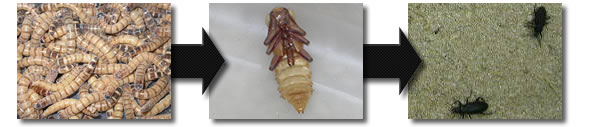
Metamorphosing superworms
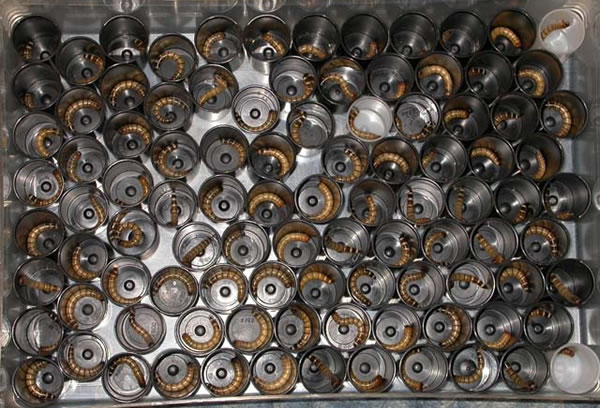
Choose the largest superworms possible and place a single worm into an empty 35mm film container. I’ve found film containers work best as they require very little space. Due to the digital era they are becoming harder to find but I’ve always had good luck at the Wal-Mart and Costco photo centers. If you can’t get them you can always use plastic bead boxes for crafts, baby food jars etc.
[ad#sponsor]
Leave the superworm in the empty film container with no food or water. Adding food or water to the film container prolongs the time it takes them to pupate and makes a bigger workload for you. As long as they are very large larva you should have very few to no deaths.
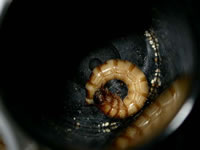
After several days the worms will become dormant and begin curling to a letter “c” or “e”. This is the start of the morphing process. Any superworms that are straight looking, hard or black are probably dead. The process from larva to pupae takes 1 to 2 weeks.
Superworm pupa
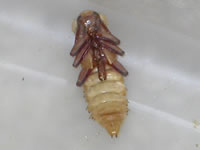
Once the worm has pupated it will look like a white or cream colored “alien” as most people call them. This is their third stage of life. You can either leave them in the film container or place them all in a separate container. I remove mine and place them in a separate container as it saves space and then you can start another larva in the film container. When their legs turn darker in color you’ll know a beetle is about to emerge. The process from pupae to beetle takes about 2 weeks.
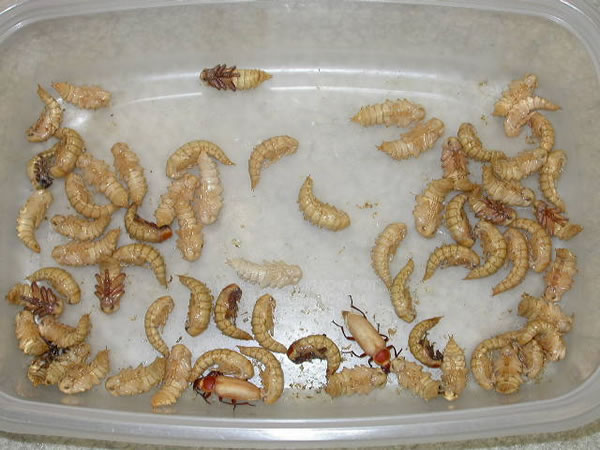
Superworm beatles
Before removing these beetles you need to put together a new breeding container. I use trays that are (14” x 10” x 3.5”). You can use really any type of container such as Rubbermaid and Sterilite but I’ve found cat litter pans to be most effective. Add about 1 inch of wheat bran or a pre-made gutload to the bottom of the container. The beetles will eat and lay their eggs in this. Try not to use coarse bedding such as oats unless you blend it to a powder. This will make it easier to separate the superworms later for cleaning or feeding your animals. In one corner I add a small piece of egg crate so the beetles have a place to gather. Otherwise they may wander through the container digging up eggs and eating them. You may now move the beetles to this container. Offer potatoes, carrots, fruits or water crystals as a water source. Moisture is extremely important for the beetles just as it is for the superworms themselves. A lack of moisture will result in beetles preying on eggs, newly hatched babies and other beetles.
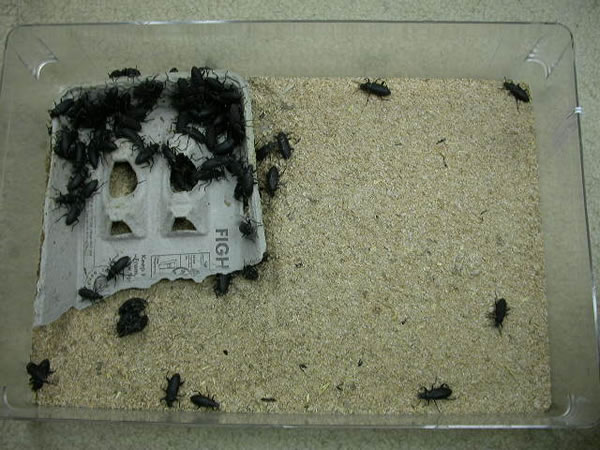
About every 2 to 4 weeks (depending on how many beetles you have in one container) remove the beetles from the bedding and place them in a fresh container as described above. This allows the eggs to hatch and furthers your chances of obtaining more babies. If the beetles are left they will prey on the eggs and possibly the newly hatched larva. The newly hatched worms could do the same with each other. Adult beetles can live up to 5 months with a female laying nearly 500 eggs in her lifetime.
Raising baby superworms
The key to hatching is heat and most importantly moisture. For the babies I keep the temperature around 78 degrees Fahrenheit. Add small chunks or slices of potato, carrot, apples etc on the bedding surface. This will provide moisture for the newly hatched babies. Once the babies grow larger you can use water crystals if you wish.
That’s it, you’ve bred superworms!
Congratulations! You have now successfully completed your first breeding cycle. It will take time before your colony is established but once it is you’ll have a continuous supply of superworms!

Fantastic article, thanks Cody!
Thxs alot
hey im thinking about breeding superworms any 1 got any tips / pointers
The article gives you great advice on getting started. If you have a specific question we may be able to help :).
for keeping the superworms can you use cricket water cubes instead of chunks or slices of potato, carrot, apples
is the superworm beetle can fly? how high?
No, the beetles can’t fly.
do you put a lid on the top of the film container?
I do not put the film container lid on the canister. Sometimes the larger superworms (especially when first added to the container) might be able to climb out. What I do in this situation is place a fine mesh screen over the top of them for a day until they settle down.
I have 45 worms all divided up into a craft container, basically same amount of room as a film container would have. I drilled 2 hols above each compartment for air and stuck the containers on a shelf in a closet on Nov 1st .. I still have no aliens .. most are curled into a “c” and have been for weeks now … other people reported alines after 7-10 day, mine has been double that 🙁
As long as they are starting to curl I wouldn’t worry about it too much. Here are a few pointers. Make sure they are the largest superworms possible. Some smaller ones may not be as willing to pupate because they are not ready. I would also suggest bumping their temps up near 80.
Can you tell me whatkind of bedding I can use besides wheat bran. If you can please tell me several. thanks
I find wheat bran or a commercial gutload to be the best bedding but you can also use chicken mash or oats. Keep it as fine as possible as course substrates tend to mold easily or collect grain mites.
if i was to keep the superworm in a deep 3 drawer plastic orginizer can they get out.
The three drawer system should work fine. As long as it’s at least 3.5” high they should not be able to get out.
what about after they turn into beetles can they fly out and can they bite if so is it hard enough to say owe or draw blood i got a rear blood type and they might like it
No, the beetles will not be able to get out and they do not fly. Anything with a mouth can bite. I have never been bitten by a superworm beetle before so I don’t know how bad it would hurt.
i’ve done research on meal worm and found out that they do eat dead leaves,plants,animals,in the wild i trying old leaves for the meal worms to eat because they do eat dead things they seem to love it now i cant find out where to go to find out if super worms can eat the same thing as far as dead leaves so i can save myself alot of money theres dead leaves everywhere free do you know if i can use dead leaves for superworm to.
I have never heard of leaves being used for either mealworms or superworms. I would be careful doing so because I’m not sure what the leaves would do to the mealworms/superworms or your animals.
ive done alot of research on them in their natural enviroment they eat everything including dead animals and insects search through google under what do cricket,mealworm,superworm eat they are also known as natural composters because of them breaking up decaying matter and feces and be used as compost its like when i studted on compost anything that came from the earth can be put back into the earth anything that crickets,mealworms,superworms,earthworm eat can be used as compost what i do is put the old fruits and vegies leaves and plants into my compost bin for the redworms to finish off
how much movement should recently hatched beetles do,or do they lay around for awhile?
Once the beetles emerge they can be a little sluggish. After a few hours their exoskeletons harden to a darker brown and they become more active.
Thanks Cody..I love this website!
Can you tell the gender of the beetles(I assume they need males)?
Yes, there are males and females but there is no way to tell them apart. As long as you have a good number of them together you’ll be fine.
im currantly breeding superworm ive bred them before this is the first time ive encounterd grain mites how do i get rid of them any help would be appreciated thanks
My superworms turned into beetles a little over a week ago and have turned totally black but they dont move? They are alive and I keep plenty of food and moisture in their housing and are kept at temps ranging from 60’s to 70″ is there something I am doing wrong or is this common or should they be really active? Thanks so much
I have never encountered grain mites so I don’t have first hand experience. Unfortunately chemicals can’t be used because it would not only kill the mites but also the superworms. Remove all the superworms and give them new bedding. Only give them about .5 to 1” of bedding and change it weekly or as needed. I would also try to keep the bedding as dry as possible.
Try bumping up your temperatures to around 75 and try to maintain that. When temps are too cool they can become somewhat dormant.
I have dealt with grain mites in my mealworms and crickets. As Cody said, the best thing to do is to change the bedding. You can also try wiping off the superworms. Before replacing the bedding, wash the enclosure and cover in hot water to kill any mites on the surface. Check the cover and sides of the enclosure in a few days with a magnifying glass to see if there are any more and keep checking until it’s consistently clear. If you see mites, you’ll have to change the bedding and wash down the enclosure again. Unfortunately, it’s impossible to save a mealworm colony unless you can pick out each mealworm. At least the superworms are big enough to “rescue”.
While breeding your superworms,do u put food in their with each one?
What do the beetles turn into if anything?If they dont turn into anything what do u do with them?
The bedding you keep them on is their food source. The beetles are the adult form of the superworm. Their only purpose is to reproduce and create more superworm larva.
I have been working on breeding superworms for 4 months now.
I keep about a hundred beetles in a dishpan size container with a bran / egg mash bedding. Keep them supplied water crystals and fresh vegies, and move them to a new container every 2 to 3 weeks. sifted out the worm containers from November today… to find a f grand total of about 50 worms. What is going on… there should be thousands of worms.
Any suggestions?
It could be a couple things. If this was the first container you started there are usually small numbers. Once you remove the beetles how are you offering the babies moisture? It sounds to me like they are not getting enough moisture therefore the superworms that hatch are preying on smaller larva and eggs. Cannibalism is very common with all stages of superworms when inadequate moisture is not given.
I keep fresh carrot or potato in there at all times and I have also added water crystals.
It sounds like you are doing things right. What I do is leave the containers alone for a few days after the beetles have been removed. Then I use medium water crystals and thinly spread them on top of the bedding every few days. Keep in mind too much moisture will cause the bedding to mold. I would keep doing what you are doing and when the second container is ready sift it out and see how many you have.
how do I mix a homemade gutload getting ingrediants from walmart? And when would it be suitable to feed breeding superworms?
if a bearded dragon eats a pupa or a beetle can it harm the bearded dragon or even kill it? and how would there eggs get from a cup full of dirt and a bunch of worms, to a bearded dragon tank were there in there for like 2 seconds and then there eaten?
Melissa,
Sorry, I completely missed your question. Commercial gutloads are really good but from Walmart you could use oats or a whole grain cereal. As soon as the beetles emerge and are placed in the breeding container they will begin to feed immediately on the bedding. They will also lay their eggs in this.
Randy,
It would be fine for them to eat a pupae as they are still soft bodied but I would not recommend feeding them the beetles. They have a very hard shell and it will be harder for your beardie to digest them. As soon as the worms are large enough they can be sifted (to separate from the bedding) and fed to your dragon.
hello,after my clan of dragons has ate me out of house and home I decided to try breading my own super worms. i started with 25 worms, i have now 5 beatles 13 larve and and 7 worms in there “C” shape. yeah!!
Question:
my beatles are still very light colored and seem “sluggish” and thay seem to be hiding under the egg crate in the dark is this normal for new beatles? do thay like light or dark? and is there a ideal temp range and humidity for best results??
When the beetles first emerge they are a little sluggish. Once there exoskeleton hardens their activity will pick up. Having more beetles will also increase their activity as will a darker area. A good temp range for the superworms and beetles is 70 to 80 degrees. An average room humidity is fine with about 50% being ideal.
this mite sound stupid but can you keep the lids on the film containers??
You can put the lids on but you’ll have to put a hole in it otherwise they will suffocate. I don’t put lids on mine for this reason and the fact that it’s very time consuming. When you first place the worm in a container they can sometimes climb out. I just place a screen over the top or place the film containers in a tub that’s 4” or higher.
how about the female beetles.. were are they going to put there eggs? do we need to put small holes for the female beetles to lay eggs?
Once they emerge as beetles you put them all in container with bran or some type of gutload. This is where the female lay their eggs.
Thank you Cody..I moved my adult beetles to a new cage about a week ago(they were in the previous cage for about two months) and I noticed the bedding moving and I found baby superworms!!! THANK YOU THANK YOU!!! This site is awesome.
whats the best type of bran/ gut load that i can get at like bulkbarn
rite now im using wheat bran
Jamie,
I’m glad to hear that you are having good success!
Andrew,
I’m not sure what a Bulk Barn stocks but things like bran, oats and wholegrain cereal are all suitable. Commercial gutloads are also very good.
I am wondering approximately how long it will take for the eggs to hatch into the worm stage and also how many from each batch you should try to add to the adult beetles in order to maintain population while providing food for my pet.
It will take about 2 weeks for the eggs to hatch at temps in the mid to upper 70s. You most likely won’t see them though as they are very tiny. The adult beetles live about 5-6 months after they emerge. I would hold back at least 25% of each batch to turn into beetles. If you end up with too many you can always cut back or just sell the superworms.
Sometimes it is a bit hard to choose from the different brands and styles of baby beddings out there on the market. I usually pick the one that fits my budget~.;
k so i put my 50 or so betels from 1 bin to the other then i saw that the bedding in the first bin is all clumpy and stuff but it doesn’t feel wet/damp
is this normal??
That sometimes happens when there is an excessive amount of moisture. If you are adding a lot of potato, carrot etc then it sometimes gets the bedding wet and when it dries it clumps.
i always prefer those wool and cotton baby beddings because they keep the baby warm**.
i want to know how long it takes the bettle to have eggs and if they only need to be pregnant once like roaches to keep on producing eggs
The beetles begin mating right away and females will start laying within a week and there after until their death. As far as a female going on one mating I don’t know. Males and females are always together so I’m sure they are repeatedly mating.
How do you know which is Male and a Females.
To my knowledge there is no way to tell the difference between males and females.
the female can’t close their wings compeletly, the mailes can.
i always make sure that my baby bedding does not have any dust mites on it**-
our baby bedding is made up of stainless steel and cotton fibers, they are great'”‘
hi there, how do i keep the temperature at a constant heat, does the worms like darkness or must it be light all the time, at the moment i hava a few worms in a old fish tank with a towel over it to try and keep it dark but to raise the temperature i will need to install a light or something to get the heat up but that means to leave the worms with a light on the whole time, the female beetle, does it lay 500 eggs in a life cycle or 500 eggs per session? greetings
The beetles and the superworms generally prefer darker areas. If you want to give them more heat you can use a heat mat, heat tape or even a ceramic heat emitter. All they really need is the low to mid 70s which is usually room temperature. The 500 eggs laid would be in the female’s lifetime but results vary depending on the female.
can they fly
No, they can’t fly.
so when do the beetles mate?
Once you put them together it’s generally right away.
oh ok cuz my darklings beetles dont mate right away they wait for a week or so to mate
hi do i need to put a lid on the container so the dont escape
what if you have only one worm will it still lay eggs??? After it turns into beetle
No, you have to have a male and female to get eggs. You can’t visually tell what is male or female so as long as you have multiple beetles you’ll be fine.
once i decide that it is time to dispose of a group of beetles toward the end of thier life cycle is it o.k. to feed them two my bearded dragons (two of them are almost 5 years of age and very large, the other two are a little over two and between medium and large size)
My baby (3 month old) dragon ate a mealworm beetle by accident, he was on my shoulder and i was showing someone my colony for mealworms and superworms and he jumped off into it and ran for the closest beetle…
I heard that if they eat too many or something they can get sick, but i cared for him and he was all good 🙂
Most reptiles won’t eat the beetles. They have a very hard shell that could be hard for them to digest. I wouldn’t get rid of them because they are old. The beetles will produce babies right up until their deaths.
is it ok if they wake or move when i check on them???? do i disturb their development??? :C
Checking in on them should not cause any problems.
When the beetles die, do you know if it is safe to compost them, like for a vegetable garden? Or do they end up putting nasty things in the soil? Is it best to just throw them in the trash?
I’m sure they can be composted along with the dead superworms, skins etc. but I usually throw all that in the trash. Their poop on the other hand makes a great fertilizer!
i am using chicken laying mass as a bedding for my betles, is it fine? can you give me any suggestions.
That works as a food. Basically anything grain based such as but not limited to bran, oats, commercial gutloads etc.
will the beetles lay egg once and then they will die ?or they can lay again ?how many times ?
The females will continually lay eggs until their death.
is it better for them to have 32-35` celcius ?because thats our normal temp here in our place.
You technically can keep them at that temperature. I find though, that anything above 85°F (about 29°C) there tends to be more cannibalism. It will become very important to keep them hydrated and make sure there is moisture available at all times.
what vegetable can provide them enough moisture ?is chayote enough ?
I’m not sure what chayote is but really any vegetable or fruit can be used. Most people use potato, carrot, apple, pears etc.
ok,thanks man.
This is a very useful information.
My question is: Does the beetles bite? Do they have dangerous mandibles?
And randy, here in the Phil. we call that vegie a “sayote” . It does not have any dangerous chemicals and is nutritious i believe so I think we can use it. You just gave me a mighty good idea.
The beetles can bite very similar to the superworm larva. If they catch you just right it will hurt, although I’ve never been bit by one.
Ah, I see. Thanks Cody. Does the beetle or the worm has a venom of some sort? Also, can you please give me an estimated length of the worm before i can isolate them for morphing?
You’re welcome! No, neither the beetle or larva have venom. The largest worms prime for breeding are right around 2″ in length. Smaller ones can also morph into beetles but it results in small beetles.
Cody, if they morph into small beetles will they still breed? Is there any disadvantage or negative effect?
I have not noticed any difference in breeding with the smaller and larger beetles. I have noticed though that the smaller beetles tend to have a shorter lifespan. If possible it’s always best to use the largest worms.
tokay are you a filipino ? because i am too..
i havn’t fed my baby worms any veggies for moisture in maanny weeks ..will they die ?
They potentially can. Most of them result to cannibalism for moisture if there is not enough present. If you start seeing half eaten superworms try offering them more moisture.
lol, my gecko loves mealworms and superworms pupaes. its the only thing tht is alive that doesnt move that my leopard gecko eat. otherwise, its all crickets
how often to put and take out carrots patatoes etc
how do i know if the beetles already laid eggs?
I generally don’t take out the potatoes or carrots as they are always eaten. I put new in every few days to every week.
There is no way to tell if a female has laid eggs or not. They will continuously lay eggs their entire lives.
HI! just would like to ask, how will it take for the eggs to hatch?
HI! just would like to ask, how long will it take for the eggs to hatch?
If your temperatures are in the upper 70s they generally start hatching in about two weeks. After hatching they are very tiny so it will be difficult to see them.
my mom hates me for having these in my room, i think bugs r cool tho. um, if u hafta put them in containers then how do they pupate in the wild?? i only kept one worm, its in my dresser drawer in an empty pill bottle, can i let it go outside? will it die, or make a weird new super bug with another beetle?
I don’t know exactly how they are able to survive in the wild but they are able too. In the wild they are not kept in containers by the thousands so they are most likely off on their own and when they reach a certain size they just pupate. In captivity the only way for this to happen is by separating them individually. I wouldn’t release them into the wild and depending on your location they most likely won’t be able to survive. They are native to tropical areas and would dehydrate quickly in a drier climate.
This is cool. This really interests me because its so expensive buying superworms. Sometimes I can’t feed my gecko due to that. I just want to ask, what will happen if I’m not able to maintain a temperature of 70 and above? Will they die? How will I put on a temperature like that?
Super worms are a tropical species and when temperatures dip too cold they could potentially die. When temperatures go into the 60s they really slow down and anything below that can be fatal. Also, warmer temperatures give better results for breeding and growth. These temperatures can be achieved by keeping the room warm, use heat tape along the backside of the bucket or even a heat lamp. Just make sure that they don’t get too hot.
I bought 48pcs. of worms from pet shop but only 20pcs survive they ate each other then start the breeding process i put them separately in an ice tray with cover only fifteen hatches others die but they continue preying its other now i only have about 6pcs last night i saw them mating they are already 1 month as bug how could i know if they already lay eggs so that i can put them again in another container for them to lay eggs i use rice bran as substrate and laying mash feed.
Thanks its very useful guide.. although i tried in the past to breed them it take so long that does not worth the effort if you can have steady supply from a shop.
soo yeah i have a question i looked at my worm bins today and theres a bunch of little moving white specs on the sides and the lids of the bins??
what are they and how do i get rid of them?
Cody,
I loved the idea of using film cannisters to try and force pupation, so I had a bit of an adventure today; I thought you’d find this to be an interesting read! I’m breeding mealworms rather than superworms, but the life cycle is pretty much identical, so I wanted to give it a shot!
First of all, I went looking through all the charity shops to find a suitable container for all the cannisters – I wanted to go for some sort of casarole dish but couldn’t find anything big enough, but was lucky enough to come across a wire tray with more than enough space.
A trip down to my local pharmacy, I asked one of the attendants if they still had any of the old cannisters (they used to process film on site) and he came back with about 40 of ’em in a plastic bag. I lined them all up to make a ‘honeycomb’ and used some string on the mesh to hold them all in place.
I then dug through my cupboard and found a square Pyrex dish and a loaf tin – I took the loaf tin to a local trade shop and managed to get a couple exactly the same, but in black. Found a 4x size shot glass as well.
I took a photo of the final set-up:
http://c.filesap.com/photos/mealworm_breeding.jpg
Now, the roles of each of these;
The white cannisters are my pupation cells.
The shot glass is where the pupae are stored. When they become beetles they’ve moved into the..
Black loaf tin, where they’re kept on a substrate of fine oat meal and bran and fed slices of Bramley apple. The black tin is going to be swapped out every few months with fresh substrate, and the beetles moved to that.
As the worms in the previous substrate grow, they’re filtered out and placed in the grey stock tin, and when big enough moved to pupation cells as needed. All other worms in the stock tin are Gecko grub!
The Pyrex dish is used occasionally with a mesh mealworm feeder to filter worms and debris from the tins.
The beetles begin mating and laying eggs right away. Just change the bedding every 2 to 4 weeks and you’ll begin seeing baby superworms.
As for the white specs they are probably fly larva or mites. I would suggest removing the beetles and giving them a new clean container with new bedding. Toss out the contaminated bedding and clean the container very well. There is no way to chemically treat or get rid of a pest bug without killing the superworms as well so it’s best to just start over. Make sure that the container is not very moist or humid because that brings in pest bugs and mold.
Hi. I desired to drop you a simple note expressing my thanks. I’ve been following your blog for a month or so and get acquired a lot of reliable information together with liked the way you’ve organised your website. I will be planning to run my own personal web site even so consider its too general and I have to focus more about smaller issues.
How do you keep yourself from having an overabundance of superwomen without loosing your breeding colony? Do you just let them keep breeding regardless? If so what do you do with the extra?
Thank you very much for this post my friend …
Hi there, just an interesting note, we live in Brisbane, Australia, and superworms are hard to get at the moment. With three hungry Blue Tongues we were wondering what to do as worm Saturday in a huge event in our house. When were cleaning our Ralph’s tank, I lifted up his rock and discovered a superworm pupa, luckily I found it before Ralph did or he would have had it for breakfast. We have set up a cabinet out in the garage, of course being Brisbane the temp is perfect out there, and our first beetle is coming out and out second pupa is on it’s way.
Thank you so much for this information, it has been invaluable for us. Our local pet shop is also looking forward to our worm colony.
@Maverick67 – To prevent being overrun with superworms you can cut back on how many beetles you have. What I would do is let them keep breeding and if you have too many you can sell the surplus superworm.
You’re welcome everyone! I’m glad you’re finding the article useful.
I have started breeding mealworms and i was wondering when i go to change out the substrate because the beetles may have laid eggs in them…..will it kill the eggs if i dumb them into another container?
In my experience with both mealworms and superworms, the eggs seem to be pretty resilient and you should go ahead and dump to your heart’s content.
i an thinking about getting a leopard gecko but my mom hates bugs so what do i feed it ?
i also cant feed it pinkies.
can they eat the beetles to????????????????????????????????????????
🙂 )!!!!!!!!!!!!!!!!!!!!!!! ! !
You can feed it mealworms or superworms, or you can look into getting a crested gecko which mostly eats fruit nectar that you buy in powder form and mix up for it.
How do u tell the difference between male and female beetles?
I have not found any way to sex the beetles as they all look identical. As long as you have a good group of them there should be a good mix of males and females.
what would happen if you don’t separate them?
i’m trying to show my parents it easy and should do it. and it will save a lot of money because were already breeding leopard geckos and they take 25 super worm a week and there like $5 for 50.
P.S. are mealworms and super-worms different species.
James,
If they’re kept together, they don’t pupate – it’s actually pretty handy for controlling your beetle population.
It’s not too difficult, but keep it mind it takes months at a time to bring a colony to maturity. They’re very slow growers, even with a heat mat helping them along. It will probably take you a couple of years at least to get to the point where you’ve enough colonies to provide 25 superworms a week!
Yeah, mealworms – yellow mealworms, specifically – are “Tenebrio molitor”, while superworms/giant mealworms/etc. are “Zophobas morio” – a lot of breeders prefer to call them “Morios” to make the difference clearer.
So I should not try to breed them then. Thanks for the info Craig.
nice post
Hi there
I had quite a few beetles but have lost at least half. How long to the males live? Are they like other insect species and only good for a one off and then die or do they last longer?
I have found that they are coming out of the pupa stage and not shedding completely, about 4-5 days later they go belly up. I am giving them fresh carrots and potatoes every day, sometimes twice a day during our heat wave that we have had to make sure they have a good water supply.
I am at a loss, any suggestions?
The beetles can live for quite a few month’s. If they are dying that quickly it’s probably a heating issue. They are probably too hot or too cold so try to keep them around the mid-70s. If that doesn’t seem to be the problem try a smaller container. Sometimes a larger container with only a few beetles will lead to death.
hi, I’m trying to get started into breeding my own superworms because our local pet shop and the only one in this town is going out of business soon. So I have to breed them for my pet Blacky, my pet crow. After reading this site about breeding those cool things, I’ve never thought it would be that much work to get my 44 superworms started. I guess I should have bought couple 100 mealworms, at least I had the right idea but had given up to soon. You see I rely on super or mealworms for Blacky’s treats during the winter. Well, anyways I’ll give it a shot with the superworms.
Oh by the way Blacky, my crow is 15 years or older now and I have read that crows can live up to 30 years when kept in captivity. Where as out in the wild 7-8 years only. Anyways I’ll let you know how I made out with those superworms, Thank you!
Okay! Today I bought 44 vary small clear cups , with holes in the each of the covers and I separated all of my superworms. Now with my meal worms do I have to separate them to when they turned in to beetles. Like separate the beetles from the meal worms to? Also do they eat their eggs and larva like those superworms do? I’m going to bread the meal worms to.
i got alot of beetles with deformed wing? … any thoughts?
I’ve watched several Youtube videos about using oatmeal for bedding and food. I would like to know if you use oatmeal, have you ever had problems with weevils?
Do you ever have trouble with weevils in the bedding? Is there anything special you do to keep weevils out? My wife and I just started thinking about raising the superworms for the turtles she keeps in her biology class for the students and this is our only concern.
Matilda,
With mealworms you don’t have to separate them to change them to the beetle stage. They will do all this on their own. If you want to separate the beetles from the mealworms themselves it doesn’t hurt anything. Both the beetles and the worms will eat the eggs.
Andrew,
Try raising your humidity and that should help the deformed wing issue.
Brian,
Check your email.
Hi and thanks Cody! So that would explain why I haven’t seen any younger and smaller meal worms, yet. So how long does it take for the beetles to lay their eggs and when should I remove them and the worms in to an other container so that the eggs don’t get eaten?
in the wild the beetles are severely territorial and kill all the other males i keep mine in my 100 gal snake terrarium where its a more natural setting its all self sustaining they build nests and produce on their own. and they are more carnivore than veggie eater and the females will in fact nurture the babies if they werent separated and bred in mass quantities i fed mine dead fish but then they learned how to catch the fish in my tank
Hey cryptomaniac21 that 100 g tank sounds cool could you take some pics of it and send it to my email at [email protected]. What type of fish do they eat
hey james, sure thing as soon as i get a camera. the fish that they catch are the smaller chubs and algae eaters, and sometimes small goldfish
Matilda,
The beetles should start breeding right away and laying eggs within days. You most likely won’t see it or see the babies for a while. I move the beetles every few weeks to a new container.
so ive been using wheat bran but ive been wondering , is there any benefit to using oats instead?
also i have a bunch of little worms but the potato i have in there is starting to mold, is there any way to get the worms off of it so i can change it out?
I have noticed no benefits with the oats over the bran. What I don’t like about the oats is they are harder to sift the superworms from the bedding and it can sometimes mold easier if more moisture is present. As for the potato just knock the babies off and replace it.
Hi, February 13, 2012 I had my super worms separated individually in really small plastic containers that I bought from the pet store so they can pupate into pupae then lastly into beetles. It took four whole weeks before most went through the morphing process only because I was told by one of my brothers to try placing few of those small containers in the living room. That’s where our wood stove is and we wanted to see if this would speed up the process and it did when going through half way of the third week. My bedroom, where I had them is usually cold anyways but colder at nights. Once I found out that the wood heat was speeding up the process I place them all in the living room. So now I have mostly all beetles. I did loose one super worm while having them in bedroom for longer then two weeks. So I kept 6 of the super worms that where near death two weeks ago and place them in one container of food and pieces of potatoes. Anyways so far, so good everything is looking good for others that been doing really in morphing, thanks to my brother Matthew. Now my question is do these beetles have to turn Black before they will breed . Will they breed in well heated room only?
Why I ask if my beetles will breed in a well heated room only is because I moved them back into my bedroom, only once morphing into beetles. I notice something though about these beetles. They been sleeping on top of each other, into 2 separate groups. One group is sleeping in one corner and the other group sleeping in the opposite corner from the other group, all hugged up together. Is it normal or are they cold and need each others body heat, like my brother thinks may be whats happening with them?
Hi, how are you? Okay I added a big junk of an egg carton into the small fish tank and all those black beetle moved into it, in one bunch. I showed Matthew my brother and he said he caught couple of them getting it on. See I get to miss all the action now with the egg crate in the tank. I was having fun washing those super worms going through all those changes, even turning from white to tan, brown and black. I still have my six super worms which I’m keeping for pets only and handling them little guys with kid gloves. It’s plus nine out side this afternoon and really hot in the house, maybe that’s helping the beetles getting frisky with each other. I hope! Take care!
Hi,
I have a question, when u move beetles and left the container so the babies would hacth u add carrots and other stuff to moister but what u do when this food rot? You take way the pieces? the babies will gather in the pieces, chewing throw him and hide inside. If u take way the pieces u lost the babies too…
what do you suggest besides oatmeal to keep the superworms in??
You can use tackle box with the dividers they sell Em at wal mart for like 5 bucks and they work great. The whole thing about them needed light is a myth we lost more in the dark we only lose 1 out of every 30 or so. We have about 250 beetles and we only have been rating them for about 2 months. And that doesn’t include the 96 pupa that we have turning now and the 200 worms changing into pupa in the tackle box right now. We started with the cups from the pet store darkened, then tried the film canisters but didn’t have a high enough success rate.t (7 to 8 out of 10). The tackle boxes work better, consolatate better, an are more convenient. I plan to spread this news because I owe the Internet for being able to feed my bearded dragons by myself so it would only be right if I let everyone else know what I learned from my studies, trails and errors. If you have any questions or want to see any pictures I would be more than willing to answer or show you. If you are looking to increase your efficiency or just start a new colony of super worms please try my method you will not be sorry and the tackle box cost 5 bucks!! Also I seen that this guy that wrote this Page didn’t have veggies in there with the beetles I would recommend putting potatoes, they don’t make the wheat mold and the government them I keep a bunch in there so the little guys don’t eat each other and also keep some in there when your babies grow up. Thanks for reading
Hi Everyone…
I wanted Meal-worms to feed to my Chickens, Guinea Fowl, Turkeys, Peacocks etc which I keep in my 1000square meter paradise near the beach here in the Philippines.
Well, my manager brought back Super-worms and now I read that everything is the same BUT…
I HAVE TO SEPARATE THEM!!
Can I use Egg trays to keep them in??
Would that work??
This is my FB if you’re interested;
http://www.facebook.com/permalink.php?story_fbid=419938274705335&id=239595316096959¬if_t=like
Thanks in advance.
This is a fascinating site for an old Brit like me…
Harry
Matabungkay, Batangas,
Philippines
With regards to the egg cartons the answer would be no. The worms are quite mobile and will simply crawl around and through any small gaps. I use the plastic storage cases you use for separating nuts bolts etc. Tactix is a good brand I have found which sells a case 12″ * 8″ * 2″ with about 40 individual inch by inch compartements with a clear clippable lid. Just drill some SMALL holes in the lid, worms in, then clip it shut. Dont forget to rest the lid flat on a peice of timber backing as you drill to prevent cracking. 2-3 weeks you’ll have beetles.
Hi Matt, I don’t know if you remember me or not but while back, I think early March sometime I mentioned about breading my own adult meal worms and my super worms beetles for my pet crow, where my local pet shop in my area was closing February 28TH of this year. Anyways I tried everything you said, since then I never gave up. Finally after having them all this time, around mid May, they all started breading like crazy and I now have many babies from both kinds of beetles. I told you also that I’ll get back to you when I have succeeded and I did. I’m now looking around for a bigger container of some kind to separate my adults super worms beetles, like I did my meal worms and their babies. Thank you so much for having this lovely site on here for people like my self, who wants to know about both meal worms and super worms. Have a great Sunday!
I am also trying to breed superworms. I am finding the hardest thing to be is separating them individually so they can turn into pupae. I have found the easiest thing to do right now is to put them in 2 oz clear portion cups. You don’t have to add the lid. It is big enough that they can’t climb out. Plus if there are dead ones, you can just pick the cups up and throw everything in the cup away whereas if you use like a bait and tackle box to separate them then you have to pick them up with your hands.
Well anyway, probably the easiest thing to do is to put them in 2 oz portion cups. I would get a long but not tall sterilite container like a 17 gallon and line the bottom of it with the 2 oz cups. They containers have wheels and they are thin enough to put under your bed, so if you have limited space like me, it is the best economical and easiest way to do it.
If anyone finds a better easier way to do it, please let me know. I am always looking for easier ways to do things. 🙂
Thanks
Hi this is a very great article. It is clear and easy to understand. I’m going to give it a try for my bearded dragon lizard. I have limited space too so I was wondering if “BRIAN” were to come back by this article if you could answer this question. Do you have any funky smells coming from the container under your bed? I rather squeeze them into my crowded garage then have stink in my room.
Does anyone else spend a lot of $$$ feeding thier lizard. That is why I want to try this because I need to save money. My beardie is costing me at least $70.00 a month sometimes more. Thats more than my german shephard. I have a pregnant mouse about to have some pinkies for him but that is not a constant supply. I am guessing that the mice are going to get too large by the time my lizard eats very many. Then it’s another 21 days. Any money saving suggestions would be greatly appreciated.
Hi Chelsea!
I haven’t actually started putting the worms under my bed. I do however keep all the works and beetles along with all my mealworms and beetles in my room. The iy way that they will only start smelling if the are dead for a couple of days and you don’t throw them away.
As well for your budget I am also running on a tight budget. My suggestion to you would be to get a lot more then you normally do and sell your extra on eBay or Craigslist. But of course you will need to get like 10,000 to like feed your dragon and have them pupate and sell them. Keep that in mind.
If you have any more questions you can comment or you can go to my website (www.galoregeckos.weebly.com) and contact me under the contact page.
I’m curious Brain, how long can superworms breed for before they die. Mine start mid May and been going at it still. Their frisky little guys and seem like they could go on forever. I keep all my adult beetles separated from their babies and beside my bed to observe they’re behavior vary closely.
Superworm beetles will live for 2-3 months before they die. They will lay 200-500 eggs in the process. Lately my beetles have been dieing within a couple of weeks. I don’t know why, I’ll have to look into better ways to do that. It could also be moisture. I’m could be feeding them to much to little or not enough.
That’s cool that those superworms beetles can lay that many eggs, I had the superworms since week before February 28Th and then I separated them for few weeks until they morphed. Once they turned into adults there was no breeding going on what so ever until about mid May when the weather started warming up and staying more often. I did lose few beetles my self. I kept them in one of those plastic aquariums, type of thing that you would put mice or hamsters in. The cover on it has lots of air holes. Yeah I notice mine were getting weak on the legs,shortly after that few died. I even found seen couple body parts scattered around. I think I know why. I had notice the beetles were fighting and I even had to break up the fight once, I keep fresh pieces of potatoes in all my superworms and mealworms and I clean them out less often and every so often I put in some fresh bran in the tanks until babies are big enough to see and separate from their parents. I may have started out with 45 superworms beetles but I’m getting a lot more of the babies then I expected it to be. I’m so glad that I never gave up and kept trying to get both superworms and mealworms beetles reproduce worms. It’s vary interesting thing to get into,
Hi! Thanks so much for this article. We’re trying to breed these worms and it hasn’t been going as well as in previous experiences and we’re not quite sure why. I’m curious to know your opinion on using apples as a moisture source. They would carry more moisture than the potatoes or carrots…do you think that may be too much moisture? I’m also wondering, since the beetle will live about 2-3 months, do you separate them from the eggs every few weeks? Or do you wait for all the beetles to die before you put the eggs in with all the larva? (I hope that made sense…)
Thanks again!
Oh, sorry. Forget that last question about separating eggs and beetles…totally missed a couple sentences…
I agree with you on the apples. They would have more moisture and they would probably be better then carrots.
As for beetles and eggs, I separate mine every 2 weeks. I put them in a whole new empty container and not in with the other larva. If you put them in with the other larva the superworms will eat the eggs. They need to grow up some first before you put the babies in with the adult supers.
I have been raising regular mealworms for a year now and have found them to be very hardy. I feed them wheat bran then almost any fruit or veggie. They love oranges, apples, carrots, watermelon, canteloup, and bananas. Whatever we have that is over ripe goes to them. To prevent mold just make sure air doesn’t reach it so burry it. I started with 200 in August and now have 8 containers with over 10’s of thousands each. I have a bug container and remove the bugs every 2 weeks so the worms are the same age in the containers. When I found cannibalism was when ages mixed, bugs and worms were together, too many per container, not enough food, not enough moister. Some how I think I have some super mealworms mixed in that is why I came to the site. They are dark in the front and back and larger but require nothing special. Any ideas? Email [email protected]
Have you ever thought about creating an ebook or guest authoring on other blogs?
I have a blog centered on the same ideas you discuss and would love to have you share some stories/information.
I know my audience would enjoy your work. If you’re even remotely interested, feel free to send me an e mail.
I breed Dubia Roaches for my cham and frilled dragon. They don’t smell,climb,fly or bite. My frilled dragon loves them. Many sites out there on how to look after them.
How many beetles required to produce approximately 50kgs of mealworms? How long will it take?
Great information! I just started “growing” Superworms. It is costing me $65 a month to feed my 3 roosters Superworms so I had to do something. That’s alot of money since each rooster is rationed only 20 Superworms per day.
So far so good. I just separted my first batch of beetles out of the container which “should” have the eggs in it. I gave the beetles 3 weeks to make me some ova before putting them in the new container.
A few questions I have are:
1. How long does it take before I start seeing babies from the eggs? And how long does it take to get to Superworm size?
2. Are the fruits or veggies supposed to be food for the beetles and babies? You mention moisture, is that needed just in the air or it’s for the beetles and babies to snack on?
I never see a beetle on any of the food, the beetles are all hiding underneath the egg carton.
3. Are cucumbers okay to use? Potatoes and carrots dry out to fast. I can’t keep changing all the veggies every day. I’ve tried apples and pears but ants found their way to the fruit.
Oh, when I first separate out the Superworms, I put each one in a dixie-cup-size paper cup. I bought my cups in the dollar store, something like 90 cups for $1.00. Can’t get much cheaper than that!
Every once and a while a worm gets out but that’s okay. I just put him back in the cup. My dollar store also has plastic containers, shoe-box-size for $1.00. Perfect for each beetle batch and then each egg batch.
Soooo, I will keep plugging away. Just wish the process was a lot faster.
Oh, I live in Florida and we keep our A/C at 75. So I’m putting the containers with eggs in them on top of an armoire, closer to the ceiling where the temps are around 78 degrees.
hi may i ask where to put the apple and when? is it when you seperate all the worms in a different containers? in what process do we put the apples or carrots. thanks in advance guys
I found this information very helpful! I have a 7-week old Savannah Monitor and he tends to prefer Superworms far more than crickets. As many others have published in here that purchasing them through local pet stores I totally agree! TOO EXPENSIVE! Lol! I’m definitely looking forward to breeding my own farm of Superworms for my hungry little man, is there by any chance a faster way to reach you other than this current forum? Also, do you have a YouTube page that which we could possibly see your farm and learn more about your methods? I think it’s fantastic for someone who has a successful breeding story to share their information to help others! It is greatly appreciated. Please get back to me via email on my questions and any other helpful tips, tricks, and info that will helpe get started! Thank you so much!
Awesome read and very helpful. I just pulled about 50+ young superworms out of my tarantula tank. Apparently they took it upon themselves to breed on their own. Now just looking at how to raise them up.
I am wondering how many superworms should be in one container. Let’s say my container is 12″ x 12″ and 5″ deep how many is safe to put in there?
Well, I’m getting ready to give up on the whole project. Nothing is happening. I’ve got a container sitting here since 9/1, nothing! I don’t see any eggs and definitely not any worms.
Next container from 9/13, nothing.
I’ve got 9 containers going between beetles and supposedly eggs and have yet to see one egg or baby worm.
What a waste of time! I’ve followed the procedure down to a tee. I’ve read lots of info online who to raise them and still nothing.
Hi Chelsea,
You may wish to check out Dubia Roaches. I buy mine from http://www.mulberryfarms.com
They do not bite, and cannot climb glass or plastic. They offer more protein than cric (crickets). They are quiet, much cleaner, and breed VERY easily.
The males have wings that they can use to flutter, not fly.
I keep a breeding tank and a feeding tank. Both breed. However, I use only for the actual feedings. I just let them eat, drink, and be merry! lol
Mulberryfarms also sell mico supers. They are great for young Dragons.
Take care.
Emerald
I decided to start raising insects as a money-making deal back in September, 2012. I’d been reading up on the various uses of these critters and decided that it’d be a good way to make some residual income, so I started with standard meal worms (bought in mid October at a convenience store that was selling them for fishing bait–sales opportunity #1). They’d all turned to adults by mid Dec., and I did the first “sifting” Christmas Day.
I bought some superworms December 31st (at a pet store selling them as pet food–sales opportunity #2), and they definitely take longer are are more fiddly (the separation of mature larvae to change into adults, as has been commented).
Here are some of my experiences:
I’ve found that placing the potato slices on the substrate surface (I use ground chicken layer pellets) tends to cause caking and possibly fungus in the substrate, so since I’m still in a small-scale situation I put a “mulch” of coarser edibles on the surface. I use a mix of wild bird seed, brown rice, and rolled oats, which will absorb the potato moisture more slowly and be less likely to be invaded by fungus or bacteria. The small larvae can reach the potato, but it doesn’t negatively affect the main substrate (and thereby the larvae). When the larvae are large enough to be moved into general population I’ll simply use graduated screening to separate the various elements (larvae from substrate, coarse substrate from fine). I expect this will work the same for the superworms.
Again, as I’m still on a small scale, I’ve got my *herd* in various containers (bottoms of juice bottles and milk jugs, mostly) near the back of the refrigerator where they get a good amount of very warm air. When it comes to separating the superworms so that they pupate I use prescription medicine bottles (well washed) and bead containers (look for those at thrift shops, surplus stores and dollar stores–don’t pay top dollar!). I only have so many, though, so once the larva has been in its ‘c’ shape long enough that it doesn’t readily unroll and start motoring around I put it in another general holding container with others in a similar condition. That frees up another cell for solitary confinement. Then I move the pupae to another container, and finally the adults to their own substrate.
In case anyone is interested in what other sales opportunities might be available for a mealworm breeder: #3–Science (used by researchers and school science departments); #4–Food (entomophagy/bug-eating is a growing interest, and we in the West are really the only culture that doesn’t regularly and extensively consume insects; just be careful of allergies, just like with shelfish); #5–beneficial insects (not so much with the mealworms and roaches, but as long as you’re already raising *these* insects…); #6–Preserved Specimens (for collectors and, again, Science). There are likely more, but these are the ones I’ve come up with so far.
Thanks to all of you for the previous comments, and especially to Gecko Time for the main article! Happy Herding, Y’all!
Forgot to add: When it comes to fruits/veggies, I start out with thin slices of potato/carrot/apple for the developing larvae after I moved the adults out–this calls for regular replacement but it also limits the possibility of fungal/bacterial invasion. Once the larvae are large enough I give them thicker slices, which last longer. You’ll actually start to notice them burrowing into the slices. For even larger larvae and the adults I give large chunks of potato or whole carrots–again, there’ll be extensive burrowing, so when it comes time to toss out the food, make sure you evict any hidden occupants, but you don’t have to put in a replacement for a week or more.
I’m raising super worms and doing good but what I need to know and what ages can I put the superworm babies together with adult worms I was a 29 gallon tank to keep my adult worms in??
just an FYI…go to your local drug store and ask for pill bottles to seperate the superworms..i went to a few diferent stores and asked for 20 at a time.i offered to purchase them but they were alwase given to me for free.. i told them it was for a school project and i didnt need the tops!. i asked for the smallest ones they had.. they worked perfect and my pupa have hatched..now im wondering how long it will be till i have to move them to a new container.? when will they start berreding? they are pretty much hiding now.. but they did also just hatch like from 4 days ago till today?.
This had nothing to do with what I looked up
Sorry. It happens. Hopefully you can refine your search and find what you want.
Hi is there somebody who can tell me how many super worm beetles I can keep in a 20l container (one of these filing drawers). Have just started out with my super worms – got 1000 and have several pupae.
If there is somebody who can tell me the similar information for the mealworm beetles, I will much appreciated.
Greetings from South Africa
Hi
I am wondering if somebody can tell me how many superworm beetles can I keep in a container which has a surface of 29 x 39cm and for that matter also how many superworms, mealworms and mealworm beetles.
Thank you very much
Greetings from a warm South Africa
I use containers that are 20x35cm. I can easily keep 1000 superworms (the amount I purchase at one time)or 5000 mealworms. I keep however many mealworm beetles I can collect in a 10 gallon tank with no problems and I’ve never been able to collect enough superworm beetles to know how many could go in either enclosure.
Is there a required specific size of the worm before I can separate it to isolation for breeding? And what is the meaning of a superworm changing its skin? Does it means it is ready for morphing or it is ready to die?
Hey all! I found this article to follow along fairly closely to what we do here. The film canister idea is GREAT. We personally use tackle boxes / craft boxes, the plastic ones with all the small individual boxes in them. They do have a lid and we drill a small hole in the top of each one. We also open the box and let it air out at least once a day. If you don’t give them air, things will go badly for you which is why the film canister idea is very smart.
I can answer my question now. Even the small larva superworm turns into pupa and into beetles. The only problem is, when they are already in the beetle form they need to grow a lil bigger before they start on mating.
My new question is, after mating when will they lay eggs and after laying eggs when the eggs will be hatch? Thanks!
About the film canister, you can use small empty plastic cups of yogurt container. You can purchase those in a junk shop. Or look for small containers like small empty bottles of medicine. Those things are much cheaper rather than buying tackle boxes.
The only advantage of tackle boxes is it save much more space than small plastic/glass bottles.
My breeding program is going well, but I have one question. I have some web-like material in with the baby superworms (which have been separated from the beetles). This stuff kind of binds all the wheat germ and oatmeal and stuff together and it becomes sort of a mat. When you pick it up, it falls apart, but where does this webby stuff come from?
You have Grain or Pantry Moth larva which will hatch into moths. Annoying, especially if then then get in your pantry! But I haven’t seen where they effect your worm populations.
It is a mold, just like when a bread is expired. You can remove those
web-like materials, just make sure that there is no eggs and baby
supers on those webs.
Hey I was wondering would ready brek be ok to use as beddinig/feeder ? New to breeding super’s any advice would be much appriciated 🙂
Ok:) so I have been considering breeding feeders for my beardie for a long while no, as my LPS has really crappy superworms, and the pack is always 1/2 dead. Today o went in to buy some, and i checked all the little buckets and found one with a Beatle in it!! Hasent happened to me yet so this little sob gave me the motivation to get this show on the road. So glad I found this site and I hope everything pans out. Although I wish I did this back in may. Here it is Sept. In Massachusetts, and I live in a very very old drafty barn… I’ll still give it a shot:)
Hi, just joined the site. I have been raising superworms for a couple of years for food for bearded dragons.
They are housed in 59 quart plastic boxes, available from Walmart and other stores.
Wheat bran is used for media- available in 50 pound sacks from animal feed stores.
A layer of peat moss in the bottom of the box helps maintain moisture levels.
A layer of newspapers can be used to cover part of the media, and also helps maintain moisture.
Some problems that you might find: small white mites that came from the peat moss; mealworm infestations indicated by webbing and/or production of small moths; mealworms from other sources.
Paper egg cartons are placed in the boxes. I sprinkle water on them weekly to provide water for the beetles to drink.
Larvae in my cultures will successfully pupate in the boxes, even though there are other larvae and beetles in the box. Isolating the full grown larvae encourages pupation, though.
I am not sure that beetles eat eggs.
Beetles don’t fight, they do well in groups.
A note of general caution: several of my dragons have died after eating wireworms, maybe they weren’t chewed and killed, and then fed on the dragons’ insides.
I had about 15 superworms in a small tote and a few pupated with the others. I have four adult beetles now one is reddish and the other black. I didn’t need to separate them.
can I use sand as bedding and do they eat rice
Your best bet is to use something they’ll eat as bedding. I think oats and other grains will work better than rice. There’s a chance of them becoming impacted by the sand, so I’d stick with grain.
I use little trays made for crafting items/nails/thread/other small items to separate worms for pupating. Cheapest trays of this kind are at Harbor Freight.
I found using a cheap plastic tackle box works great for these guys for holding until beetle stage then I use an old cat litter box for the beetles.
I have noticed the development of a substantial amount of a whitish, soft, grainy substance on the carrots I give my super worms. When I move the carrots the grains slowly begin to tumble off and almost seems alive. Is this some kind of fungus that I should be concerned about? If so, what can I do to stop this from happening? Thanks!!
These are probably grain mites. Check out the Gecko Time article here:
http://geckotime.com/how-i-got-rid-of-grain-mites/
Thank you Aliza!!! I read the article and I am sure that is what it is. I didn’t mention, but the ‘powdery’ substance is getting all over the area around my superworm container. I will step into action immediately to clear up this problem. Thank you so much!!
Good luck with the extermination!
BIG problem raising super worms and meal worms PANTRY MOTHS,How do you keep from getting pantry moths?? they obviously come with the meal you use which mine is a combo of oatmeal wheat germ and wheat bran, im about to give up on raising the worms because pantry moths can be devastating to your own food supply. have you any suggestions other wise my superwom farm is for sale. also I use my empty pill bottles for separation stage the small ones seem to work best as they morph quicker in a smaller enclosure.my set up is a 3 piece plastic bin set.
Here are a couple of ideas based on my experiences. (If Cody has more to say about this, I assume he’ll comment as well)Basically, you either have to contain your food so the moths that you put up with can’t get it or you have to find a way to eliminate the moths:
Contain the food: Keep everything in the fridge or in canisters. Don’t leave food out. Get the pheromone moth traps and hang them near the food (and near the gut load). Keep the gut load you’re not using in moth-proof containers. Accept the fact that there will be some moths around but they won’t get into your food
Eliminate the moths: Use the traps described above. Take the super worms out of the gut load to the extent possible (this may mean giving up on some of the babies initially) and freeze the gut load –I think this will kill the moths and eggs, but you should probably do some googling to be sure. Keep the super worms in a separate room with the door closed to minimize moth invasion. Kill moths as you see them.
Good luck.
no room in the fridg or freezer ,,everything is in jars and i kill the moths on a daily basis.ill try the p traps otherwise its not worth the frustration i just grow the worms for my chickens who eat them like candy…… expensive candy.
somebody tell me that you need to microwave your oats to kill the moths and eggs is that true?
Can you use cornmeal as a bedding supplement?
I would assume you could, though I imagine a variety of grains would be more nutritious
Wazup guys, unfortunately we do not breed much insects in South Africa, probably because reptiles are found in people`s gardens and are a common occurence;) I have breed superworms for a year now and have experimented quite a bit. I have had the most success having all of my containers in a big cupboard heated with an infra-red lamp at 28 degrees celcius, I give them fresh carrots daily. did not notice any spike in growth when I offered the larvae additional fat or protein through the commercial fish flakes I added. I have had many problems with mites and like someone asked earlier, I ALWAYS microwave my oats for 1 minute and then let it stand a few minutes to cool off before I place it in the containers, I have never had any problems with mites again.
How do we sex the bugs
You really can’t as far as I know. Just get a bunch of bugs and hope for the best.
Freezing grains for at least 48 hours has helped in keeping any unwanted critters at bay. I do this for rice and flour in my pantry and live in warm/humid Florida and have no issues once I discovered this tip.
Does anyone know for sure how long a female carries her eggs before laying them and how long it takes for them to hatch after they are laid? Also, to answer the question about the cornmeal as a substrate/food source, YES you can use it. That’s what I use for my worms as it makes it so much easier to sift them out when gathering for pupation or feeding time. I have had no issues with mites/moths/mold so far. My water crystals are kept in a shallow container in each bin and when I add potatoes, I put them in skin side down to help keep bedding dry.
It’s often approximately 2 weeks for most females to carry their eggs, but it can range from slightly less than that to upwards of 6 weeks. This is based on my experiences with female geckos and the interval between clutches. The incubation time depends on the incubation temperature. At the low end, incubating at 80 will result in hatches in 7-8 weeks and at the high end, incubating at 88 will result in hatches approximately 4-5 weeks. I’m more confident about the low end because that’s where I incubate.
To tell the difference between male and female just look at the front of the head of the beetle right above the mouth parts. The males have a clear window shaped like a trapezoid. This I call their “headlight” but unfortunately it does not light up. It is small so you might need a magnifying glass.
Sorry, Aliza… I was asking about female superworm beetles.
sorry about the misunderstanding. I was kind of wondering why you were asking about gecko eggs in a post about super worms. I should have known better! I have no idea how long the females carry eggs because, buried in their substrate, the whole thing is kind of mysterious. Your best bet would be to google and see if someone has done any studies about the life cycle of the superworm. Good luck.
I did google it and was led to this page. LOL
I’m flattered. I’ll send a message to the author and see if he has any ideas.
Why does mine looks dead not curl in c or e. Theyre just straight and dead? Will they still turn into pupa?? Need advice tnx in advance! 🙂
The beetles typically start breeding right away and lay eggs within a few days or up to a week. By the time they’re exoskeleton completely hardens (this is when they are completely jet black) is when they should start laying eggs.
As far as how long it takes for the eggs to start hatching it really depends on temperature. The warmer it is the faster they develop and hatch. I find that around 75 to 80° is typically around two weeks.
How long do the Beatles live? How long do worms kept together live?
I’m guessing beetles live about a month or so (Beatles, on the other hand live anywhere from 40 years [John Lennon] into their 70’s). I’ve kept worms for up to several months and the ones not yet fed off were still alive. That’s the most I can tell you.
Help! I’m not having any luck with the eggs falling into my bottom bin. I have door/window screen at the bottom of the Beatles’s bin for them. Do I need to use a different size screen? I am not sure what I am doing wrong? Any suggestions would be greatly appreciated!
Hopefully Cody, the author, will reply as well. I’m honestly not sure how you can tell whether the eggs are ending up in the right place or not since they’re so small. When I was breeding super worms I just left the beetles in the bedding and sifted them out every month or so. Then you don’t have to worry about where the eggs are or aren’t falling.
Kari put toilet paper rolls in the bin with the beetles. Pack them in closely (I stapled mine together on the ends). The beetles will lay their eggs in the creases, the eggs will hatch and the baby worms will wiggle down into the bottom bin then.
The eggs rarely fall through since the beetles stick the eggs to surfaces, they aren’t loose. I would use separate bins as described in the op. it is the easiest way that I have tried. when using a screen bottom I find that not all the babies go to the bottom and it is a pain.
I started this process last April. The first babies are finally full grown. I followed the advice from this website mostly, but I also found a great YouTube video. I use a medium sized rubbermaid container that has three drawers. I put the adults in the top. The bottom has been cut out and I put non-slip kitchen drawer liner under it. These come in rolls. They are soft and have tons of holes that the eggs fall into, but the beetles can’t escape from. I simply duct tape the stuff to the drawer. It works a freaking treat. I am hoping to do demonstrations at my son’s elementary school when he starts later this year.
I started breeding mealworms in the same manner, but use a much smaller three drawer rubbermaid. I have the healthiest mealworms I have ever seen.
I also breed Dubias. My beardies main food source. These guys just do their thing without much help from me.
What prevents you from using water crystals from start to finish? Is is that the water crystals are too big for new born superworms? Would using a smaller size water crystal work?
Can the beetles be used as food? I found a pupa and beetle in my roach container
Not many geckos seem to like them, but you can try.
Aliza
I breed my own supers and beetles Email me if you have any questions. I will try to help as much as possible.
Emerald
thank you so much for this article. I have been looking for an alternative to the typical “mesh bottom” that supposedly allows all the eggs to fall through, but as anyone who’s used this method long enough knows, it doesn’t quite work out as well in real life as it does in theory, with many eggs and baby worms never making it through the bottom and instead end up mixed in with the beetle tray. simply sifting out beetles from a container every couple weeks is much easier and faster than handpicking wayward worms from my beetle bin, and vice versa. very glad I found this article before getting started.
Using rolled broken up oatmeal works really well you just sift the whole bin in a wire strainer and the beetle’s stay in the strainer
I’m hoping to raise Superworms for my baby chicks. I’ve been at this for many months and would really like to see it through. So far I have been successful, to a point…
Bought lots of Superworms…CHECK!
Gutloaded them & then separated each into single compartments…CHECK!
Got lots of pupae…CHECK!
Got lots of beetles…CHECK!
I put new beetles into a large tub together with all the ‘right stuff’, i.e. wheat germ & oats, fruit & veg variety for moisture, cardboard tubes for hiding and egg laying, temperature around 77 degrees.
And here is where my progress stops! After weeks of beetles being together in Bin 1, I moved them into a Bin 2 hoping for larvae to appear in Bin 1. It has been weeks and NADA! I have changed beetles several times now so they won’t eat any possible eggs. I leave the old bins alone with food and moisture sources but I still cannot see any baby worm larvae in any of the former bins. Am I being impatient? Can it really take this long for the eggs to hatch? My first beetles are a couple of months old now.
WHAT AM I DOING WRONG?
I swear it took me a full year to get from beetles to full size superworms. I didn’t have to separate mine. I cut out the bottom of the bin and replaced it with kitchen cabinet liner. It is soft and has small holes for the eggs to fall easily through. It did take months before I started seeing those tiny baby worms. Good luck!
Guys thank you!!!!!! I’ve spent hours trying to separate substrate from worms and usually sift then spend hours with tweezers picking out worms. Why didn’t I think to grind it to powder first, doh! You just saved me a lifetime of work thank you
Thank you Nat! Finally…I’VE GOT WORMS! I can see little larvae wiggling around in the substrate. It took MANY months for this process to work from start to finish for me but now I am glad that I didn’t give up. My chicks will also be happy that I stuck with it.
Hi everyone.I have been breeding mealworms , forest ground roaches and superworms for years.Then stopped and started again.Now on my 2nd round of breeding superworms , i managed to get the colony going..I have it such that there are always beetles so when the old ones die , the newer ones come and replace them.Strangely after a while , my superworm beetles just decided to stop breeding.I’m not sure if its seasonal or what , but if anything , they should breed better in the Spring than in Winter..I check just about every week or so and nothing’s happening.I dont like to disturb the beetles too much , otherwise midway through mating , they will get disturbed and stop..This is the first time it has ever happened.My mealworms are on the same mat , so I dont think it could be temperature related.I hopefully dont have all males..hopefully..Any feedback would be much appreciated.Thanks..Ajay
Will it not hurt the eggs/baby worms when you sift the beetles out?
They do fine. They just fall through the sifter holes.
Do the supers have to have a lid on the separate containers to pupae
Hi , instead of sifting , you could just take the beetles and and put into another container thats all set up.Then you just keep the first container aside , just putting a moisture source every week , and leave it out of the way.After a few weeks ,when the worms are big enough , drop them into a big tub where all the big worms are and go on like that.
No, unless they’re going to get out of the container.
A lot of my pupa look like they have dried up beetles or something and are not turning into beetles at all, not sure what is going on but it has been a few weeks in pupa stage and no beetles. What could have happened?
Could you maybe post a pic or 2 so we could have a look and try to guess what happened.Also at what temperature do you have the pupae on ? Very cold and they will take longer to pupate , in my experience..
I used to raise mealworms. I got grain mites and it was so bad. I ended up tossing them all to my chickens and starting over.
Now I’m thinking of trying the super worms and I am wondering what the difference is between them and the large mealworms. Do they have a softer exoskeleton? Would they be good for White’s tree frogs?
I am currently raising Blaptica Dubia roaches but would like to raise some worms as well.
As for the pantry moths. I had those very badly a while back due to some bird seed I bought. I have also gotten them in my roach bins. To combat that, I have been blending their food finely, (I feed chick starter) and then microwaving it. This has prevented me from getting pantry moths and grain mites and doesn’t seem to have any negative effects on the roaches.
Do you know how to breed fruit flies
I’m sure if you google “breeding fruit flies” you’ll find out.
I find those little white aliens after supers have escaped my dragon… flush them!!!! Found a couple of the black beetles also…. went swimming too….
Great article thank you, giving this a try!
Reconsider flushing the beetles. You can save money by breeding the beetles, making your own superworm colony. Also, your dragons will enjoy eating the beetles if you don’t want to breed them.
What white aliens are you referring to? White superworms? When they are white, they are at their most nutritious stage for your dragon. The same goes for the beetles, when in their alien morph stage. The morphs are very nutritious for your dragon.
Female beetles are rounder at their bottom. Male beetles are more pointed at their bottom. It can be hard to tell.
What size should the super worms be to separate?
Choose the biggest , fattest worms you can find, approx 4-5cm long ..in inches , it will be about 2 inches long.
You can buy bulk film canisters on Amazon for anyone who is interested in using them 🙂
If you don’t want to buy film canisters you can get clear jello cups with lids at a dollar store also
Great advice! Have some supers separated too pupate and ready to go. I have feeder colonies of hissing roaches,Dubia roaches and regular mealworms. Never could figure out how to get the supers going. Now I see separating them too pupate is the key. Gotta raise yer own feeders when u have as many geckos,dragons,tarantulas and scorpions as I do. Also if ones finding it hard to acquire film canisters and u live in a state where marijuana is legal and you frequent marijuana dispensaries I suggest using leftover flower containers instead of throwing em out. Same size as film canisters with snap on lids. Some may have moral objections to said suggestion but the containers work perfect for my supers and even spiderlings and scorplings as well if you raise and breed arachnids.
I have a colony of beetles in a plastic container and they are always moving around but I do not see any eggs. How big are the eggs? I am ready to give up on this
The eggs are pretty tiny. It may take awhile, but, if it’s working, eventually when you look really closely at the substrate you will see tiny things moving. I’m not the person who wrote the article, but I will tell you that my personal experience of trying to breed super worms in a powdered grain substrate with added veggies was a total bust (though it worked great for my mealworms). What worked really well was when I was breeding super worms in my bioactive enclosure. In that case the substrate was eco earth and I kept a shallow container of grain in the enclosure, which I removed during the daily misting. I think what made it work so well was the humidity and the substrate which gave them the opportunity to burrow (and to pupate, since they could be somewhat isolated). I had to change the arrangement because the super worms were biting the tail of one of my geckos, but if I were to breed super worms again, I’d recreate that situation: eco earth substrate with good drainage, misted daily, with grain stations “on the side”.
What do u put the baby superworms in
They should be kept in a substrate of powdered grain so they can eat and you can sift them out to feed them to the geckos.
Thank you so much for all the info! You have saved me from spending so much money!
Christine,
To breed fruit flies peel a banana and leave it on your kitchen counter. While you are waiting for the fruit flies to beam in from their home planet Drosos, gather up some spider silk and start weaving a tiny net. Attach the net to the end of a kitchen match with the head removed. Place a small flashlight so that it illuminates the area immediately above the banana. Take a clean empty olive jar and place a small piece of banana in the bottom. Place a comfortable stool next to the counter. Now have a seat and wait, holding you net just outside the flashlight’s beam. When a fruit fly appears in the beam, scoop it up in your net. Then place it in the olive jar. When you have enough flies, place the jar in the refrigerator to chill them. Then empty the chilled flies out for your pet, a few at a time. Be sure to replace the banana on your kitchen counter every couple of weeks. Now you have a working fruit fly colony, and an easy means to feed your pets.
I know you have to separate them to begin the pupa stage, but after they’ve become pupae can you put them all back together?
Cody may reply as well, but in my experience you can have the pupae together, but if they’re in with the beetles the beetles may eat them.
If you put them in containers do you still need to poke holes?
I have had my Beetles breeding for a very long time it seems. I use oats And smaller meal for them to lay exam and they hang out In sections of egg crate. I looked tonight
And I see what appears to be millions of tiny tiny crawling things I mean these things are so small They’re like less than a millimeter long… Our baby super worms that small?There are lots of these things crawling around and they are so tiny I can barely see them. I hope they are super worms and not something else
They are either super worms or grain mites. If it looks as if the whole area is heaving, it’s grain mites. If you have a magnifier, take a look. The grain mites are round and the super worms are long. Here’s a Gecko Time article about grain mites: http://geckotime.com/how-i-got-rid-of-grain-mites/
You can put all the pupae together. Just remove the beetles as they emerge so they don’t cause any problems.
I’ve tried raising my own worms in the past but I ran into some trouble with the beetles. The worms were fine but I could never seem to get the beetles to lat more than 2-3 weeks. I could never figure out why. They were fed well enough and had the proper bedding. I thought it may be the temperature. My house normally is set 68 degrees in the night time but other than that I’m out of ideas. Any thoughts for why this is happening?
Hopefully Cody will respond to you as well. I have limited experience breeding super worms but every time I kept the beetles in grain gutload they died pretty quickly. My best success was keeping them in my African Fat tail gecko cage which had eco earth as a substrate. I misted the enclosure every day and I kept a small container of gutload in the enclosure (I would remove it when misting)for them to eat. The beetles did well and produced plenty of super worms. I had to get rid of them because they were eating one of the geckos’ tails. If I were to do it again, I’d get a 10 gallon tank, put about 2″ of eco earth with a drainage layer on the bottom, put in some things for them to crawl under and leave some jar lids of gutload and mist daily.
wheat bran is the substrate you need to use.
I have super worms that I morphed back in Oct and didn’t have any issues with them becoming beetles. They’re eating and breeding non-stop and haven’t had any die, however I haven’t gotten any babies. Any suggestions as to why would be awesome!
I wonder if there’s any chance the beetles are eating the eggs or the babies.
Just a quick question..What moisture source do you provide and how often ? If there is no source of moisture , or not enough , the beetles will eat the eggs..and even the newly hatched baby worms because that will be the only moisture they can find.
Aliza it could be possible that they’re eating the eggs. I was also wondering if it could be the low humidity and or temperature. I keep my house around 70* and it’s dry where I live especially during winter.
I would put vegetable parings in with adult super worms and also did the same when I was breeding mealworms: eggplant peels, broccoli stems, pieces of zucchini and orange peels for example.
I have carrots, sliced of potatoes, and celery in their bin
I have carrots, sliced of potatoes, and celery in their bin. I’ll definitely try adding more water source. I’ve added a misted paper towel in the past that they seem to like and gather at.
How long can you keep the larvae together before they die?
Since I tend to buy my super worms in bulk and use them up, I have no idea. I’d imagine at least a few months. Perhaps the author will see this and respond (though realize that the article was written a long time ago).
Thanks, Aliza.
I managed to find out from another website that they will live as larvae for 6 months to a year.
Thanks for letting me know!
Thank you so very much for this information!! Have my supers in containers now, so we will see how it goes!
How do you keep them warm enough? My husband keeps our house fairly cool.
They may mature faster if they’re kept warmer, but in general, if the house is tolerable for humans it’s probably OK. For extra warmth, if you want, you could look into a ceramic heat emitter.
How do you know when the beetles are breeding? (I know, sounds silly but I really do not know.) Thank you!
Judy, u won’t be able to miss it. It looks like dogs doing the deed.
haha – Thanks so much Rebecca. I think I’m familiar with that! Can’t wait to get home tonight and look for the ‘signs.’ 😉
I want to th Lank you all for the information provided here. I went in on shipping with a friend and bought super worms in bulk for my rats as treats. Since I had so many, I figured it would be a fun science experiment for my kids to see if I could breed them. Today, I saw my first baby in the substrate I removed my beetles from about a week ago. I keep my worms and beetles in the sterlite drawer systems. They are easy to keep organized and easy to clean. When I first had the beetles together they were just in a small Tupperware container with oats that I powdered in the blender. I’ve been sharing my video of my babies with everyone I know and so far, nobody is excited but me. Ah well. Thanks for the information!
Dear sir.
No one says which Darkling beetle is used for the super worms, as they are not the same Darkling to breed the smaller mealworms.
What do you say.
Danny
The super worms are Zophobas morio and the mealworms are Tenebrio molitor. Let Google be your friend! The mealworm beetles are about 1/2″ long and the superworm beetles are much wider and about 1″ long.
Catrina – I would be happy to watch your video! Also, thanks for the tip of grinding oats in the blender!
I am happy to report that I have been successful in breeding Supers; thanks to this site and one other. Kudos to Cody for sharing this information!!
From my experience, what Cody says about “The key to hatching is heat and most importantly moisture.” is the right on point! In the beginning, I had some trouble, but then I tried a heating pad that I used to use for my beardies and boy did that do the trick!!
I used a setup similar to this http://www.beardies.info/supers/supers.html
Good luck to all!
My Pupae (super worm) are turning to beetles now how long before they start to lay eggs. Then how often do I change out the beetles when laying eggs to grow the Larva or Super worms.
was curious as well as to how long it takes a “new” black beetle to mature and start laying eggs.
How do you grow superworms egg to larvae. I have difficulty growing.
I am not the author of this article, but I will tell you that I have never been successful breeding super worms by keeping them in a substrate of gutload with added veggies. My best superworm experiences have been breeding them in my geckos’ planted enclosures. I keep a small cup of gutload in one corner of the enclosure which has an eco earth substrate and gets misted every evening (gargoyle geckos). The one thing that’s annoying is that they do tend to chew up the styrofoam background.
So far this is working out good for me. Appreciate the instructions.
I have bred superworms before and just fine like this. But now I am trying again and they sit in the little containers for weeks and mostly die eventually. In two months, I have maybe 8 that have pupated. I am stumped. What could possibly be wrong?
I have no idea, but my attempts to breed super worms in a gutload substrate all failed. Now I’m breeding them in my gargoyle bioactive enclosure and it’s working really well.
Please share what a bio active enclosure is? I think possibly my supers got cold in shipping and they are weakened, Terry
A bioactive enclosure, in a nutshell, is where there are plants in the enclosure and small bugs that clean up the gecko poop (by eating it), which breaks it down and fertilizes the plants. The whole environment functions as a unit that is self sustaining. If you want to read about it in Gecko Time, check out these articles:
http://geckotime.com/bio-active-reptile-substrate/
http://geckotime.com/creating-a-bioactive-leopard-gecko-setup/
Super worms don’t do well if they get cold, so that may have been the problem. My superworm beetles are in my gargoyle cage that has a substrate of coco fiber. There is also a dish of gutload in there for the worms and bugs to eat Except for the fact that they are chewing up the cage styrofoam background, they are doing well in there and if I sift the soil, I always get super worms to use.
I have not tried this system yet but I want to know how and why there are centimeter long “baby” superworms always at the bottom of the geckos water bowl. They do have the superworms in the tank with them but none have turned into the larvae or beetles.
I would raise them to be feeders but they die in the water before I can get to them.
Linda
Offhand I would imagine that they need more hydration so they go for the water source. If you have those “baby” super worms in the dish, how are they getting there? Are you putting super worms that size into the enclosure? What’s the substrate? If you’re not putting little super worms in and you’re seeing them in the water dish, there are 2 possibilities: either the super worms are breeding but you’re not seeing the beetles, or what you’re finding in there are not super worms but may be dermastid beetle larvae. I have never had any luck producing super worms in gutload bedding; the beetles have always died. I’ve been breeding super worms very successfully in my gargoyle enclosure which has a coco fiber substrate and gets misted daily. I keep a dish of gutload in there for the beetles and worms. The breeding, though, has been too successful: the beetles and worms chew up everything including the cork bark, styrofoam background, and, as I noticed last night, one of the gecko’s tails! They are now being moved to their own coco fiber enclosure.
The Kodak folks years ago spoke out against the using of film containers for holding food substances (campers were using them for salt and pepper) as there are heavy metals in the plastics that can leach out. I would be worried about poisoning pets by raising food this way. Better to use Yorker bottles without the tops, they’re chceap and easy to order en masse.
I know you can raise mealworms on styrofoam, they love to eat the stuff.
Ken – I have never used them, but thanks so much for this information!
https://www.youtube.com/watch?v=dCwaTdtEiI8
Seems like this guy is using your words and images.
Thanks for the information. I have commented to that effect on his youtube site and also sent a message to the author of the article letting him know what happened.
My house is fairly cool during the winter so I use what they call a heat mat. This item is made to put under a plant tray to help seeds germinate and also helps plants grow. I use the heat mats for seeds/plants, super worms, and for baby chicks after they hatch from eggs. I’m not selling anything but here’s a link to the heat mat that I buy:
https://www.amazon.com/Seedling-Durable-Waterproof-Hydroponic-Heating/dp/B071ZVRXWQ/ref=asc_df_B071ZVRXWQ/?tag=hyprod-20&linkCode=df0&hvadid=198107334619&hvpos=1o1&hvnetw=g&hvrand=8307757164359831556&hvpone=&hvptwo=&hvqmt=&hvdev=c&hvdvcmdl=&hvlocint=&hvlocphy=9011294&hvtargid=pla-350203670361&psc=1
Thank you Greene!!
What do you do with the Beatles? Do you let them die out or do something else?
I assume you mean what to do with them if you’re breeding. They will die off eventually of “old age”. I just let them be. If you mean what do you do with them if you end up with a beetle and you’re not breeding, I would say either dispose of it (garbage), feed it to something that will eat it, start breeding super worms, or now you have a pet! I don’t think leaving a super worm in the cage with the gecko is the end of the world, though I had to remove all the beetles from my gargoyle cage (I was breeding super worms in the cage) when I saw a beetle chowing down on the gargoyle’s tail!
Hello i was wondering if it is safe 4 a gecko 2 eat the beetles-they like the worms but i hav never seen them eat the beetles-thanx and appreciate the info!
Yes, it’s finer them to eat the beetles but they generally aren’t interested.
I was in the reptile business about a decade ago and I had issues with the superworms eating through the plastic tops to the containers I got them in at the store I owned. So I just read an article, turns out these guys can eat and gain nutrition from a lot of different plastics and Styrofoam. They have a special bacteria that creates an enzyme that breaks down plastic and they can absorb the carbon from it. So theoretically, you can feed them ground up plastic and help save the planet.
It’s an interesting notion. I don’t find them to be very fast eaters, though they did a number on the styrofoam background in my gargoyle enclosure! The first time I bought super worms, many years ago, my few (at the time) geckos didn’t like them so I put the plastic container in a drawer and forgot about it. Months later I found the container with a nice circular hole in the top. Not long after that, one of my kids started screaming “what’s that really big beetle!” ‘Nuff said.
I have had my superworms for more than 3 years. Lately some have started the pupating process even though they are kept together. I have about 100 superworms together in a container. Any idea what would be causing them to pupate when kept with other S-worms?
I would imagine they are in a container that allows them enough room so they feel separate. I’m currently keeping super worm beetles in a 12x12x18 Exo terra with a container of gut load, some cork bark and coco fiber substrate. They regularly pupate in this environment.
Anne I was wondering have you had the very same superworms for more then 3 years? I’ve read mixed info on how long they live.
Earlier I bought 10pcs. of superworms and now I’m interested to propagate them. Hoping for success, thanks for this info so much! <3
ps. I was about to use it for fishing and for business too, I'm 17 and I'm a former hamster taker and mycologist as of now.
Good luck in your endeavor!
Can’t wait to give it a go! Do the individual containers need to be opaque or are those clear disposable plastic containers ok (in other words if they see each other will it hamper the metamorphosis)? Are lids best for them as well during this stage (with air holes of course)? Is a lid recommended for the beetle box (can they climb out easily)?
I’m not the author, but I”ll tell you that the beetles can’t get climb smooth plastic sides so you don’t have to worry about that. I’ve been breeding super worms on a very limited basis and I’ve consistently found that bedding the beetles in powdered grain, the way I did when I bred mealworms, has never worked for me. I’ve had my best success, believe it or not, keeping them in a cage-type enclosure with coco fiber and a small tub of powdered grain. The worms bury themselves in the substrate when they’re ready to pupate so there’s no need to isolate them. They find the grain and eat it. I also put a piece of cork bark in there and they eat that as well.
About the water crystals. How this crystals works? How many times can I use them? Buy them once and than use it many years? Can I refill them or so?