

 Marcia McGuinness
[ed. note: At the time this article was written, it was assumed that the aggressive crickets described were Gryllus assimilis. Subsequent research has determined that these aggressive crickets are not Gryllus assimilis but an unidentified species of the Gryllus genus, sometimes referred to as Gryllus locorojo (which means “crazy red” in Spanish).]
The common house cricket (Acheta domesticus) may soon be a thing of the past. The deadly Cricket Paralysis Virus (aka Acheta domestica densovirus, AdDNV) that decimated the specie in Europe around eight years ago has essentially wiped them out to near extinction here in North America as well. The feeder insect producers have not even had a chance to recover from the devastating financial losses of the mealworm shortage that wreaked havoc on the reptile community in 2008, and we are now faced with yet another feeder crisis.
[ad#sponsor]
There is a new cricket feeder being introduced. It is the Jamaican Field Cricket (Gryllus assimilis), and it’s being marketed as the “Super Cricket”, or Black Super Cricket. They are totally black when they are young, but as adults they have dark bodies, and light brownish legs. Their heads are a variegated orange-brown color. The males have short wings, and the females have much longer wings. They are native to the Caribbean, but are now indigenous to Southern Florida and Southeastern Texas.
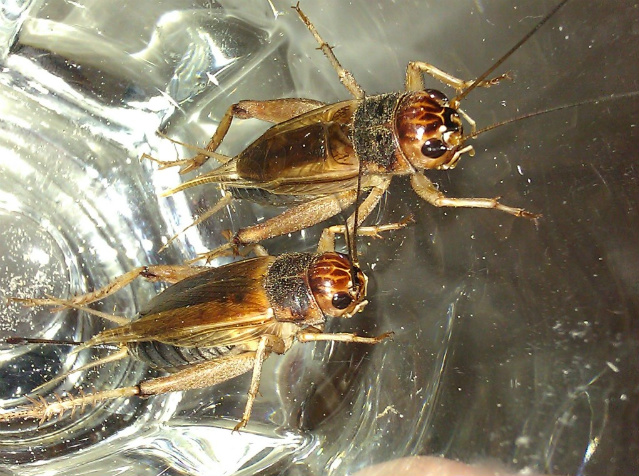
Top – male G. assimilus , bottom – female (photo by Diana Heideman / Siren Fish & Reptiles)
These crickets are very robust, much bigger and meatier than the former cricket so you don’t have to feed as many. They don’t jump as high, are quieter, and are resistant to the densovirus (AdDNV). These crickets are like our ‘domestic’ crickets on steroids.
Sound too good to be true? Well…
These Jamaican Field Crickets are not only big in size, but they have H-U-G-E mandibles (jaws) designed for chomping heavy vegetation. They are aggressive, and can be vicious. They will chomp your fingers (drawing blood!) AND chew on your geckos. These crickets bit my Nephrurus. milii and Nephrurus. levis, stressing them to the point of one dying, and several others to the point of mobilizing all the fat reserves in their tails literally overnight. I woke up to a dead, half-eaten N. milii and there were only 2 crickets in the tub. I have several other rare Australian geckos that have not eaten since they were fed these crickets a month ago, and I expect to lose at least two of them. Even my leopard geckos stayed on top of their hides for days to avoid these vicious bugs, even after I removed them.
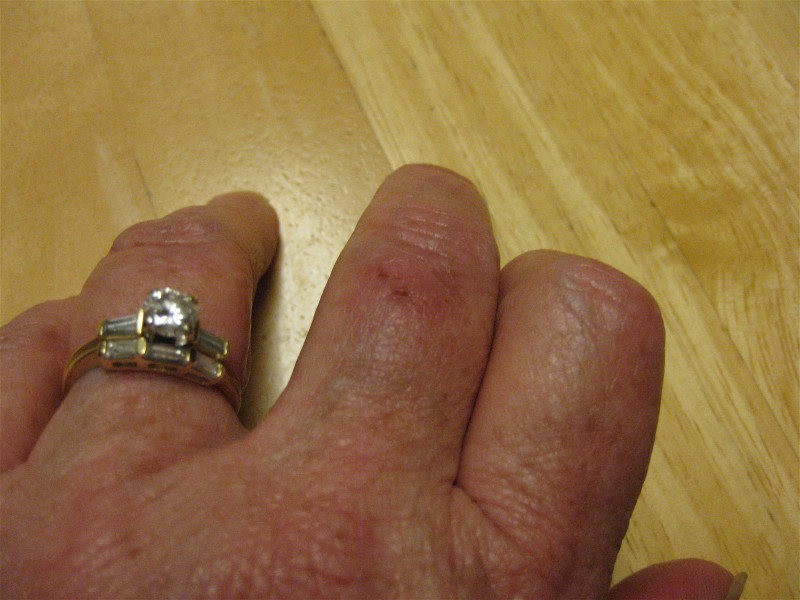
Bite from adult Gryllus assimilis
After this devastating situation, I contacted at least a dozen major cricket breeders recounting this experience, and soliciting more information regarding the Jamaican Field Cricket. I obtained detailed facts from Timberline, Ghann’s, and Armstrong’s, a short email from another company that simply stated, “Having these crickets is better than having no crickets at all”. I did not even receive the courtesy of a response from the other cricket suppliers. I also contacted the USDA for information on the potential for environmental affects, but have not received a response from them either.
What I learned from those that did respond is that the cricket farmers are aware that the Jamaican Field Cricket is aggressive and is not an appropriate feeder for many animals, and they have known this since the Europeans first started working with them eight years ago. I was informed that raising and breeding this species of cricket requires a permit from the USDA, and as of the most current information I received, they are illegal to ship across State borders at this time. One cricket grower said flatly that shipping these crickets is “breaking the law”.
I posted this information on Facebook and to online forum communities as a warning to others, and since publicly sharing my tragic experience I have been contacted by a few other reptile breeders that also had negative encounters with the Jamaican Field Cricket. One Bearded Dragon breeder reported that an entire clutch of hatchlings was maimed by these feeders, having their feet, toes, and tails chewed. Another claimed several African Fat-tail babies being injured as well. Both of these breeders were shipped the Gryllus assimilis in lieu of their regular A. domestica crickets without notice. One pet store reported to me that they also received the “super crickets” without being prepared for them, and they actually chewed through the shipping boxes they arrived in. I urged them to contact the cricket suppliers with their reports, but they were reluctant to do so.
Businesses and livelihoods are being affected by this feeder crisis. Not only do reptile breeders and keepers have to deal with another blow, but the cricket feeder supply companies are taking astronomical financial losses and employees are being laid off in a challenging nation-wide economic crisis. There are rumors that the cricket breeders are attempting hybridization of the A. domestica and G. assimilis in hopes of creating a less aggressive yet pathogen resistant cricket. We can hope this will be a successful venture.
In the meantime, if we are forced to use the “Super Cricket” as a feeder for our geckos, I can offer the following suggestions:
- be specific when ordering crickets, asking for A. domesticus
- order a size smaller than you usually do
- feed these crickets good, nutritious food… they are savage eaters
- don’t leave any uneaten crickets (even two!) in your animal’s enclosure
- if you must leave crickets in with your animals, put some cornmeal or carrot pieces in with them so the bugs have something else to chew on
Finally, ask questions, do your research, and develop an affirmative communication relationship with your feeder suppliers. Report all issues, and provide them with constructive feedback with your experiences – both positive and negative. We must present a united front, and remain optimistic that together we can overcome this obstacle.
[ad#250]

This is quite disturbing
Good information to be aware of. Not worth taking the risk. Thanks for a great article.
Good info! The ones I’ve been getting, I was told, are a hybrid of the domestic cricket and the black field crickets and are supposed to NOT be able to bite animals due to smaller mandibles. Looks like I need to go take a closer look at my crickets after work today!!!
On a bright side, I’ve fed these new “hybrid” crickets to everything from Eurydactylodes to Phelsuma (30+ species of geckos or so) and haven’t had one single issue.
Good luck to everyone else and hopefully we can come out of this crisis unscathed.
Good to hear, Kevin. Since I submitted this article I have been contacted by several other breeders who have recently been using the new hybrids without any issues. This is good because it means we have a more robust and less aggressive feeder crickets that is also resistant to the virus! Trust me, if you had the pure G. assimilis, you would know… 🙁
We have a small reptile store and sell a lot of crickets. We will share this information and appriciate your sharing this knowledge with us.
Terry Cubero@ Reptopia in Bend Oregon
The solution to this is to simply not feed crickets. Roaches (of several species) are an excellent feeder alternative that are better in so many ways.
Will, I have a moderate colony of B. dubia… but the only problem I had was that they will burrow in the substrate of my knobtail geckos. I am already ramping up to do away with crickets as feeder althogether. As of the publication of this article, I have lost a total of 5 Aussie geckos due to the stress of this ordeal and they never ate again. I waiver between heartbreak and rage.
There are two suppliers that still have healthy domestics. Check out Rainbow and Armstrong. Alternative feeders such as B. dubia where state laws allow are also an option.
Expresscrickets.com also has healthy domestics
I think everyone just needs to get roaches, much better than crickets… can’t believe people still use crickets as feeders. 🙂
What were you doing to it? Why would it of bit your finger? I think your a fake!
Brad, I’m sorry if you think I would ‘fake’ something like this. I’ve been a gecko breeder for nearly 16 years and am certainly not known for making stuff up.
I keep my crickets in a large plastic trash can, and I was scooping crickets into the feeding cup when a large adult bit me. It was still latched on to my finger when I pulled my hand out! I have two other very reputable breeders that have witnessed the power of an adult G. assimilus cricket’s mandibles here at Golden Gate Geckos. Email me and I can forward it to them for a response.
Also, Timberline has a H-U-G-E full page advertisement in the most recent Reptiles Magazine that validates this claim for the G. assimilus feeder crickets. The ad is towards the front of the magazine. Check it out.
I’ll be more than happy to send you a bunch of these crickets to test your skepticism! 🙂
Well, I FINALLY got a response from the USDA:
“110620-000036 Response Via Email (USDA/APHIS) 09/28/2011 09:36 AM
We appreciate your desire to comply with USDA regulations. With a permit from USDA’s Animal and Plant Health Inspection Service, suppliers may import and sell Gryllus assimilis (Jamaican field crickets) to customers in certain States, including California. To ensure that any purchases are made from a reputable dealer, we suggest that you ask a prospective supplier to show you a valid permit to ship to your State. We have received several reports of these crickets displaying aggressive, biting behavior. Accordingly, we understand cricket suppliers are investigating the use of other species.”
Marcia sorry to hear your loss…this must be truly devastating for you. Although many people dont say it, but were all thankfull that you took the time to alert everyone about this. It’s a shame someone said this is fake…no idea why anyone would even try to fake a story like this anyways what positive outcome would happen to marcia for lying about these crickets?. adam your a complete troll and idiot i’d love to see you in a glass tank full of these crickets instead of the poor animals.
You wrote this?! Wow, very nice article. I remember you telling me about this and I’ve since spread the news to local pet owners and even warned Petco about these feeders to avoid terrible consequences for the poor unprepared gecko and their owner. Even did what you showed me, pulled the cricket out and exposed their jaws so people know that what I said is real and serious. I hope they will eventually breed the aggression and the jaws out of these awful things. Good work and keep it up! God bless!
Thanks, Christina! You were here at Golden Gate Geckos and saw first-hand the massive mandibles on these crickets and how they bite. I hope your post here confirms that I am not a ‘fake’ and these crickets are vicious.
One of the major cricket farms sent out an advertisement because they are going to start breeding and selling the Gryllus assimilis crickets, and broadcasted that all the bad publicity is nothing more than ‘rumors” and ‘propaganda’. Needless to say, I didn’t take that very well.
I just received a ‘ping back’ notice that this post was made regarding the G. assimilis crickets: http://www.frogforum.net/food-feeders-live-frozen-culturing-etc/11319-gryllus-assimili-super-crickets-safe.html#post84557
Also, another very reputable breeder spoke at length with Sunshine, a feeder insect farm in Oregon, that reports that there are NO hybrids at this point. Apparently, the female G. assimilis are eating the male A. domesticus when exposed to each other in breeding colonies.
The picture you show, and the crickets you are talking about are not Gryllus assimilis but instead are an as yet unidentified species being called crazy reds because of their color and aggressiveness. Ghann’s has started shipping the assimilus and we love them, much hardier and as yet not aggressive as you describe. I have my hand in the container with crickets crawling all over me and have not received as much as a tickle. If you take a look at the pictures Ghann’s provides you can see there is a clear difference. I don’t think you have posted this article for any other reason than to try and educate people, which I commend you for, but you need to do some serious research before sounding the alarm on these crickets that could save our industry. Ghann’s is getting rid of the domesticus completely within the year, and I for one thank them for all they are doing to help sustain the viability of our industry. Cockroaches are not the answer. I agree they are a wonderful food source, but our lease specifically states we are not allowed to keep or sell any species of cockroach, and even if we could many customers cringe at the thought of potentially exploding populations of roaches in their homes.
Craig, I appreciate your thoughtful and accurate information. I just received my first “REAL” G. assimilus crickets from Ghanns, and they are certainly NOT the same crickets I received last year that were labeled as such. Trust me, I did my research and sent the photos to at least half-dozen cricket growers, names provided on request, Including the USDA that confirmed they were G. assimilus. do you know what the scientific name is for this “species being called crazy reds because of their color and aggressiveness”?
I’m sorry Marcia, I have not been able to identify the “crazy reds” even thought I’ve talked to several producers. Ghann’s has not identified them as of yet either and they are one of the most thoughtful producers I’ve dealt with. If they can’t figure it out with their resources I doubt I will with my paltry contacts. I’m glad you have tried the real gracillus cricket. I think you’ll find that you’ll like them. I do have to say though that the large ones should be labeled “monster size”! They are absolutely huge.
UPDATE: The ‘real’ G. assimilus crickets are working out very nicely. I will be putting together another post or two to clear this up.
Thanks, Marcia. We’re looking forward to it. You could even do an article follow-up if you want.
This is why I asked if you were a fake. We have worked with the real G. Assymilus crickets for years on a large scale yet to have a problem.
QUOTE=Brad “What were you doing to it? Why would it of bit your finger? I think your a fake!” Brad, you automatically ASSumed I was a fake without asking any questions or contributing to this discussion in any way except to criticize. Your comments lacked credibility and were troll-like in my opinion. I was sent crickets that were labeled as ‘Jamaican Field Crickets’, and the photo I had was also confirmed to be A. gryllus by three California cricket growers. All I know is that those crickets drew blood on my finger and KILLED several of my rare Aussie geckos! I felt I had an obligation to the community to call a heads-up, and by doing that we have come to realize that what I was sold was a farce.
I have spoken with MANY cricket growers regarding this tragic situation in a professional and non-confrontational manner, including Clay Ghann. He convinced me that the crickets we were getting here in California were NOT A. gryllus, and I took it to heart and ordered several thousand when they were available. What I received from Ghann’s as A. gryllus were definitely NOT what I was sold as the same cricket specie here in California.
As an honest and ethical breeder for nearly 17 years, I am standing up now to support what I know is the truth and disspell the false ‘fact’ as I was presented in this situation. I certainly would not do this if I had anything to hide, and I would like to set the record straight.
Being called a ‘fake’ by someone who doesn’t even give their full name and spells like a 3rd-grader was like adding insult to injury.
Just sayin’…
I too am from California. I am in High School, and I can understand my spelling is a bit off. My teacher has a tutor helping me on evenings and weekends. Thank you for understanding!
CORRECTION!!! I really messed up in my last posts… I am referring to Gryllus assimilis (G. assimilis) and NOT A. gryllus.
Brad, as a high school student you will be given some leeway for your immaturity, but you need to think before you type. Insulting people you know nothing about will almost always get you in trouble. You added nothing to the discussion with your comment. Just remember, there are no excuses for being rude. If you wouldn’t say something to a persons face, then don’t type it either.
Thank you for putting this up, I’m trying to do much research before getting a leopard gecko, knowing there’s vicious crickets is helpful
Marcia I found your information truly educational. I have been at wits end trying to figure out why all of a sudden my poor flying gecko has these bleeding bites on her from the crickets. I know they are from the crickets as I witnessed the cricket walk up to her and just start chewing away at her tail to the extent that they have drawn blood. She has been showing signs of depression and I can only figure it is due to this unwarranted attack on her from her “food”. We have been feeding her and our skunk gecko crickets ever since we got them and have never had a problem it is only the last 3 times my son and I have noticed these crickets literally eating away at the gecko’s. We also found the end portion of our skunk gecko’s tail in the bottom of the tank and have since discovered they will “break off” or “throw” their tail when being attacked. This was totally new news to me as I had never heard of such a thing. At first I thought he had gotten under some of the wooden structures we have in the tank and got caught and his tail got broken off then, but now I’m thinking the vet was right when he advised us that he probably did it himself trying to protect himself from something attacking him. I am going to advise my son of these problem crickets so that he can check with the store he buys his gecko food from and see just what kind of crickets they have and to let them know of this problem. I also am going to go and remove the crickets he just put in there and get rid of them. Those poor gecko’s do not deserve this kind of abuse they are actually fun and very personable once you get them use to you and they deserve nothing but the love and care that most people give their pets. Thank you again for the information, you have helped me so much. It is feeder worms from now on until we can get non-aggressive crickets. Good luck to you and keep up the good work.
Faye, I am so very sorry you and your reptiles have had to experience this horrific experience with feeder crickets! All in all, I lost over $5,000 in rare geckos… but the loss is so much more than monetary value. These beautiful, gentle creatures had to suffer and endure the aftermath of literally being eaten alive by crickets, and no words in the world can describe the heartbreak I endured trying to help them.
Please know that the crickets I received as G. assimilis were NOT this specie of cricket! I was shipped the “Crazy Reds” that were being falsely marketed as G. assimilis, and I have yet to be informed of their accurate specie information. I have been getting true G. assimilis from Ghann’s, and they are working out just fine! If the crickets you are getting look like the ones pictured in this article, DO NOT USE THEM!
I hope your animals will make a full recovery, and want you to know that you are not alone in this tragic situation.
I feel awful right now. About an hour ago, I went into my gecko’s cage and found her crickets in her mealworm bowl. They must have been hiding under her bedding. All of a sudden they are huge. I took them all out because I think they are eating the mealworms. My gecko tail has been looking a bit thinner too. I did a google search to see if this was possible and found this article. I feel like I might be killing my baby. I really hope I got them out in time.
I have done the research on these and found that these one that you are describing are not actually Gryllus Assimils. They are an imposter breed from California that are much more aggressive then the real field crickets. You can tell the difference because the true field cricket has a dark brown to black upper thorax and head. The ones in the photo have a reddish tinted head and thorax. These crickets are unidentified as of yet but are supposed to be illegal to ship across state lines so I would notify the proper authorities of it.
Hi all,
I wanted to thank Marcia for her informative post. I keep and breed several lizard species in the UK.
I just wanted to share what I found out last week after using G. assimilis for the first time.
I have naturalistic set ups, which are mostly heavily planted and I enjoy trying to recreate as natural an environment as possible for my animals.
I had recently acquired a couple of beautiful young captive bred Riopa fernandi (please excuse me if this is not the latest latin name but I am struggling to follow the latest revisions…)
I had add the animals for a couple of months and they were doing very well. They were perfect in every possible way.
Having run out of crickets (A. domestica) from my usual supplier, i picked up a couple of tubs from a store. These were labelled as “brown crickets” and I didn’t pay much attention to them. They were the right size for the animals and though nothing of it.
I put a few in a very heavily planted set up with my two beloved Riopas. These being very shy and fossorial, i didn’t check them for another few days.
I was greeted by absolute horror when I did!!
I couldn’t see them at all and most of the plants were completely ravaged, with so much damage, most had to be taken out and thrown away.
I eventually found one skull (all that was left from one of my lovely lizards) and a very stressed other that had half of its tail missing (Chewed off), toes missing and bite marks all down one side. it died two days later.
I felt sick! It had taken me so long to acquire these 2 perfect little individuals.
I know they are not rare, nor particularly “valuable” (beauty is in the eye of the beholder and I cherished these two little guys!). I am still shocked and learned a valuable lesson….
A few sprays of insecticides later, I was rid of what G.assimilis had left and vow never again…
You may as well try to keep your lizards in the same cage as a large scorpion or tarantula!
Pass the message on, these are totally unsuitable as food for small animals!!!!
Kind regards
Frederic
Frederic, I am heartsick for you in the tragic loss of your Fire Skinks. The G. assimilis crickets are savages. Even thinking about our beloved creatures being eaten alive by these insects brings back the trauma of losing mine… and it WAS a traumatizing experience for all but the crickets. I’m glad my article is still circulating so hopefully others can be spared! Thank you for sharing this heartbreaking event.
I understand you had problems with this species but I find your opinion some what polarized. I bred this species for at least a year (pretty small scale)and fed them to lizards and frogs as small a house geckos. I never had a problem, but I always made sure to feed accordingly size instars. I’m entertained by the whole fake Latin name locorojo, who made that up. Just goes to show you, don’t believe every thing you read on the internet. I believe them to be gryllus assimils but can’t positively id them. They are very hardy and I think they are pretty neat. I did get nipped though once or twice but it never broke the skin. Unfortunately I neglected to mist the eggs of my last batch and that was the end of them. I’m actually looking for some one that still sells them. I had got them from bassett’s but they switched to the banded crickets. Any one know where I can find some??
Bill, I believe Ghanns Cricket Farm still raises and sells Gryllus assimilis.
Ghann’s Cricket Farm does NOT raise or sell Gryllus assimilis (Crazy Reds) due to their aggressive nature. Instead, they produce Banded Crickets (Gryllodes sigillatus), which have worked out very well! I don’t know if Bassetts is still raising Crazy Reds, which were the species that killed my geckos and are pictured in my article.
EDIT: Crazy Reds are NOT Gryllus assimilis (Jamaican Field Cricket). Crazy Reds are Gryllus locorojo. It is illegal to raise this species of crickets now. This entire incident and the subsequent article I wrote over three years ago was indeed a case of mistaken identity by many cricket growers.
For some great information as well as identification of the various species of crickets, take a look at the bottom of the page on the Ghann’s website:
http://www.ghann.com/Cricket-Species-Info.aspx
Thank you for correcting yourself on the identity of the Gryllus assimilis, as like you said, they are not the crazy reds. Ghanns was indeed raising and distributing Gryllus assimilis for years after the virus basically wiped out the majority of the house cricket population in our industry. I know this because I used to buy 30,000 a month from them for years. I didn’t know that they had switched to the banded cricket because I stopped buying from them a year ago after some questionable business decisions were made by them causing them to lose my loyalty. I now buy from Flukers who still raises and sells Acheta domesticus, the house cricket. Flukers never had a problem with the virus and have always had a steady supply. As you said there has been a lot of misidentification of crickets the last couple of years. I was the one that pointed out to you in 2012 that you had misidentified the crazy reds as Gryllus assimilis in the first place. My quote from 2/18/2012 “The picture you show, and the crickets you are talking about are not Gryllus assimilis but instead are an as yet unidentified species being called crazy reds because of their color and aggressiveness. Ghann’s has started shipping the assimilus and we love them, much hardier and as yet not aggressive as you describe. I have my hand in the container with crickets crawling all over me and have not received as much as a tickle. If you take a look at the pictures Ghann’s provides you can see there is a clear difference. I don’t think you have posted this article for any other reason than to try and educate people, which I commend you for, but you need to do some serious research before sounding the alarm on these crickets that could save our industry. Ghann’s is getting rid of the domesticus completely within the year, and I for one thank them for all they are doing to help sustain the viability of our industry. Cockroaches are not the answer. I agree they are a wonderful food source, but our lease specifically states we are not allowed to keep or sell any species of cockroach, and even if we could many customers cringe at the thought of potentially exploding populations of roaches in their homes.”
Craig, back when this article was written, literally everyone was confused on the cricket species. I researched what information was available at the time, including talking/corresponding withBassetts (who sent me my killer crickets), Ghann’s, Timberline, Rainbow, and American Cricket Ranch. ALL of them told me the ‘crazy reds’ were Gryllus assimilis. We have all learned a lot since July 2011. 🙂
Hey There. I found your weblog the usage of msn. That is an extremely
neatly written article. I’ll make sure to bookmark
it and return to read extra of your useful information. Thanks for the post.
I’ll definitely comeback.
Hello there,
I breed these “red fields” for about 16 years. I was suprised about the negative publicity about them.
The bite of a Red Field can be painfull (they actually don´t bite but squeez to get the liquid out of you) but I never had experience of bleeding wounds.While working with all types of crickets my experience is that they all bite but the blacks have more strength in their jaws.
That´s why I don´t understand the problem.
If you have to leave some crickets with your pets, please make sure that they have the good size and that they are well fed and had their water. allso important to leave something to eat for them to avoid to start chewing on your pet lizard.
studies has proven that the “Crazy Reds” are high in protein and excellent livefood for your pet.
We received what looks exactly like the crickets pictured from our local pet store. And they attacked and stressed out both of our leopard gecko hatchlings. We weren’t sure what caused their deaths but I kept saying the crickets seemed mean. We fed them smaller ones. They just stopped eating. One would eat more meal worms and she lasted 3 weeks longer then the other, but she too died We didn’t realize until this article the mistake that was made
Sorry for your loss.
Morgan, I am so very sorry you lost your little hatchings. Although this article is old and confusing in some places, I really do not understand why these “crazy red” crickets are still being cultivated and sold. I have had so many emails from people who have experienced tragic losses as a result. I no longer use crickets as feeders at all. Instead, I have a very large and productive colony of Blaptica dubia roaches. If you are interested, I will send you enough of these bugs to start your own colony just for the price of shipping.
Thank you so so much for posting this! My poor, tiny western fence lizard was attacked and I had no clue why until I read this article! Luckily enough, a vet was able to save him but he was so badly bitten. If you hadn’t posted this I would not have understood why he was attacked. Please, anyone reading this article, take it seriously!