
 Aliza
Aliza
A successful reptile breeder, in addition to knowing the mechanics of breeding and caring for hatchlings, must also understand basic genetics in order to plan and execute reptile pairings. In addition, the only way to make a positive contribution to herpetoculture requires the ability to provide the genetic history of the animal he or she produces. An understanding of genetics means that the breeder is familiar with terms such as “dominant”, “recessive”, “homo/hetero-zygous”,” polygenetic“, that he or she knows the possible outcomes of the reptile pairings and can also plan for specific outcomes. The best way to learn is to read about basic genetics and to then learn about the genetic possibilities for the gecko species that most interests the breeder. This article will provide some very basic information to get the beginner started and will illustrate how the genetics are expressed through a real-life example: a pair of leopard geckos I am breeding and the first 6 offspring they have produced.
[ad#sponsor]
Basic Genetic Terms
All vertebrates that reproduce through the union of two parents receive genetic material (called “genes” or “alleles”) from each parent. Consequently, each creature has a pair of alleles for many of its hereditary traits, one from each parent. Genetics is the study of how the pairs of traits interact, are expressed and are transmitted. Speaking specifically about leopard geckos (though this is true of all vertebrates), for each trait, such as pattern, color, size and body proportion, a gecko’s pair of alleles will either be 2 of the same or 2 different ones. When the gecko has 2 of the same allele, it is considered to be “homozygous” for that trait; if the alleles for the trait are different from each other, the gecko is considered to be “heterozygous” for that trait. So how do you know what the leopard gecko will look like? Here’s the key:
Dominant: Most traits are either/or possibilities. Some traits always prevail over others. A “dominant” trait is the one that prevails. For example, the trait that produces black coloring in leopard geckos is dominant over the trait that fails to produce black coloring (known as “albino” in leopard gecko genetics). A gecko that received the black coloring (normal) trait from one parent and an albino trait from the other parent will always show the black coloring and will never look albino, even though it has an allele for albinism. A gecko that has 1 dominant allele (with the other being recessive) will not look any different from a gecko that has 2 dominant alleles for a trait.
Recessive: The opposite of “dominant” is “recessive”. This is a trait which, when paired with its dominant counterpart, will never show up visually on the gecko. In the example above, the albino trait is recessive and, unless the gecko has 2 alleles for albinism, it will never show up visually in the gecko although the gecko does possess the genes for albinism.
Co-dominant: Sometimes it will make a difference whether the gecko has 1 or 2 dominant alleles for a trait. Usually the 2-copy-allele will be referred to as the “super” form of the single copy allele. The most common example of this in leopard geckos is the “snow” trait where the gecko, at hatching, has only black and white coloring (as opposed to the black and yellow coloring of the non-snow gecko). By contrast, when the gecko has 2 copies of the “snow” allele, it hatches silver or charcoal colored, with solid black eyes, and matures to a white gecko with black spots (in contrast to the single copy snow allele where the gecko frequently yellows as it ages). A gecko that has 1 copy of the co-dominant allele (“snow” for example) and 1 copy of a regular dominant allele (normal coloring) will always express the co-dominant trait.
Line bred or Polygenetic: Some traits are more complicated and are likely expressed as a result of more than one pair of alleles. In these cases, breeders have the best results by pairing geckos that are closest to the ideal of what they are trying to produce.
Heterozygous: As mentioned above, this refers to a pair of differing alleles. It becomes important to breeders because the unexpressed allele can be passed on, giving the offspring the chance to end up with 2 recessive alleles and to express the recessive trait.
Getting Practical with Leopard Geckos
All this theory lays the groundwork for the actual leopard gecko pair I will be talking about. These geckos possess the following genetic traits:
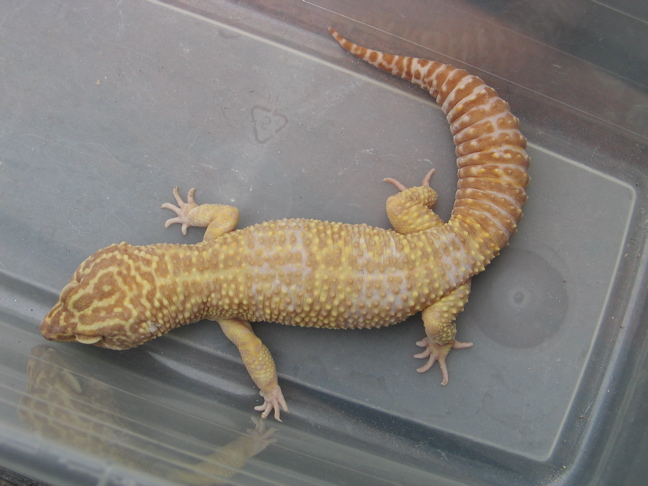
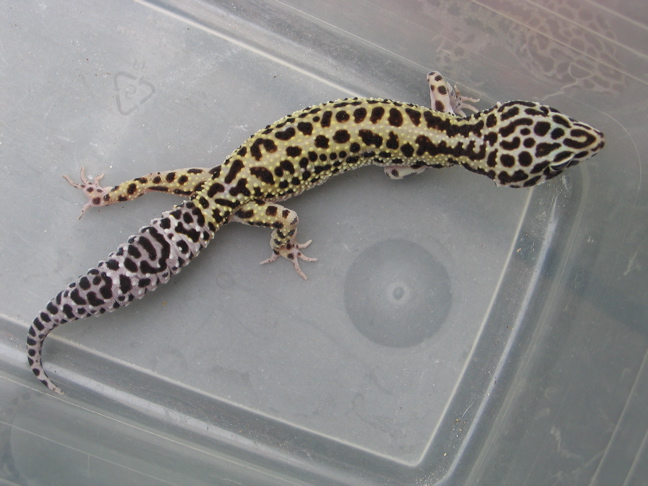
Albino: This is a recessive trait. The father, Eragon, is an albino gecko because he possesses two alleles for albinism. The mother, Zora, who does not look like an albino, possesses 1 allele for albinism and 1 for “normal” coloring which is dominant.
Snow: This is a co-dominant trait. Zora has 1 allele for the “snow” trait. Since Eragon has no snow alleles, none of their offspring can end up with 2 snow alleles so none will express a “supersnow” form.
Stripe/jungle: In leopard geckos, this refers to a range from a broken pattern of the horizontal bands (“jungle”) to a vertical, head to tail pattern (“striped“). It is still unclear whether this trait is dominant/recessive or polygenetic, or whether different striped lines fall into different categories.
Eragon and Zora’s Offspring
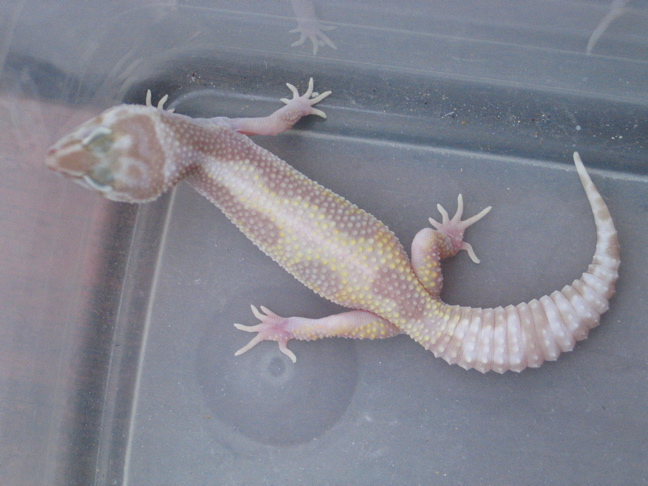
At the time this article was planned, 6 of Zora’s eggs had hatched and are pictured as a group below:
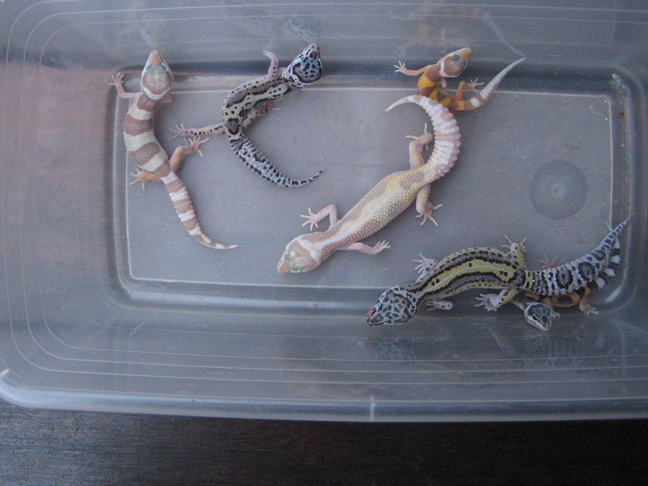
The first hatchling expressed all 3 of the parents’ possible non-“normal” traits: albino, stripe and snow. She has head to tail striping, no black coloring, and the white and beige coloring of a snow albino. This gecko is “homozygous” for albino and has 1 snow gene. She will likely produce a preponderance of striped offspring, especially if she is paired with a striped mate.
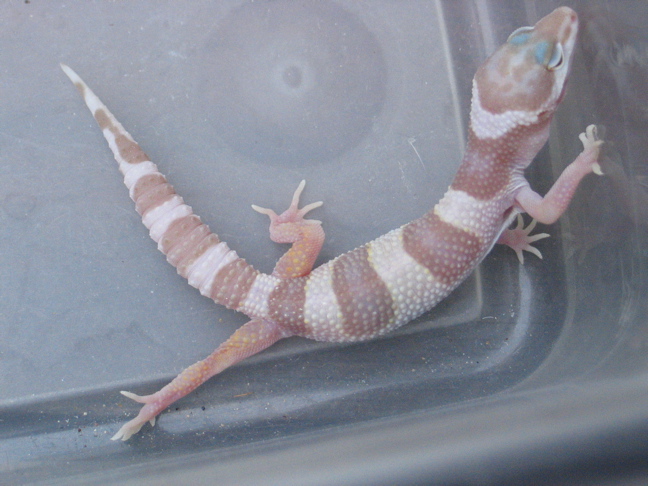
Two of the hatchlings have inherited the same 2 traits from the parents: they are snow and striped/jungle.


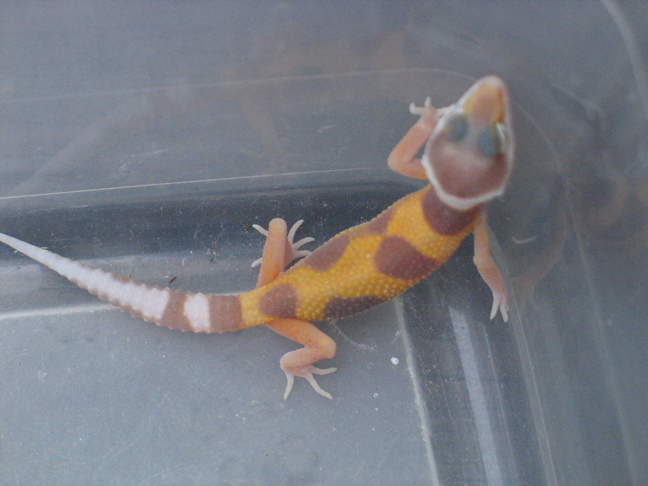
Two other hatchlings have also each inherited 2 traits, but different pairs of traits: one is albino and snow (but not striped) and one is albino and striped (but not snow).
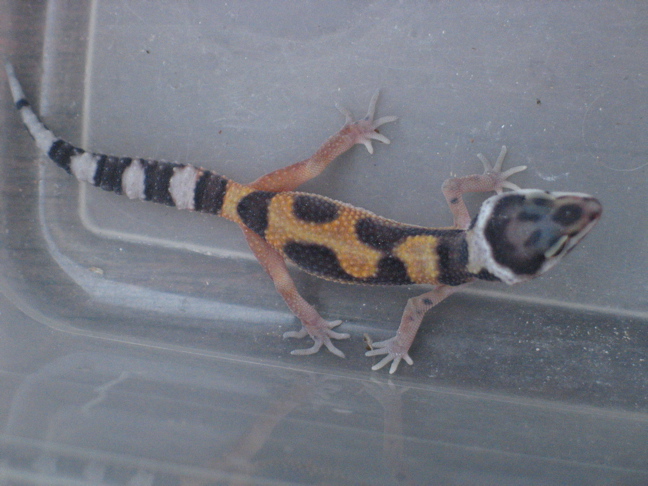
One hatchling has inherited none of the recessive/codominant traits, though it does have some broken bands on the body (but not the tail). This one is neither a snow nor an albino and doesn’t display broken bands on both the body and tail so it’s not considered to be a stripe or jungle. This is a good example of a gecko that looks nothing like either parent but has primarily inherited the non-expressed traits (except the father’s banding).
I hope this pictorial genetics lesson has helped to put a “face” on the more academic explanations. In order to test your knowledge, see if you can answer this question: What other combinations, which haven’t hatched yet, could result from this pairing?
Did you pass the quiz?
[ad#sponsor]

What an interesting article. I think all science lessons should be taught with cute little critters, lol. I recently posted about my own leopard gecko, Nimue. She looks a bit like Zora but without the stripe. Check her out here http://the-bee-loud-glade.blogspot.com/2011/07/spotlight-on-leopard-geckos.html
Loved your blog article!
Hi
I would like too ask a question too you ,if i breed a diablo blanco with another morph does that make the offspring het for diablo blanco and when those offspring are bred back too a diablo blanco would i get some db offspring?
Technically you could call them het for diablo blanco. However, one component of the Diablo Blanco is “Raptor” which is a combination morph (albino, eclipse and patternless stripe). That means that a het for Diablo Blanco bred to a Diablo Blanco may not pass on all the traits that make up the Raptor. Some of the offspring may luck out and possess all the traits but there’s no guarantee since it’s not a simple on/off kind of situation.
thanks very much for your help,ive got a giant blanco het diablo blanco,gorgeous boy so hope too breed him with diablo blanco soon.
Hope too get some good offspring.
hi, I have kept leopard geckos for 3 years now.
The first one I bought is a hypo I think, no one can actually tell me
Exactly what he is. He has the leopard patterns of a wild type on his head and tail
But on his body he has two lines of spots right the way down his spine, with a few fade spots on his body. I’m guessing he carries the patternless gene and the wild type, but someone told me he is a hypo, very confused.com loool, we called him Milo. my second one is a female albino who we called lyla. Together these two have produced quite a lot of eggs each season, but have died Due to no incubator. I have decided that next year I am going to breed properly and have just purchased another baby Leo who was solder me with the morph type raptor, but to me it looks more like a sun glow ?. My question is whats the difference ? I’m guessing it’s the eyes ? when u surfed the net, sun glows seem to have red or orange eyes, and my little baby has dark eyes. Is that difference ? Thankyou
hi, I have kept leopard geckos for 3 years now.
The first one I bought is a hypo I think, no one can actually tell me
Exactly what he is. He has the leopard patterns of a wild type on his head and tail
But on his body he has two lines of spots right the way down his spine, with a few fade spots on his body. I’m guessing he carries the patternless gene and the wild type, but someone told me he is a hypo, very confused.com loool, we called him Milo. my second one is a female albino Belle who we called lyla. Together these two have produced quite a lot of eggs each season, but have died Due to no incubator. I have decided that next year I am going to breed properly and have just purchased another baby Leo who was solder me with the morph type raptor, but to me it looks more like a sun glow ?. My question is whats the difference ? I’m guessing it’s the eyes ? when u surfed the net, sun glows seem to have red or orange eyes, and my little baby has dark eyes. Is that difference ? Thankyou
Hypos are geckos with fewer than about 10 spots or so (there is no official standard) on the body; sunglows are albinos with no body spotting (i.e. superhypo albinos) and RAPTORS are albino geckos with the stripe characteristic (vertical bands on both body and head), little to no spotting (although people are now saying they have banded and jungle RAPTORS which is technically a contradiction in terms), tangerine color and either ruby red eyes or ruby snake eyes. A note about the eyes: some geckos are born with red eyes and as they mature the eyes start looking normal. I would imagine that these geckos do carry the (recessive) eclipse gene and would produce eclipse babies if bred to another gecko with an eclipse gene.
hi i have a tangerine bell enigma with red eyes its parents are a mack snow bell and bell albino i think it is a female what can you suggest me on what to pair with her i want to produce some unique looking geckos
Really unique looking geckos are created by people who invest a lot of time and generations of gecko breeding to refine something that’s one of a kind. It’s not something that happens by picking two geckos and putting them together. That said, your female gecko has genes for bell albino, tangerine, eclipse (if the eyes are all red) and enigma. Do you know whether it’s a Mack snow as well? I urge you to think very carefully before breeding an enigma, especially if it’s young since you won’t know whether it has or carries enigma syndrome. (There’s an article in Gecko Time about enigma syndrome) Beyond that, check out leopardgeckowiki.com and reptilecalculator.com to educate yourself about the genetics of different leopard gecko morphs and then you’ll be able to figure it out for yourself (which is much more fulfilling than just having someone tell you what to do). Good luck!
ok thank you i have read your article about the enigma syndrome and i still want to breed her but not with an enigma anymore..what do you mean if its a mack snow does it means it carries mack snow genes or it is mack snow morph too anyways thank a lot for your siggestion and ill consider them
If one of the parents is a Mack snow, your gecko may be a Mack snow too but it’s hard to tell with an adult. If it’s not a Mack snow it doesn’t carry any Mack snow genes. Be aware that even if you breed an enigma with a non-enigma, the enigma trait is dominant so you will produce babies with the enigma trait. Enjoy your research.
Ive just acquired some Aptors and I am not entirely sure what to pair it with. They are both female. My male collection consists of mack snow enigmas (no syndrome), mack snows, blizzards, sunglows, bell albino, norms, and shtctb. At first I thought one jungle aptor with the mse, and another with the ms. Now im wondering if I should swap a male for a blizzard? Or even if there were some others you can suggest. I will soon also be acquiring a ms tremper albino male, which will go to the final jungle aptor.
This explanation was much easier to understand than most! I have a question about a potential pairing for my first clutch next year. So I currently have three leopard geckos; 1 female (Bold Stripe Mack Snow) and two males (1 hypo-tangerine & 1 Mack Snow het Tremper Albino). Which combination of male and female will produce more variations? I’m thinking of breeding a stripe line. How likely will it be for me to get stripe hatchlings from either of these combinations? Any help you can provide is very much appreciated. Thank you in advance. 🙂
Also, do you have any suggestions for pairing with other geckos that I don’t have?
If you pair the female with the male Mack snow, you will get some snows and some super snows. If you get a female tramper or het tramper and pair with the male Mack snow you’ll get some Trempers and some snow trampers (if you get a female snow tramper you’ll get some super snow trampers). If you get a really nice tangerine female, it would be a good pairing for the male hypo-tangerine. Your female bold stripe will likely produce some jungles and stripes. Keep the best stripe and if you breed for male, you could breed it back to the female bold-stripe.
Wow that was a really fast response, thanks for all the information! If I breed the baby back to the female won’t that casue any genetic problems?
Limited in-breeding (also called “line breeding”) is OK, as long as you outcross (i.e. breed to an unrelated gecko) every few generations.
hi! i have a question about snow diablo blanco.. how you determines if your gecko is a real snow diablo blanco not a diablo blanco? i have a male diablo blanco the parents is macksnow het diablo blanco and the mother is diablo blanco. now i use two female pairing diablo blanco and blazing blizzard het diablo blanco, now they give me both offspring all pure white body no color yellow coloration of the body and two solid red eyes.. now you think my male breeder is a proven snow diablo blanco?
There is an extensive post about this topic here:
http://geckoforums.net/f125-morphs-genetics/99913.htm
We have a male leopard gecko that we have paired with a tangerine albino gecko and we have only had one successful hatching. The baby would be what????? We would like to know what we call this one. I can e-mail pictures of all three is someone can help us define the baby. Thanks
Ideally, I would need to see the hatchling. The female is a tangerine albino and unless the male has an albino gene, the offspring will not look albino (though they will all have a gene for albino). If the hatchling is orange, it’s a tangerine. If it has 1-10 spots on its body it’s a hypo tangerine. If it has no spots on its body it’s a super hypo tangerine. Unless you know more about the male, there’s no way to know if the hatchling has genes for any other recessive trait.
What would you get if you bred two Leo’s together that were both double gets for two different types of albino (say,two Leo’s that are both het tremper albino and het bell albino)
You would get some normals and some albinos. You wouldn’t know which of the albinos were Trempers, which were Bells and which were both (some breeders are selling leopard gecko morphs called “bubble gum” which are more than one albino strain but I think the jury is out as to whether they look different from albinos). If you bred these “mutt” albinos to other geckos you would further muddy the waters. In short, you would get a genetic mess. That’s why responsible breeders don’t do it. Thanks for asking, hope you liked the article.
Wow, what a quick response and great answer to my last question. One more question…
I bred what Ron Tremper called a “Banded Albino Eclipse” to a Diablo Blanco female, both with red eyes, and I had a baby hatch out yesterday that is very white with super pale yellow bands, red eyes.
What is it? A RAPTOR? Or a banded albino eclipse? Or something entirely different?
I attached a pic.
I don’t see the picture. However, Tremper’s “banded albino eclipse” is, I assume, what he’s now (correctly) calling a gecko with all the Raptor qualities except for the patternless stripe. I think what you got is another banded albino eclipse that’s also het for blizzard. Technically, a true Raptor has to be a patternless stripe, though many people are selling geckos as “banded Raptors” (which is my opinion is a contradiction in terms since the “p” in “raptor” stands for “patternless”). The genetics involved are Tremper, eclipse and blizzard, and since both parents express the Tremper and eclipse trait (i.e. 2 genes for the trait) and only the female has the blizzard trait, you get offspring who will all be eclipse and Tremper (some nicer than others) and be het for blizzard. Make sense?
yes, that makes sense You can see the picture by clicking my name (I put it as the url). Thank you so much for your responses.
What do you suggest pairing a female snowbell with? I understand that she is het for eclipse (most likely her siblings all eclipse). Thanks!
I try to stay away from just telling people what to breed with what because I feel strongly that an important part of breeding leopard geckos is to understand the genetics and to have a plan with a goal. That said, a few guidelines to consider:
–only pair with a gecko whose genetics you know
–don’t pair with any albino strain besides Bell
–pair with another snow if you want the opportunity to produce super snows
–you have 2 recessive traits in your gecko: Bell albino and eclipse. If you want to see those traits in the next generation you will need to pair her with another Bell albino and/or eclipse or with a gecko that is het for these traits.
Good luck with your breeding plans
thanks for your reply!
Hi in that pumince square what would tangerine be represented as and if it was a tangerine hey genetic stripe how would it be put into the square thanks
It’s actually called a “punnett square”. You will not be able to put either tangerine or stripe (jury is still out on whether it’s genetic or exactly how it’s genetic) into the square because the square only works for traits that are simple dominant/recessive or co-dominant. The tangerine trait is called “polygenetic” or “line bred” which means that there’s no way to know what percentage of offspring will have the trait (that’s what the punnett square is set up to tell you). If you breed these traits, you can only know that some of the offspring will likely have tangerine coloring to some degree. I suspect that the stripe could possibly be dominant, based on my breeding results, but there is no data, so it has to be treated as polygenetic like the tangerine for now.
I got 2 leopard geckos from the petstore. One at boxing day 2015 and one on April 5. Is there a way to do a genetic testing or something to figure out what morphs they are? I have an idea of what they are but as i learned from this article, can only visually see their dominant traits. I would love to know what mine are so i can breed thm when they’re older.
Sorry, there’s no way to do genetic testing. That’s why the recommendation is not to breed geckos from pet stores since it’s rare that you can find out their genetic background (unless the pet store gets its geckos from a breeder). You can, of course, breed the geckos and sell the offspring as pets, but serious collectors may not be interested.
May I please use this example while teaching genetics to my sophomore Honors Biology class at Mt. Lebanon High School in Pittsburgh, PA? I will make sure to show them your website and provide credit to you.
Sure! I’m flattered!
I know this site is for Leos but I have a question about an African Fat tail. I have a Tang het pattern less X Oreo het white out baby. The baby looks like the Tang het pattern less male ( the dad) with some Oreo on the tail. What would the baby be? should it be bread? if so to what?
Thanks for any feedback.
The article was about leos, but the site (geckotime.com)is for all geckos. As I understand it, white out is co-dominant. That means that a gecko either exhibits the white out trait or it doesn’t and if it doesn’t, that means it didn’t inherit the whiteout gene. Consequently your Oreo parent cannot be het whiteout. Tang, as far as I know, is line bred/polygenetic which means that breeding tangs together will result in better tangs. Since both patternless and Oreo are recessive, your baby is definitely het for Oreo and has a 50% chance of being het for patternless. If you breed it to a nice tang, it will produce more tang offspring. If you want to get Oreos, you’ll have to breed it to an Oreo or het Oreo. If you want to check to see if it inherited the patternless gene, you’ll have to breed it to a patternless fat tail and see if you get any patternless offspring.
Thank you so much for all the info. This will help out a lot when it comes time to decide to breed or not. My baby Is only 6 weeks old. I’m gathering as much info as I can till then. He/she was the only one in the clutch that was not an Oreo from the breeding pair. Since the Tang gene is a line bred I will probably try to breed out the Oreo trait first because I don’t know how far in the Tang is.
Thanks again.
If the other offspring were all Oreos then either the non Oreo parent is het for Oreo, or your Oreo fat tail is actually a white out.