

 Maureen Winter
More and more hobbyists today are keeping or thinking of keeping Lygodactylus geckos in their home.
About Lygodactylus williamsi
Lygodactylus is a genus of geckos with 60 species and 34 sub-species. Lygodactylus rarely exceed 4 inches. Due to this they are commonly referred to as Dwarf Geckos or Dwarf Day Geckos based on their diurnal nature. The most popular one being kept in captivity currently is Lygodactylus williamsi. Many people cannot resist the male’s bright blue coloring, including me. The females usually are an olive green, but sometimes they also have a bit of the blue coloring as well.
It should be noted that many of the Lygodactylus williamsi kept in captivity today are wild caught. Because of this many people are still perfecting their husbandry techniques which is why you may not find a lot of information (at least in English) about them throughout the Internet or in books.
Lygodactylus williamsi are very rewarding geckos with lots of personality, as are other Lygodactylus. When you first receive your Lygodactylus williamsi they may be a little shy, but over time you will find them waiting right at the door or at their feeding spot for their next meal.
Because most Lygodactylus williamsi are wild caught, you should have a quarantine terrarium setup before placing them in their permanent terrarium as with any other new animal. Quarantine should last for a period of two months. During this time you will be able to combat any possible problems with the help of a licensed herp Veterinarian.
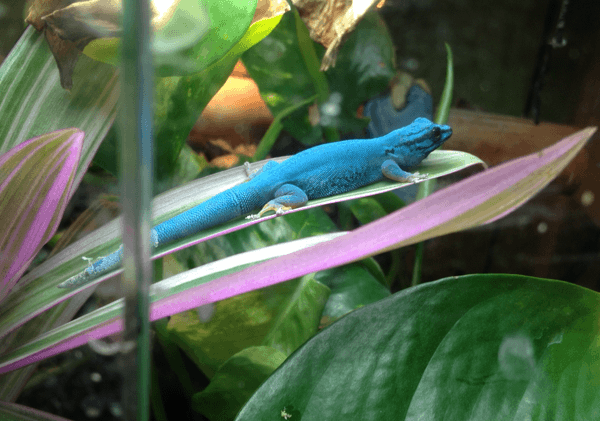
Housing and Feeding
Due to their small size, their terrarium does not need to be too large. The majority of people in the USA keep them in 20-25 gallon terrariums orientated vertically. Because they require UVB (some even say it is very crucial to their survival in captivity) you will have to modify your terrarium a bit to allow for the passage of UVB through the top. They should be provided with a UVB lamp in the 5.0 range. A daylight tube or compact bulb should also be provided, as Lygodactylus williamsi are sun worshipers and love bright light. Heating can be achieved with Halogen puck lights.
Lygodactylus williamsi do best with a humidity level between 50-80% (naturally increasing at nightfall), which is easily achieved by a daily misting. Their temperatures range between 75-80F throughout the terrarium during the day. The basking area only may reach temperatures of 90-95F safely.
The walls of the terrarium should be decorated with cork bark. Other decorations may include cork branches or tubes for climbing; you may even add some Liane jungle vines in. Lygodactylus do best with sand/soil mixture. There is a lot of debate as to the planting of Lygodactylus terrariums. Some believe artificial plants are best because they are easiest to keep clean, but personally I, amongst others, have found they do best in enclosures with lots of live plants. Live plants also help to keep the humidity levels up. Read our primer on for planted vivariums for suggested plants to use.
Lygodactylus williamsi will eat various insects. I feed mine a varied diet of Musca domestica (Curly winged fly), Trichorhina tomentosa (Tropical woodlice), Drosophila Hydei (fruit flies), and crickets to name a few. All food is dusted with the appropriate supplements at each feeding. Once a week I provide my Lygodactylus with a meal of Repashy CGD. I do not provide my geckos with baby food. A bowl of crushed up cuttlefish bone is available at all times during the breeding season and replaced once weekly with a fresh bowl. This will help give females the extra boost of calcium they need for laying eggs and staying healthy after doing so. Between March and November (breeding season) they should be provided with 12-14 hours of daylight, with 10 hours in the winter months. It should be noted that Lygodactylus may not follow along with your idea of stopping them breeding for a few months, so you may need to separate them during the winter months to allow the female to regain her strength for the next season.
Lygodactylus williamsi should only be kept with one male per terrarium. You may be able to keep two females with your male, however some have trouble in doing so. Also due to their profilic nature, you may really only wish to keep them in pairs or you will have an abundance of babies on your hands.
Watch for part 2 of this topic about how to breed L. williamsi coming next month.

I have only recently acquired the addiction to geckos and bearded dragons. I also have an iguana, but I am not such a fan of the iguana and I have several scars from nasty bites that I have gotten from two different iguanas. They are too large for my taste anyway. I would like to bread the geckos and the beardies and I am trying to bread crickets and super worms as well as the regular meal worms to feed my new friends. I am not sure which I like better, but I think it might be the beardies as they are aggressively friendly and do not appear to be shy as the geckos are.
@ Susan Leslie
While geckos, beardies and crickets would probably taste ok breaded and deep fried, the appreciation of these animals usually come from breeding them, not their use in the culinary arts. Please don’t deep fry our pets!
P.S. I think it is especially funny that in the sentence previously you mention that Iguana’s are too large for your TASTE, and then say that you want to bread the geckos, beardies, and crickets.
I understand iguanas are commonly eaten, where they are native.
On a different note, I have found Lygodactylus williamsi to be, hands down, the absolute best tiny reptile pet. While all Lygodactylus share some similar traits, due to my interest in the Genus, I have L. kimhowelli, L. conradti, and L. angularis, as well as L. williamsi. The personality differences are striking.
Most Lygodactylus geckos are quite shy and secretive. Not L. williamsi. Almost to the animal, they are bold, and very quickly become accustomed to human activity and virtually lose their fear of humans altogether. This happened with my wild-caught animals within 3 months.
Other Lygodactylus run for the corkbark as soon as you approach.
These animals will let you put your finger right in front of them, and instead of fleeing, they will lick it curiously. This is very endearing behavior–their intelligence is surprising, and they learn quickly where the feeding stations are, and will come to you for food.
I’m breeding these animals, and I have sadly found that the hatchlings are exceptionally delicate, and mortality rates can be as high as 60%–the hatchlings seem to simply fail to begin feeding properly or thrive, even when ample proper food is provided. Once they double their length, they become much sturdier, and show the same hardiness that the adults appear to have.
I am still working with various combinations of conditions for rearing the hatchlings. It is good that once they are over this most delicate stage, they seem to be nearly bullet proof, but I hate to see the tiny ones vanish.
I’m very much hoping that more will be learned about these personable tiny creatures, and better captive breeding techniques will be discovered–they are very prolific. I think they’re going to wind up being very popular pets for those with limited space.
@ donna
hi isee your breeding these stunning little geckos, just wondering if your selling any as im after a male specimin but struggling to find one, if ya could help that would be great…or even if ya could point me in the right direction
cheers
Hi Donna,
Although I have only had my L. williamsi for nearly 8 months( 9 pairs), I’ve had close to 98% hatching and rearing success. Needless to say I am absolutely in love with them, agreeing with everything you said about their personality and more.
I have tried and still trying different ways of rearing the hatchlings and have close to 40 babies from all the pairings. I will not count my successes until I can breed them into the F2 generations.
One of my current experiments ( with 5 pairs) is to leave the hatchlings in with the parents although this is frowned upon, but nothing ventured, nothing gained.! Primarily because I was running out of space to keep up with the expanding collection! My larger tanks are 24’L x 16w x 18’H, and well planted with live plants and an array of lighting equipments. ( details if you want).
The hatchlings and plants thrive under these conditions and the parents seem bemused by their presence! I observe them closely and have never noticed aggression or any inclination to stalk the babies. Under such conditions I find the hatchlings very soon figure out where the MRP dish is and where the crickets nymphs are in the large see through plastic container.
The MRP is indeed God sent and the hatchlings grow fast and strong on this.Every 3rd day I change the mixture to a fruit & honey mixture. I currently prefer this system over seperating them at birth and raising them in smaller tanks. Also I like observing their inter-reaction with their siblings and parents. Until there are problems with agression then it will be time to separate them.The hatchlings and juvies are very quick and agile and seeing them run along the leaves and branches always brings a smile to my face.
Having said all this, I have had only one pair that consistently ate their hatchlings. I do not have enough knowledge or data to say why that was so, but from observations of some pairs some may be less tolerant or more canibalistic and therefore impossible to leave the hatchlings in.
I hope that my short experience with them has allowed a small window to open for different people who are interested in breeding these absolutely gorgeous geckos. May you have better luck with them soon.
Hi Stuart,
If you are leaving Repashy in the terrarium all the time, which I suspect you are with the way that you wrote things. I am not surprised you are able to keep the offspring with the adults this way. On Repashy Day here the geckos are usually so fattened up they barely move.
To one of my pairs I have lost only 4 hatchlings to my knowledge to being eaten. To some off my offspring where I have had to add smaller ones sometimes, there too I have noticed consumption of smaller ones as well on occasion. While it does not always happen, you have to keep in mind that it may happen with or without your knowledge, which is why I say it is better to be safe than sorry.
With as many pairs as you have, I really hope you are following some incubation guidelines for them so you have an even sex ratio with the hatchlings, as the market is pretty flooded with males as is.
Hi Maureen,
I would be really interested in your opinion on if a “female” I have been sold as one half of a pair is in fact a female or a juvinile male – finding it really hard to work out and have asked some people but no one is totally sure. Can you help me?
I have some more photos taken if need be!
Thanks
Mike
what would happen if the blue lightning gecko was extinct
You mean the electric blue gecko? If it becomes extinct in the wild then the only geckos of this species will be in captivity. Either the gecko will remain in captivity only, or some group will decide to start a repopulation project if this gecko’s habitat still exists in the wild. If all the blue day geckos in captivity die, then the gecko will no longer exist anywhere on our planet.