

 Aliza
Aliza
[ad#superworm]
Failure to eat, or a reduction in eating habits in a gecko is not really a problem in and of itself, but a symptom of either an illness or a natural situation. Since most keepers consider regular feeding to be a sign of good health, it is disconcerting when a gecko doesn’t eat. Most of the time, a gecko does not eat well due to illness, stress or life cycle events.
Illness
A gecko which is impacted, has an infection, a high parasite load, or who has MBD (Metabolic Bone Disease) is likely to stop eating. Some of these illnesses can be observed by the keeper: an infection may show up as a puss-filled lesion, a reddened or swollen area, or filmy eyes. A gecko with a respiratory infection may have plugged nostrils, be laboring to breathe or may make unnatural “croaking” sounds. Signs of MBD include rubbery legs and jaw and inability to bear weight. Geckos who are impacted often have a swollen belly and may not move their bowels for a long time. Although MBD and impaction may be “cured” by increasing calcium and vitamin D3 intake, and a warm soak respectively, geckos who are ill need to be seen by a vet who may prescribe antibiotics or some other treatment. Some illnesses are unavoidable even by the most experienced keeper. However, good husbandry practices will minimize the chances of illness in all gecko species.
[ad#sponsor]
Stress
Geckos often react to stress by decreasing their food intake. You could say that all situations covered in this article ultimately lead to stress and result in decreased eating; this section will cover the stressful conditions not due to health or life cycle issues. Geckos become stressed by a variety of factors including being shipped, other transfers to a new environment, and bullying by other geckos. Improper temperatures, especially temperatures which are too low, also stress a gecko and make it difficult to digest food. In the case of a transfer to a new environment, usually when a gecko has a new owner, the gecko will resume eating once it becomes comfortable in its space. Some geckos have been known to hold out for weeks until they become comfortable in their new homes. In these cases, there is nothing to do but to continue to offer food regularly and to wait until the gecko is ready to eat. It also makes sense to consider the possibility that there is another cause as well, such as life cycle or illness that is occurring at the same time and to treat accordingly.
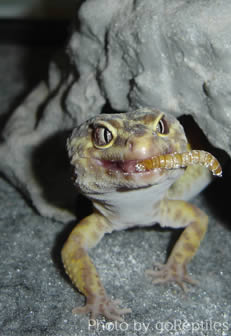
Bullying among geckos may be overt or covert. In some cases, the dominant gecko in a group can be observed attacking another gecko at random, or whenever the other gecko attempts to eat. Bullied geckos may have bite or scratch marks. A more subtle type of bullying occurs when the dominant gecko continually crowds the submissive one out of the spaces it chooses. In leopard geckos, this can be seen when the dominant gecko follows the submissive one from hide to hide and sits on it wherever it goes. A novice keeper may conclude that the geckos are “cuddling” when in reality the opposite is occurring. Geckos who are being bullied must be separated immediately. It may take the bullied gecko more time to to recover from the stress and begin eating, even after it has been separated.
Life Cycle
The most common cause of decreased eating is the normal variation in feeding due to the gecko’s life cycle and seasonal factors:
Hatchlings
Hatchlings do not need to eat during the first 3-7 days of their lives because they are still receiving nourishment from their pre-natal yolk sac. When they do begin to eat, it is not unusual for many hatchlings to start very slowly, only eating 1 or 2 prey items a day. Geckos that feed on fruit nectar diets, such as crested geckos, may not appear to be eating at all, since it’s impossible to tell whether or not they have touched their food. In addition to this normal slow start in feeding, some hatchlings take an even longer time to get the hang of eating and gain weight more slowly than their peers. Some hatchlings have medical conditions, not obvious at hatching, that will ultimately make it impossible for them to grow and thrive. Hatchlings which can be handled can sometimes be encouraged to eat by hand feeding: when prey items are fed, the keeper can hold the hatchling gently in one hand and press the feeder against the gecko’s mouth. Some geckos benefit from the keeper crushing the feeder and rubbing it on the gecko’s lips to encourage a feeding response. Nectar-feeding geckos will sometimes lick the food from a Q-tip. As a last resort, geckos can be fed a pureed “slurry”, developed by Marcia McGuinness of Golden Gate Geckos (http://www.geckoforums.net/showthread.php?t=19356).
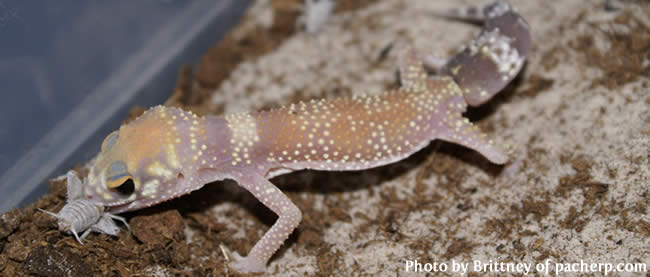
Juveniles
When young, juveniles often eat a tremendous amount and grow quickly. At a certain point, which likely varies among gecko species, rate of feeding decreases significantly as growth rate slows. This can sometimes occur suddenly and is perceived by the novice keeper as a “problem” due to the change in rate of feeding. As long as the gecko remains healthy and alert, this is probably a normal change. It is also an indication that it is time to change a daily feeding schedule to every other day or every 2 days.
Shedding
Many geckos do not eat the day or days before they shed. (Other geckos have been known to pause in the middle of shedding to “chow down”). Observe the gecko carefully to determine whether it is in the early stages of shedding and wait until a day after it has shed before considering other reasons for decrease in feeding.
Breeding
There are a variety of circumstances related to breeding that cause temporary decrease in feeding. Males often stop eating early in the breeding season as they become fixated on breeding. Females who are ovulating often stop eating. Even if geckos are not in the same enclosure, they may sense the presence of the opposite gender gecko and respond by ceasing to eat. Female geckos who are about to lay eggs often become too uncomfortable to eat in the day before they lay. In addition, female geckos who are relentlessly being pursued by a male may also stop eating, a condition more related to stress, which is addressed above. In most cases, there is nothing the keeper needs to do but wait until the conditions causing the change have ended.
Seasonal
Many geckos are sensitive to the change in seasons even though they are maintained in temperature controlled environments. These geckos may demonstrate a significantly decreased appetite in the fall and winter. Some “brumate” during the winter months and may not eat at all, choosing instead to sleep most of the time in a cooler part of their enclosure. For geckos which are brumating or “cooling”, temperatures may be dropped for at least a 6 week period. Food items may be withheld but water should be offered. Keepers should be aware of the possibility that geckos may decrease their appetite and observe them carefully to determine to what extent they will need to be fed during the winter.
In conclusion, proper husbandry, attention to possible medical problems and awareness of the natural life cycle of the gecko will most likely result in a thriving gecko and a less concerned keeper.
Leopard gecko photo by GoReptile & N. milii photo by PacHerp.

My gecko is well kept and gas been eating since I got them a year ago but now they have both avoided the mealworms I put in there cage. This has been going on for about a week and I am worried that they are starving themselves.
why won’t my frog eyed gecko eat i can’t figure it out she’s not shedding and i don’t think she is brumating but she won’t eat at all
I will respond the best I can, though you have to realize that I’m not a vet and I know nothing about frog eyed geckos. Based on the article I wrote, go through this checklist of questions and the answers should point you in the right direction:
–how long have you had the gecko? If it’s only been a short while, it may still be settling in
–are you sure you are keeping it correctly? A gecko living in the wrong conditions and not being supplemented correctly may look OK for quite awhile, but is actually slowly declining and won’t really show it till it’s in pretty bad shape. If you’re at all unsure about whether you’re keeping it correctly, read some care sheets.
–Is the gecko going through any “life changes” such as newly reaching the adult phase where it eats less, ovulating if a female? If so, it may decline in eating
–Is the gecko normally active and still looking as if it hasn’t lost weight? If so, it may be OK. I have geckos (some of my day geckos) that I have never seen eat, yet they look as if they’re thriving. I have leopard geckos that I know haven’t eaten much of anything in months, but they haven’t lost much weight either.
Hopefully, these questions will help you figure out if you have a problem or not. If there’s an indication that you have a problem, you should consider a vet visit.
I just took my leopard gecko juvinile to the vet. She hasn’t eaten for 1-2 weeks and lost a lot of weight. They gave me parasite antibotics for 2 different parasites she may have and pain meds. The pain meds are because her belly is bruised. She unfortunatley was trapped uner a rock and may have injured her belly and so she may not be eating. The vet was not too expensive considering all the medication. But may give you an idea of what to do. I hope she will live.
hi, i just got my gecko a wwk ago and he is not eating at all. I put crickets in there, the small ones for him. I change his water and take out any dead crickets too. the temperature is at 80 and goes up to 90 during the day. I cahnge to a red bulb in the night. Even though i do all this, he still stays under the wooden block all the time and he looks a bit thinner. im really concerned about him, hopefully its just his new home taht he needs to get used too.
Our leopard gecko is also a juvenile and is not eating. We got him 2 1/2 weeks ago and has barely eaten anything. It seems only the minimum to stay alive, but he is very thin and seems tired all of the time. I’m very concerned.
If you got your gecko from a large chain petstore, there’s always a chance that it wasn’t in such good shape to begin with. In that case, you should contact the pet store about returning it or find a reptile vet to take it to. If you got it from a breeder, contact the breeder to see what may be going on with it.
I am a bit concerned. I purchased two beautiful adult leopard geckos 3 days ago, both of which are gravid. I did plenty of research before deciding to own leopard geckos and was well prepared, having the tank set up with everthing they need, even a special spot to lay their eggs. Anyway, they have not eaten yet. I have offered crickets everyday and neither of them seem interested at all, so after about 20 min or so, I remove the crickets so they will not bother them. I also have a mealworm bowl in their home that I have kept supplied with medium – large mealworms. Still, there is no interest. They have moved about the enclosure from the warm to the cool side and between different hides. I am especially concerned with the female who is a bit smaller than the other. She is not hiding all the time, like the other, but she just lays on the warm side out in the open and when she does get up to move seems very slow and lethargic. She does not seem scared at all when I put my hands in to feed or moisten the paet moss. I have read that it can take a little while for them to get used to their new home, but any suggestions on how I can get these mommas eating?
i got my golden gecko a week and 4 days ago and it has not bin eating its crickets and am afraid it will die its only bin drinking water but only a little pleas help dont know what to do
ive had my tokay gecko for about a month and a half now, he used to eat reguraly but now has stopped and hides in his rock mostly. im not sure if its the seasons changing or if im doing something wrong. i constantly spay tropical mist in his habitat and feed him every other day. can you email me or tell me what you think the problem is?
Many geckos slow down in winter. Most of my leopard geckos are barely eating. I’m not familiar with Tokays, but I’d imagine that if your husbandry is correct and he’s not losing weight or showing signs of an infection, he’s probably fine. If you see other indications of poor health, contact a vet.
I just got my new leopard gecko 3 days ago its a juvenile and is always tired and won’t eat meal worms or anything just crickets, which it can’t even catch because its always slow and tired. I’m really worried, its a beautiful gecko with nice stripes and colors, i don’t want it to starve. 🙁
This was very helpful, my gecko wasn’t eating and i didn’t know why.
My Gecko is not eating and it was just shedding before and we offer it food and everything but just worms not crickets also there is a white colored thing thing coming out of its mouth I thought it was just sheded skin by its mouth and they told me to take it of because it almost was off and it just kept on coming
The gecko sometimes swallows a long piece of skin and if there’s a piece sticking out, when you pull it, the whole thing will come out. It’s not a problem. Many geckos don’t eat in the days before and after they shed.
i know that my lizard wont eat which probablay means that he is dying<3
My giant day gecko just ate 2 little rocks!
Any idea why a day gecko would eat a rock or 2?
Im lost hopefully it doesnt hurt her and she poops it out
It may have thought the rock was something else, or was trying to get something else and got the rocks by accident. If there are rocks small enough in the enclosure for the geckos to be able to actually eat them, they should be removed (the rocks, not the geckos).
Have had my leapoard gecko a year and tree months started out as a baby , just sheded for the second time he stopped eating before the shed and has completed the shed has not eaten for at least a month is this normal? Other then that he is drinking water does not look like he has lost weight but eyes seem to have a film on them.
My granddaughter got a leopard gecko for Christmas that my son got from someone with the tank. We got it a better tank and it was eating meal worms (which is what we were told to feed it.) just fine and than it shed at least 2 weeks ago and has turned it’s nose up to them ever since. She has only had one bowel movement which was last week. She seems to be the same size but I’m worried that it may be sick. I called a vet and they wanted $50 just to check it out which I don’t have right now. Is there any thing or things I can do to help it?
I got a gecko about two years ago but ever since this past Christmas she hasn’t been eating her mealworms and I am worried that she is sick because she has grown very skinny. Her tail is very thin. She has also been up more in the day and has been sleeping almost the whole night. She’ll eat her crickets that I give her but she won’t touch the worms. Is this just a seasonal thing that she’ll do in the winter? Because I don’t have the money right now to bring her to the vet. Is there anyway to fatten her up, get her to eat the worms, or at least get her more active than she is now at night? If u know anything just reply.
Please I am desperatley worried and I have no idea of what to do.
If your gecko doesn’t want mealworms but wants the crickets then the best thing to do is to provide crickets. It’s possible that the gecko is getting skinny because it’s not getting enough to eat, though many of my geckos aren’t eating right now and have not lost weight. It’s not unusual for geckos to eat less during the winter and for female geckos, in the early spring when they start ovulating, to eat less. It’s not normal for them to lose a lot of weight. I have no idea why she’s more active during the day but there’s nothing you can do to make her change her habits. I recommend you switch to crickets and see what happens. If she keeps losing weight then she’s probably got something wrong with her, like parasites or impaction and she will need to go to a vet in order to get treated. There’s just nothing else that will work. If she’s being kept on sand, you should get rid of the sand in case she has gotten impacted from eating the sand.
My geiko’s went blind and are not eating, Help
Hi I have a handsome African Fat-tailed gecko,I got him for my 16th b-day last month but he hasn’t been eating lately,he’s a good weight but he looks like he’s been living off the fat in his tail. I know it’s breeding season but I just want to make sure before I take him to the vet and find out he has a parasite or something. So I thought I’d research it first,I would appreciate a response.
The easy answer is to take them to the vet. Otherwise, you need to send more information and details but the response will probably be “take them to the vet”.
Here are the basic steps you should go through:
a. Make sure your husbandry is correct (proper floor temps, humidity, appropriate supplemetation)
b. See if he’ll eat if you hold him and gently push a feeder at his mouth
c. If none of this works, take him to the vet
I got a gecko from my friend because she was moving and she said that he was not eaten and this was going on for a month and that she been hand feeding him and would put the food down his mouth but now I had him for another month and he still wont eat willing I have been doing the same to keep him alive
You could try putting him in a small tub in dim light with some mealworms or crickets for a short time and see if he eats any. Try this for several nights and don’t feed him for a day or two so he’s hungry. If he’s losing weight and doesn’t look well, he’ll need a vet visit.
Hey, I just got a leopard gecko about 2 weeks ago. When I first got buddy he seemed fine, buddy was eating normal, and walked fine. He started shedding normally but after buddy finished shedding he hasnt ate in a week I am very worried all I want buddy to do is eat !!
PLEASE HELP !!!
One more question , I want my leopard gecko to be active more want can I do to make buddy active ??
My gecko is not eating at all.its been like 5 days since shes eaten.i tried buying her meal worms,wax worms,and crickets but none has worked.her tail has gotton way smaller. But i noticed that the other day she has started to act strange.i put my hand in her cage to see if she was okay then she bit me,she normaly never bites ever.her tail then started to mave around very quickly.i cannot afford to bring her to the vet.Any ideas? I am very worried and scared, i dont want her to be sick or die.somebody please give me some ideas!!please!
If the geckos still alive there is a Appetite /spelling/ Stimulite u can buy at the Local PetStore. Hope this helps and let us know how she is currently doing and if the Spray helps, let us know that too.
JC
Small hobbist
10 chameleons
5 Fliers
1 Albino King Snake
1 Pink Toed Trantula
1 Black Emperior Scorpin
Your gecko may be impacted with seminal plugs. Look up hemipenis impactions to see what they look like. The tell-tale sign is it looks like there’s a little bit of poop sticking out of the cloaca. Put some vaseline or oil in the dirty area and massage the base of each lump between her legs, one side at a time, and use your thumb or other hand to open up the cloaca. If the plugs don’t pop out, use a paper towel and wipe upward while pressing at the base. Don’t be afraid to be firm. Takes about 5 mins.
My african fat tailed gecko is not eating. She does not even get interresed. We had her in 3 days she has eaten 1 cricket the first day, but not anymore. D:
It’s not unusual for a new gecko to take awhile to settle in and eat. I find that fat tails especially can go off eating at the drop of a hat. Give her a few weeks more; she won’t fade away from not eating for awhile. Keep offering. If she doesn’t eat in a few weeks, you can hold her and gently push a cricket at her mouth till she bites it and eats it. That sometimes gets her “jumpstarted”.
Its a 8 month’s old african big tail.Do you think I shall try mealworms instead?
I try to put them into her mouth, but she denied it :’C
Going to give her a bath since just found out that you cant have sand in the cage since the pet store told me to and they dont know a shit i just found out.
So she might got something that stopps in there, but thx for the fast answere, best site ever xDD
I have had my two gecko’s for over a month and there have been a few times that the dark spotted one turns very light in color. Before putting the crickets in the cage I do sprinkle them with the calcium power and I get them from the same pet store. I do not have a moister bed for them… is that something I should have??? I got them as baby’s and I’m not sure when they will be shedding. I have paper towels on the floor of the aquarium and change them one a week… is that too long or should I change it twice a week. I am getting ready to move them from a 10 gallon to a 55 gallon and want to make sure they handle the transition in good health. I have heard that “Calcium Sand” is the best in case they digest it… can you give me insight on that??? I am in this for the long haul and want the best for my two gecko’s. Thank you in advance.
Your geckos have probably already shed overnight when you didn’t notice. When the dark one gets very light in color, it’s probably ready to shed. They will benefit from a humid hide because it gives them more choice of habitats and can aid in shedding. Make sure you’re sprinkling the crickets with calcium powder that has vitamin D3 in it and get some vitamins as well. If the paper towels are in good shape after a week then once a week is fine. Do you know whether your geckos are males or females? Please try to find out if not. If they are anything but 2 females you should not keep them together to avoid too early breeding (male + female) or fighting (2 mature males). Calcium sand is not the best because they get easily impacted and it does not get digested. I recommend ceramic tile but paper towel or repti-carpet is also OK. You can read my care sheet for leopard geckos on my personal website here:
http://geckcessories.wordpress.com/leopard-gecko-care-sheet/
I have had my leopard gecko for over a year now, and we are very close, but about a month ago she stopped eating. She has gotten very skinny and her tail is very thin. I am very worried about her. About two weeks after she stopped eating, she grew film covers over her eyes. please help!
As I said in the article, not eating is usually a symptom rather than a problem. The film covers over her eyes are either due to poor shedding or an infection. At this point, the only thing you can really do is to take her to a reptile vet. You can find one by looking online or calling your local regular vet and getting a referral. As far as why this happened to begin with, it may be that you weren’t given the proper information about what to provide for her. In general, that includes the proper heat, substrate (what’s on the floor of her cage), and vitamin/mineral supplements. Here is one caresheet you can read to find out about these things:
http://geckcessories.wordpress.com/leopard-gecko-care-sheet/
Good luck with her.
Hi I understand that it takes a little while for Leos to start eating after being transferred, but I purchased 2 female geckos that are approx. 4 months old 4 days ago and thy are not eating any of the mealworms put in their cage. One of them is smaller than the other should I be worried. I checked the surroundings and have one moist hide half on hot, half cool, one dry hide on cool side, water and mealworms dish on cool side and heat tape 95* on the hot side. They seem to take no interest whatsoever in eating.
It’s not unusual for some geckos not to eat for as much as a week or more when moved to a new environment. Another important thing to take into account is what they were fed before you got them. Many pet stores feed both mealworms and crickets. It could be that these two were only eating the crickets. You could always try a different feeder that moves around more. That might do the trick. I have been feeding my hatchlings mealworms and the ones I keep to adulthood usually get tired of mealworms and switch to superworms or crickets. Good luck with them.
We have had our gecko for about 5 months. He has been great. About a week ago he shed and it was hard. We had to help him a little. He hasn’t eaten in about 2 weeks and has changed. He walks in circles and tries to eat but misses the mil worms. We have offered him wax worms to try to fatten him up because his tail is getting thin. I’m afraid our other gecko is taking all the food so we separated them. Also to see if he is pooping. What do we do?
My African Fat Tailed gecko has not been eating for about a month and a half. He just shed throughout this past week but i’m getting worried.
Hi. I have a leopard gecko that I got in mid August. He has always eaten fine. About maybe 3 weeks ago, his eating habits slowed down from every day to every other. Last Wednesday, he stopped heating all together. I have tried soaking him in some warm water for 10-20 minutes but that hasn’t helped. Yesterday I did a bunch of research and tried assist feeding him. I was feeling better because he ate two meal worms (with assist feeding) but went to check on him today and saw that he did not keep them down. I have no idea what to do now, and I’m really worried about him. If you could help at all that would be great.
i dont think my gecko is bullying the other but sometimes she does follow her and ”crowd” her on the heating pad, is that bullying?
she’s also not eating, i did just get them so its probably that, but im concerned that it may also be that the gecko is to small for the crickets.
One gecko following another around and crowding it is definitely a sign of bullying. Also check for scratches on the “followed” gecko. It’s not unusual for geckos to take up to a week or more to start eating again in a new environment, though if they are very young, they should eat sooner. How big are your geckos? I’m feeding regular size crickets to geckos as small as 12-15 grams. Keep an eye on them and if the situation doesn’t improve, consider separating them. If they’re so young you don’t know the sexes, you should have an extra setup just in case anyway.
My two leopard geckos are not eating. I had the for almost a year and everything was fine. Then about 2 days ago I found out they were both males and separated them immediately. One of them was being bullied. I have sand as a substrate in both enclosures. They also both have not shed for a while. In all their life I think they shed once.They have a moist box and a cool hide by the way. A response would be nice.
It’s likely that the geckos may not be eating because they’re getting used to being in a new space. Even the one that may still be in his original enclosure has had a change since the other one isn’t there. It’s not unusual for geckos to eat less or even nothing during the winter. I have a number of geckos who are barely eating. It’s a big issue with mammals because they need calories to maintain their body heat as reptiles don’t. There is, of course, an outside chance that they are impacted from ingesting sand. If you do plan to continue keeping them on sand, play sand is recommended; calcium sand is not (despite what the pet store says). I recommend that you be sure their floor temperature on the hot side is in the low 90’s, continue offering food and give them some time. If they start to visibly lose weight then it’s time for a vet visit. Most of my geckos who aren’t eating continue to be at healthy weights.
This is very helpful. Thanks!
My daughter’s gecko, she has had now for 9 months now. During that time the gecko has shed and has had a very healthy appetite. However for the past few weeks the gecko has hardly eaten and we are worried. What exactly is the cycle thing?
The “cycle” refers to ovulation (which can be seen as a pair of pink spheres in the gecko’s belly). For most leopard geckos, the ovulation and breeding season is in the spring and summer. They tend to ovulate continuously for several months. Your gecko is old enough to be ovulating and some geckos do reduce their eating significantly. My best suggestion is to keep offering in the hopes that she’ll eat when things stabalize and to find a reptile vet if she loses a significant amount of weight.asq
When my AFT was about a year old he lost his tail, he has been on a pablum from the vet ever since. My friend adopted him from the pet store that we are groomers at, and after a year of force feeding him I took him in. I have had no luck with feeding him. I’ve had him for over a year and now he won’t lick the pablum off of him nose anymore, he seems to “snap” at the syringe now. I leave meal worms, fruit flies and delegged crickets in his tank all the time just in case he wants them but no luck. He has lost so much weight in the past 4monthz and I myself have been injured and am on compensation so I can’t take him to the vet. I feel horrible like he’s given up! Please help I feel so inhumane watching him starve and force feeding him
If he’s snapping at the syringe, try poking a mealworm or cricket at his mouth instead of the syringe. Maybe he’ll snap at that and eat it. Also, remember that sometimes the gecko is just in bad health in general and the lack of eating is just a symptom. He may not be one that you can save.
Aliza
my gecko was attacked by ants and now she is not eating her color has changed from bright yellow to a dull gold she hasnt eaten since wednesday what shall i do? i believe she was drinking water as i seen her in her water bowl but not eating?
Did the ants bite her or just infest her cage? Are you living in a place where there’s a heat wave on? These are 2 things that could make your gecko temporarily stressed. It’s not unusual for a gecko to stop eating for awhile. If her color has changed, it’s likely that she’s getting ready to shed and that’s why she’s not eating (she’s probably shed before if you’ve had her for more than a month but it may have happened during the night). Watch to see if her color gets bright again (after she sheds). Keep offering food and try not to worry if she doesn’t eat for a few days. Consult a vet if you notice: wounds from the ants (not too likely), severe weight loss (tail getting skinny).
My daughter has an African Fat Tailed Gecko, the temperatures in the cage were low for about a month or so, the gecko has a sore of his mouth, the bottom, and he has lost a significant amount of weight. We are putting crickets in the cage every couple of days, and it appears that they are just dying. There is no reptile vet in the town I live in, and I am unaware of what to do… The gecko also with open his mouth frequently as if it is taking long breaths… I don’t want her pet to die… Please help!
From what you describe,the gecko is probably beyond home remedies. Check this website for a reptile vet near you: http://arav.allenpress.com/arav/findavet
I’m hoping you can maybe help me? My gecko has not eaten in about a week. He looks at the mealworms/waxworms, pokes them with his nose and then just leaves them. There has been no change in temperature, environment, handling, ect. He shed last week. He had a sore on his mouth, but we took him to the vet for it and now it’s completely healed. Any ideas about what it could be?
My son got a young gecko for his birthday in August. he was doing well eating and growing. it in now October and the gecko has stopped eating and only wants to sleep all the time, I am very worried he is nothing but bones. nothing else is different, I am really worried about the little guy. I try to feed him but he just goes to sleep. could this be the bromate thing?
We got a gecko about 2 weeks ago, who is a young adult, and was shipped. He seemed great at first, and looked like he got bigger after a few feeds of crickets in calcium. After escaped crickets, we changed to mealworms. We have an under tank heater, temp varies more than I would expect. and wondering if thermometers accurate. We do have warm and cold side and hiding places. We read to clean cage regularly, so we put him in holder tank 2 days ago and cleaned it and put him back in regular tank. He had 1 good feed after that, but now, he seems not himself, wasn’t really hungry yesterday, and pooped and peed a LOT in the Tank, Now seems kind of listless, not hungry, curled up in a hide. Temp in his area reads 93, I’ve seen it from 91 to 100. Any suggestions or ideas?
Get a digital thermometer with a probe to monitor the temperatures if you don’t have that kind already (under $10 in most pet stores). Get a thermostat for your heater if you don’t have that already.
Many adult leopard geckos eat less and sleep more in the winter. Keep offering food every 2-3 days. Unless there is considerable weight loss, the gecko is probably fine.
hi, my gecko Simba hasn’t been eating its been almost 2 weeks I have crushed up mule worms, he is licking it but he’s not eating crickets or anything, but on a good note my other one in the same tank is eating perfectly fine. what should I do?
The first thing to do is to separate your geckos for awhile and see if the one that’s not eating starts eating. Some geckos just don’t eat much during the winter and generally also don’t lose much weight. Some geckos, even if they’ve been together for awhile, can get into bullying situations and the one being bullied won’t eat. You call one of your geckos “he”. If it really is a “he” and if both of them are males, they should be separated anyway or you may find yourself with only one live gecko.
We have returned our Leopard gecko to Petco twice cause it stopped eating both times. But the second time its bones looked like jelly, very soft and wobly. She just ahead and now looks a different color than when we got her. I was told at Petco she needs a uvb light. But at Petsmart I was told that is not necessary since geckos are nocturnal and do not need uvb. I have a heat lamp and moss for humidity. She looks a yellow color and was a gray color before. Do you think I’m taking care of her OK?
There are several issues here. Generally, UVB lights are not recommended for leopard geckos as Petsmart indicated. However, they do need calcium and vitamin D3 (usually supplied by UV light) to metabolize the calcium. This is usually provided in powder form by dusting the feeders. Failure to provide both these elements will result in Metabolic Bone Disease and the gecko will seem soft and wobbly.
When a gecko is ready to shed, it can look “frosted” or grayish. Once it’s shed, it looks bright again. Sometimes the whole thing happens in the course of a single night and the owner never knows the gecko has shed. Sometimes the gecko looks dull or frosted for several days before shedding.
Please go to my personal website (http://geckcessories.wordpress.com) click on the “care sheet” tab and read my entire care sheet. It describes what you need for a leopard gecko and why, as well as what you don’t need and why.
My leopard gecko will no longer eat after a horrible shedding. We have has her for 4 years and never encountered this before.Typically she will shed with no problem; the last two have been rough for her. This last one more so, it left skin over her eyes. we tried to assist her in removing it and she wasn’t having it during this shed and currently she will not eat. I almost feel as if she has suffered eye damage or something from the skin that blocked her vision. They are black looking from what I can see, she don’t keep them open long. Idk if that’s even possible. I know she use to be fat and rambunctious not she is skinny and barley doing anything. She has not eaten in almost 3 weeks. she does drink her water and go into her hut. She lounges under her light as long as it is on.
I am worried of my gecko his new i just got him last month but until now he is not eating i need your help his a male and whants his problem thanks he is gonna die?
I need help my gecko doest eat for a month i just got for a month but until now he doesnt eat yet whats his problem? He is gonna die?
There have been a lot of questions recently from people with leopard geckos who aren’t eating. I feel a lot of the answers are in the article, but, once again, here is a brief summary. If you have concerns about your gecko not eating, do the following:
1. Make sure your temperatures and supplementation are correct. If you’re not sure what this should be, google “leopard gecko care” and read several care sheets
2. Many adult leopard geckos eat less (or not at all) in the winter. As long as the gecko is not losing a lot of weight or doesn’t have a visible infection or illness, it is fine if it doesn’t eat
3. If your gecko is losing a lot of weight, has problems opening its eyes or sores on its mouth, you must take it to a vet to get it properly treated. You can find a vet near you by looking at this website: http://arav.allenpress.com/arav/findavet
I hope this is helpful.
I just wanted to thank you very much for the information I have found on your pages. I am trying to help a coworker with his leopard gecko, a very handsome young critter, who has stopped eating. My coworker felt so much better after reading that it might just be because of the winter coming on. The gecko seems very healthy in all other respects. Thank you for putting this information out there for us to find, as my coworker was becoming frustrated and upset thinking he might lose the gecko to illness or starvation.
Thanks for your comment. It’s nice to know I’ve been helpful.
Hi! I obtained a new adult female leo in September whom had a smaller tail in proportion to her body than the two younger leos I already own. she is in her own habitat and we are very carful about making sure temps and everything is always spot on. We noticed though early on that she doesn’t eat very much. Seems to have no interest in mealworms or crickets and will eat once in a while. More often than not she’s curled up in a hide on the cool side of the tank. Its the end of Nov now and I She weighs 7.23g less than her weight of 54.4g on Nov 5th. I caught her puking up a mealworm and over the past months we’ve noticed that once in a while there will be like this big clump of mealworms all stuck together and if you touch it it breaks apart super easy, seeming to be made of just shells. Any idea what is going on with her?
I would say a gecko like this needs a vet visit and should be kept quarantined from your other geckos: handle her last and wash well before and after handling her.
Hi, I have two geckos, both female. It’s a complicated story so I’ll start at the beginning: I got my first gecko about a year or two before we moved. Once I moved, I got another gecko who was about a inch or two bigger than my first. After she came, my smaller one started getting bullied and my bigger one was also eating all the food. I separated them for awhile before putting them back together where they did fine. A few months ago I noticed that the bigger one stopped eating. At first I thought it was the change in seasons, but she now spends all her time by the heating pads. Here’s what’s confusing me though. Now the bigger one has lost a good amount of weight and the smaller one has gotten remarkably bigger. I haven’t seen any bullying, but I will separate them anyway. Is there anything else I can do?
Start by separating them and if weight loss continues, take a fecal sample with the gecko to a reptile vet.
I have had my male gecko for about a year now with no problems before. It is winter here so it is cold in the house but how tank stays at required temp high 80s and 90s. For about a week now he refused to eat or even go near his food. He drinks a little bit not as much as he normally does. He has shed during this time but still wont eat. I’ve held him but he acts very scared which is not normal either. He doesn’t move from his hide much except for when he is trying to climb the tank walls. I’m worried about him. His tail and body looks healthy.
This is normal winter behavior for many adult geckos. It’s not necessarily the heat as much as the change in light, I think. As long as he isn’t losing a significant amount of weight he’s fine. Some of mine barely eat for months. Check out this other Gecko Time article for some confirmation: http://geckotime.com/the-yearly-cycle-with-geckos/
my gecko has not been eating for about 3-4 days and has been sleeping by my half rock against the glass and does not want to eat anything
This is not surprising behavior for winter. As long as your gecko is not losing a lot of weight, just keep offering food periodically and don’t worry about it.
ok thank you ! merry christmas
I have a female leopard gecko. She has been with us for about a year. She has eaten well, laid eggs about 6-7 times over the past year, and has shed at a semi-regular interval. Currently, she has not eaten in 6 weeks, We have our own meal worm farms, in which she used to eat 4-8 per day. Her eyes are mostly closed – not covered with a film that we at least can see- but almost closed to a slit.Any suggestions?
If she were acting normally except for the eating, I’d say that it’s just the winter slow-down. If she seems more lethargic then I’m afraid she will need a visit with a reptile vet.
My geco is not eating my meal worms and crickets
Read the article if you haven’t already. Read the sequel here: http://geckotime.com/my-gecko-will-not-eat/.
There’s a good chance there is information in the articles that will help.
If not, send more information about your set-up, type of gecko and what behaviors you’ve noticed.
Many geckos stop eating much in the winter but maintain their weight.
If the gecko is losing weight, think about a reptile vet.
Help pls, My Tokay Gecko i caught 3 days ago and just a while i try to feed it with cockroach. It seems he refuse to it, and i just put him inside a small cage? what im curious is how long a gecko will survive. And i tease the gecko about everyday like try to point my hand at him and try to bite could it be he`s angry or somewhat?
Hi, Our gecko has gotten a very thin tail and hasn’t been eating her crickets. She also doesn’t open her eyes much. We have had her for about 15 years. I am wondering if she may just be at the end of her life span. She also seems very lethargic and seems to just want to sleep.
I’m not an expert, but it does sound like she’s ready to go.
Hi,
I am looking for help and advice on my Leopard Gecko Tiger who has stopped eating now for 2.5-3 weeks.
His eyes are near enough closed and he wont keep them open. He is not eating and i think this may be the cause also.
Any advice or help would be grateful and if you need any more information do email me back.
If this is something you cannot help or advice on then I do apologise for sending this email.
I have been to the vets where he was checked out. I was told he was ok and that as he has not been eating, the fat from the back of the eye has been used and therefore eyes have been sunk in. I am not too sure and therefore took him again to a different vet for a second opinion last week.
The vet saw skin in his eyes which he has taken out, flushed his eyes and gave me antibiotics drops to use twice a day. It has been a week now and he still wont open his eyes completely. I will be taking him to the vets again however need some advice.
His tail is still fat, however I am concerned it will start getting thinner the longer he does not eat.
Thanking you in advance
Regards
Sam
Please help! My son was given a baby Leo just over 2 weeks ago and he hasn’t eaten anything since getting him. At first I wasn’t to concerned thinking he was just getting use to the new place but he’s now losing weight, his tail is becoming thin and his poo now a light brown liquid with something white in it that kind of resembles bird poo. He’s been sleeping a lot more than normal the past couple of days but still has fight in him he tries to resist being handled.
Hi
I’ve had me Leo since March 2014, he’s (actually she’s) always be active and happy to eat, but since November he’s been eating a lot less and shedding way more frequently, almost fortnightly, today I noticed he had vomited the worms he had last night, normally I feed dusted crickets but let him have 3 wax worms last night as he just didn’t seem bothered with the crickets. His tail is still nice and big, I feed him every other day, he has been going to the toilet. Could it just be because it’s winter? At the begging of November my heating broke which caused the temp to drop to low for a day, and he’s not been the same since.
Changes in the environment, including temperature can cause temporary decrease in eating (but not one that happened 3 months ago). Winter also causes some geckos to eat less. If your gecko was a hatchling last year, she is probably old enough now to be ovulating and for some geckos breeding season has started. Some ovulating geckos eat less. If she visibly loses weight, take her to a vet, but if she continues to act the same except for the eating, she’s probably OK. Don’t let her get too dependent on waxworms; they are fatty and not that nutritious.
Hi. We have had our leopard gecko since the start of December and 2 months on I have still not seen him eat. He is about 6 months old and is still small and thin. When we try to feed him with meal worms or crickets with the tweezers he just licks it and turns his head away. He is however active around his viv so maybe he eats the mealworms on the night time when i dont see him. Could u give me some advice please and should i stop handleing him for abit ?
There’s a sequel to that article here: http://geckotime.com/my-gecko-will-not-eat/ which may help.
The questions to ask yourself are:
Are the temperatures in the cage correct (low 90’s on hot side floor, not air)?
Are you using sand (if so, the gecko could be impacted)?
Are you finding poop in the cage (if so, the gecko is eating)?
If you got your gecko from a big chain pet store, there’s a chance that the customary stress and overcrowding has caused its normal parasite load to increase. In this case a vet visit is required. You could also try crickets or super worms. Some leopard geckos get bored with mealworms.
Hi my name is Eriana I had my juvenile leopard gecko since June of last year. Recently he hasn’t been eating in the past 2 weeks and i’m getting really scared. The funny thing is he still poops but doesn’t eat, i feed him mealworm and sometimes super worms. Right now his substrate is sand ,i given him calcium and D3.I use a heating pads and i have l UV lights that also use. What should i do ? Should i take him to the doctor ? Change his food intake ? ,Should i change substrate? Please if there’s any advice that you can give me, or a doctor you would recommend I would be forever so grateful.
Many geckos, once they become adults, don’t eat much in the winter. I have a number of leopard geckos who are barely eating. As long as his tail isn’t getting a lot smaller, he’s probably fine.
Thank you so much , but what happens if his tail gets smaller ?
If it gets a lot smaller, you should probably take him to a reptile vet. You can find a vet near you here: http://arav.allenpress.com/arav/findavet
Have had gecko for 2 months i canged her food from locusts 2 mealworms next day she wont eat anything #HELP
Maybe you should go back to locusts. It’s not unusual for a gecko to stop eating for awhile, especially at this time of year. She will be fine if she doesn’t eat for awhile, but she may not like mealworms.
We took ownership of an adult Leopard Gecko 10 days ago – we gave her a couple of crickets after a few days, which she did not eat, and after leaving her alone for a further five days, we cleaned out her vivarium ( because it stank ), placing her ( ..I think with minimal stress.. ) into a cardboard box . Once the vivarium was cleaned out, and she was repatriated with her surroundings, she was very lively – climbing about and even sniffing and occasionally licking my hand… But since then she has gone extremely quiet. She has hardly come out of her new cardboard house which I made her – she had’nt much shade before … and I don’t think she’s eaten even one (chilled and dusted) cricket , nor any of the mealworms we’ve put in there for her .
Should I be worried that she’s not eating ? Am I making any stupid mistakes …. ?
Please help.
It is pretty normal for a gecko in a new space to be very curious and check things out and to then seem very lazy and stay hidden. It is also not unusual for a gecko in a new situation not to eat. Some adult geckos eat very little during the winter and some female adults eat very little when they are ovulating (and we’re at the beginning of that season).
As long as your husbandry is correct (in general floor temperatures in the low 90’s on the hot side, measured with a digital thermometer with a probe, no sand) and the gecko is not visibly losing weight in most cases it’s fine. I’d recommend the following:
1. read care sheets (mine is on my website: http://geckcessories.wordpress.com) to be sure you’re doing things correctly
2. keep offering food
3. if the gecko is visibly losing weight, take her to a reptile vet to be sure there isn’t some other problem.
Hi my 6 month old leopard gecko has stopped eating he still looks happy and healthy but will not eat crickets or locusts he shakes his tail to go for them but just doesn’t is this normal its been about 5 6 days since he last eat properly is this normal please help
They can go for quite awhile without eating. If your gecko has gotten to the 25 or more gram level, it may not be as hungry. If you’re feeding it every day, go down to 2-3 times a week. If it starts to look as if it’s losing weight, take it to a reptile vet. Otherwise, just keep offering and give it some time.
OK thankyou I’ll try this and let you no thanks again
Hello my leopard gecko stopped eating since last week.I don’t see he’s going to shed,and the temp is 80 Fahrenheit . Please I don’t want him to die help me Answer me as soon as possible.
Geckos sometimes don’t eat for awhile. They are usually fine. If the 80 degree temperature is on the floor on the warm side, it’s too cool and should be more like 90. If the 80 degree temperature is in the air, it’s probably too hot. If your gecko is female, she may be ovulating and may not eat for awhile. She’ll be fine. Read the article again and follow any advice that seems to apply to your situation.
My gecko is about 3-4 months old and he hasn’t eaten in about a week. I offer him wax and meal worms twice a day and he turns away from them. He use to love eating. He spends a lot of his time in his den or under his tree. I’m very worried about him. Should I bring him to a vet?
There could be a number of reasons why your gecko isn’t eating:
–He may have reached the size and weight where he doesn’t need to eat as much: try offering food every other day (and consider eliminating the waxworks)
–He may be bored with the mealworms: try superworms or crickets and see if he eats
The two situations above are most likely what’s going on, but here are more possibilities:
–There may be something mildly wrong with the set-up that is having a cumulative effect on him: read care sheets to be sure you’re doing things right. In general make sure the ground (not air) temperatures on the hot side are in the low 90’s and that he’s not on sand
–For some reason the gecko may have an elevated parasite load: take him to a vet
It certainly never hurts to take the gecko to a reptile vet, who can review your husbandry and decide if any treatment or change is necessary. You could also try the less drastic changes first.
I want to buy a baby leopard gecko what are the vest websites to order from or breeders in UK thanks
I have a baby gecko that I had for some time now, she used to eat every night that I gave her a certain amount of food (10-12) crickets. But now it’s been 2 days since she hasn’t ate. I make sure I don’t hold her 2 much (her crawling on my hand) so she doesn’t get freaked out. I’ve checked and she’s not sick rather. Could this be just a molting process about 2 happen?
Please help.
Not eating for 2 days is not a problem necessarily. SHe may be getting ready to shed and she may be getting to the size where she doesn’t need to eat every day. Just keep offering and don’t worry.
Does anyone no of any reptile vets near Gosport Portsmouth area have been looking but can’t find 1 thanks
You would need to be more specific about your location. I don’t know which Portsmouth this is and don’t even know which country it’s in. In general you can find a vet here: http://arav.allenpress.com/arav/findavet
My son has a Gecko who is over a year old maybe closer to 2 years. She has not ate in almost 3 months. She looks healthy and is she coming out during the night. She has also shed about 3 times during this non eating period. We do keep water in her home at all times. She has also pooped during this time. Not has much by any means but she has. I have only had furry animals so not sure if this is normal for a gecko.
I have found that some geckos eat much less (or not at all) during the winter. Some females eat less or not at all when they’re ovulating. If her tail doesn’t look thinner, then she’s probably OK. Just keep offering. If her tail starts to look think you will need to take her to a reptile vet.
My gecko hasn’t eaten anything since November of last year and it’s April now. I’m so worried about him and I have no idea why he won’t eat. I try to feed him, but he just won’t eat. He still sheds and doesn’t really have any alarming symptoms except lethargy..does anyone know what’s wrong? He won’t eat anything I offer him.
I can only tell you that I have one gecko that also frequently doesn’t eat in that period. I don’t think it’s that usual. I can’t guarantee that it’s not a problem. I’d recommend to start with checking your husbandry (non particle substrate, floor temp in the low 90’s on hot side, air temp not above low 70’s most of the time) and then consider a vet visit.
We just got a juvenile Leopord Gecko, it’s been 5 days without eating. We tried crickets and butter worms with no luck. Getting very worried, we even placed the bugs right in front of the Gecko. Feeds are at 8:30pm temp at 86f in the day and 74f at nighttime 30% humidity.
Are you measuring temperatures on the floor of the hot side or in the air? Generally temperatures should be in the low 90’s on the floor (as measured by a digital thermometer with a probe, not one of those round analog thermometers that stick on the side of the tank). Ideally, air temperatures should not be much over low 70’s most of the time. Did you get this leopard gecko from a big chain pet store? Often the leopard geckos at these big stores are not in good shape, especially if they are very small. If it’s very small with a pencil thin tail, please return it to the store, because it probably won’t live long. If it’s bigger and its tail is decently thick, it will more likely be OK. You may need to take it to a reptile vet (which is what I had to do with my first gecko that I got from a big pet store). To find a reptile vet, look here: http://arav.allenpress.com/arav/findavet
Hey i have a leopard gecko that i thught up untill about 2 weeks ago was happy and healty but ive been going over the forums and by now he should have at least grown another inch or two and his tail should be a little thinner than my thumb but he hasnt grown at all in the year that ive had him. ive never noticed him sheding or anything. hes about nine or ten months old. ive looked at every problem from every angle i can think of but i havent seen him eat anything in at least two weeks, and he acts like hes weak. his tail only about as thick as a number two pencil and i know hes not impacted because he pooped yesterday but i dont see how because im 90 pecent sure he hasnt eatin anything. i even put him in a little warm water to help with impaction if that was the problem but he didnt like that at all he acted like he was to weak to keep his head out of the water if you have any thoughts please reply.
I really think you need to bring him to a reptile vet as soon as possible. If you need help finding one, check here: http://arav.allenpress.com/arav/findavet
My gecko hasn’t been eating in a while now and she still has old skin on her head
Gently mist your gecko’s head and work on getting that old shed off. this is especially important if it’s near or in her eyes because it can lead to an eye infection and/or difficulty seeing and a gecko that doesn’t feel well (not to mention doesn’t see her food) will not eat. Otherwise, if she is normally active and not losing weight (tail is not getting skinnier) then she’s probably fine and my just be ovulating. If she’s losing weight or you can’t get the shed off, she needs to see a reptile vet.
My Leopard gecko hasn’t eaten in a month and I’m worried
The response to this is coming up soon in a Gecko Time column.
I just got my gecko from a family who no longer had time for him.. He is about 4 yrs old. They only fed him meal worms in fridays. I tried to feed him he only ate one this friday. I put him down to get him another one and he ran from me. I gently picked him up put him in a box cleaned his cage then put him back. Its now sunday and i cant get him to eat. The family told me he ate 4-8 worms in fridays. Im going on vacation and my husband will have to feed him but im worried he wont eat by then. Which is may1st. I do have these pellets the family gave me for when they were away or not going to feed him and i could put them in but just want to make sure he is ok. Im thinking since ive only had him a week today he still needs to adjust to me.!? Also they had sand in his cage this whole time!? I changed his sand and i read sand is not good for them? Please give me some advice or relief if you can!!
My leopard gecko has not been eating . She has layed her first 2 eggs and now she is not eating. Her tail is getting smaller and I don’t know what to do. HELP!!!!
In response to the 2 most recent comments: There will be an article coming out 4/28 which will address the general issue of geckos not eating, so read that. Also, be sure to read the article. In most cases your concerns are addressed.
Do they need light overnight? I have a heat light but then the temp doesnt lower that much?
They need consistent belly heat. They do not necessarily need a temperature drop at night, though if it happens it’s not a problem. If all you have is a heat light and it gets turned off at night, it may not be enough. The temperature on the hot side on the floor (not in the air) needs to be in the low 90’s.
My gecko has been eating a steady ammount of lateralis roaches ( around 3-4 per day ), then I fed her a mature Blaptica Dubia, she munched it down, but she stopped eating ever since! the day before yesterday she just bit the other Dubia I gave her, but left it alone afterwards, I’ve tried with the roaches as well, but to no avail ( She never wanted to eat mealworms ). She seems and acts normal, isn’t slow, doesn’t drag herself on the ground, just refuses to eat. I have a part of her enclosure “walled off” so she can enter, but the bugs can’t get out, and that’s where I put roaches so she always has food, and she did learn to eat them from there on her own as much as she wants, but now she just goes there ( pretty much because I made her ) and just ignores her food. Maybe I’m stressing her out because I have been putting the bugs in her part of the “enclosure” in order to try and make her eat ( I had to remove her shelters for that purpose ) ? But I haven’t been doing that until a day ago, any advice or should I just go to the vet as I planned to ?
I think moving her to one side of her familiar environment is less stressful than putting her in a different environment. Leopard geckos can do very well not eating for several days to weeks. Maybe give her 3-4 days off and then try again.
My 3 year old gecko has not eaten for about 2 weeks. Her tail has gotten thinner than her body width. Her tail used to be fatter. I put some meal worms in and crickets. She is a lazy one so she usually goes for her favorite dish (the meal worms) and the crickets at night. So when i put out the meal worms in the dish she came over looked at them, then licked one then walked away. I need HELP ASAP. Do i need to change her food? PLEASE RESPOND
-Hudson
Ok, first i dont know if this has to do with it but my gecko is blind, but has been before he stopped eating. I just changed his cage up a bit but because he is blind that probably doesnt matter. i think he knows when there is food in front if him because since he is blind i have to put it by his face. i think he might be ill. He had an infection, he has filmy eyes, and he makes unusuall croaking sounds. I dont know how old he is, all i know is that he wont eat, ny p
PLEASE HELP. My gecko is blind, due to old eye infections and filmy eyes, so i have had to put the mealworms by his mouth for him to eat it. He stopped eating about 2 weeks ago. I dont know how old he is. He also has been making unusuall sounds. I did change his cage before he stopped eating but because he is blind i dont think it matters. he doesnt look like he is suffering but my parents said we should put him down.Please help
I cant get the rest of his skin off his toes? I read sonewhere mineral oil? I dont want to hurt him! Can someone please just email me so i can feel more comfortable with him!
Please take your gecko to a reptile vet. It’s not unusual for geckos to stop eating for awhile, but when you add that he had an infection and has filmy eyes, that needs a vet visit.
hi,
I have a female leopard gecko who has not eaten in two months. She was 73 grams when i got her, but she is now only 60 grams.
I know that her weight isn’t worrying, but her tail has gone really thin. The only way she will eat is if i rub the side of her mouth until she opens it and put a worm in the side of her mouth. At first she would eat them when i did it like this, but now she keeps spiting them out. I’ve tried her with meal worms, wax worms (to try and entice her), and crickets.
She wasn’t in the best conditions when i got her, she had an r-50 spotlight (on 24/7), and bug riddled bark substrate. we changed that, adding a heat mat (which she always lays on) two hides (one on the warm side and one on the cold side) we had to give her a moonlight night light as i think the light her previous owner used may have slightly damaged her eyesight as she kept walking into things when it was dark.
I have seen about them not eating during ovulation, but it has been worse since she has smelt our male gecko. Could breeding them help?
I am very concerned that her weight will steady out and then drastically drop again.
Any help i would be very grateful of.
Thank you
I have bred females in the past when I felt that they may be more inclined to eat after laying eggs. I’ve also had breeding females that ended up in worse condition due to breeding. I have a number of females that are hardly eating due to ovulation. I would recommend either that you keep offering, or consider a vet visit.
Do not ever leave live insects to roam a lizards habitat it will stress your lizard out and crickets will eat on your pet. This will cause your lizard to stress and maybe even die. Please this is very important. And always check online for best heating for your lizard and how moisture it should have. And provide vituiminD and calcium for a leopard gecko very important:)
I am in desperate need of help. I haves preganant female gecko. (Who is very thin) and won’t eat. She doesn’t move a lot, and closes her eyes a lot, sometimes refusing to open them. She is currently in a 20 gallon terrarium with her mate. I tried moving her to seperTe container, but that didn’t help much. What do I do in this situation. PLEASE HELP.
This is a situation where she needs a reptile vet (just like there are situations with humans where we need a doctor and no amount of home remedies can cure us):
http://arav.allenpress.com/arav/findavet
I don’t know how to respond to a comment, but I’d just like to thank you for answering my question. Unfortunately, not even and hour after I posted the question, she passed away. Thank you for the help though. I’m assuming she got sick or something went wrong with the pregnancy. Thanks again, Molly.
Sorry for your loss.
Hello, I recently bought a leopard gecko and he’s pretty young & really skinny so I supply him with enough meal worms, crickets & calcium powder so he can reach a healthy body mass. However he doesn’t seem to have an appetite.. I’ve tried force feeding him but he usually tries to spit it out. I’m really worried because he was skinny when we got him & he gets skinnier by the week. :/ Help please?
Where did you get the gecko? If it was a young gecko from a big box pet store, it may not have been in good health to begin with. In this situation, he really needs a vet visit. He may have parasites or an infection. Here’s how to find a vet:
http://arav.allenpress.com/arav/findavet
Yeah, I got him from Petco. I recently went back and told them. They recommended that I force feed him Repta-Boost. So I bought it & im gonna try that for a bit.
I hope that works out OK. Remember that not eating is usually a symptom rather than the problem itself, so if it doesn’t work, he will likely need a vet visit to solve what may be the underlying problem, like possible parasites.
That’s true. Would you suggest me trying this first & if his condition doesn’t improve then I take him to the vet? The reason why I still haven’t taken him to one is because I work very often I by the time I’m home it’s already really late and the only reptile vet near me is closed.
Sure, try it first and if it doesn’t work I’d recommend the vet. If he’ll take the supplement it will mean that he has some food in his system and is more likely to poop which means you can get a sample to the vet to help with diagnose.
Okay, I’ll do that. Thank You 🙂
Hi! I’ve been having some problems with my gecko and I was hoping to find some answers. I’ve been looking everywhere, but no one seems to know what’s quite wrong. My 9 month old gecko, Hercules, hasn’t been eating in almost 2 weeks. He’s shed his skin once since he last ate but refuses to eat now. He ate most of his skin so I figured maybe he just wasn’t hungry after that. He’s been going to the bathroom regularly and drinking water on a daily basis but will not eat his mealworms or any other food I attempt to give him. The last time he pooped it was yellowish mixed in. I use paper towels instead of a sand substrate, his tank is constantly between 80-85 degrees, and he always has water and wet moss in his tank. He usually is up at night and climbing around but recently he’s been sleeping all the time and sometimes doesn’t even open his eyes. Hercules is normally a very energetic gecko but now he’s become very lethargic. I noticed that his tail is shrinking and he’s becoming skinnier. If you have any idea what could possibly be wrong, please let me know! It’s starting to worry me now and I’m not sure what to do!
It honestly sounds to me as if he needs a vet visit. The only thing I can see that could use some correction in your setup is the temperature. If it’s 80-85 in the air, that’s too warm (although if the house is that temp due to summer, and it will go down again when it gets cooler, it’s probably OK). If the floor (as measured with a digital thermometer with a probe, not one of those dial ones or the heat strip) is 80-85 it’s probably too cool (should be in the low 90’s). Although geckos do sometimes go off food for, believe it or not, months, if a gecko is lethargic and noticeably losing tail size, it’s time for a vet visit.
We have some gecko’s that a person gave us and one is very weak. I suspect it has metabolic bone disease. I can’t get it to eat, because it just flails around at the food and can’t get any in it’s mouth. I’m so distressed watching this creature try to eat. What can I do?
Mash up some crickets and/or mealworms and smear the guts (sorry, I know it’s gross) on the gecko’s mouth so it can lick it off. Dip your finger in water, then dip it in calcium powder (with D3) and smear it on the gecko’s mouth as well. Think seriously about a vet visit.
Hi Tori, my gecko has the same issues as you described of yours. Just wondering what actions did you take, vet visit or other means, and if Hercules is getting better. Thanks!
I have a male not sure what his age is I’ve had him for several months he was eating fine honestly a glutton 6 + crickets at night my son brought two female geckos over to breed. the females did fine eating drinking being merry and my mail was interested in them but after about 24 my male refused to come out of his rock and eat so after 2 days I took the females out and separated them it is now been six days and he is still not eating and he is not pooping I do not know whether to bring the females back to him or whether he is sick
Hi,
Ive commented on this site before and got a good response. Its been about 2 months that my gecko hasn’t eaten. I thought since his eye were still shedding that he wouldnt eat. Ive taken him to the vet for his eyes being closed. I thought he was sick. But the vet said he had skin in his eye and gave me drops… So i thought that was happening this time and then he shed yet again. I noticed his very fat tail is not so fat. Im going to call the vet tomorrow in the morning but is the mushed up worms a good solution? I heard also baby chicken food? Please let me know. Thanks again
I just had questions about my gekos. I have two of them both juvenile , one is the all white and it don’t seem like it’s been eatting because every time I video tape them or watch them it always the other one eatting or moving around in the cage which is a poke a dotted geko with different colors . The guy I bought them from said he thinks they both might be females. So I didn’t think about them bullying each other. I only had them since the 10th of October. I been feeding them meal worms. I put 8 in the cage twice or sometimes 3 times aday. I didn’t know if that is too much or not. Is it normal the white one is not eatting?
Some geckos take longer than others to feel comfortable and start eating. Some geckos don’t eat much when the weather gets colder. There can be bullying even with two female geckos. You may want to do a trial separation to see if the white one starts eating. As long as she is alert and her tail isn’t getting thinner, it’s probably OK. I recommend you leave a bowl of mealworms in the cage at all times and check it each evening. If the geckos are adult or close to adult size they only need to be fed 3 times a week.
Mashed up mealworms is a good idea if he’ll eat it. If there is skin in the gecko’s eye, it needs to be removed. I would imagine that drops would help if there’s an infection, but if the skin is still there it will need to be removed. Hopefully the vet can do this. If the tail is getting skinnier, it would be a good idea to see the vet again.
There could be several reasons for this:
–it’s getting colder and some geckos don’t eat much in this weather
–he has smelled the females and now he’s more interested in mating than eating (just because you didn’t see him breeding doesn’t mean he wasn’t doing it when you weren’t looking). Even though the females aren’t in the same enclosure, he may still be aware of them
–he got overwhelmed by them and is stressed out
As long as he isn’t losing weight (i.e. tail getting smaller), try not to worry, just keep offering
Unless you live in the Southern Hemisphere, this isn’t breeding season for most leopard geckos and you may want to wait until late winter/early spring.
hey, so four days ago my geckos tail dropped, I think it was due to infection but I am not entirely sure. Now she wont eat, and I don’t know what to do. I’m thinking about a visit to the vet. I’m just worried about her. She really needs the nutrients from the food to help her tail grow back.
I wouldn’t be surprised if the gecko is a bit traumatized and might take a while to eat. It’s more of a concern as to why the tail dropped. If you think she has an infection you should definitely take her to the vet.
i just go mine from a women she was selling him for $40 and she only had him for a prop in her room. i was at my dads when i got him and then i went to my moms, And im really scared cause i have cats at my moms but i leave my door shut when i go to school. and i gave him 2 and he did eat them and idk what to do we don’t have enough money to take him to vet even if we can i would be so upset if he sick or something.
He did eat what you gave him or he didn’t? It’s not unusual for a gecko in a new place not to eat for awhile. It won’t hurt them. Keep offering food and give your gecko a chance to get used to its new home. They can go for awhile without eating and won’t get sick. Relax, enjoy your gecko, and give it some time to get comfortable.
Hi there,
I hope you can help me. I have a male and female Leopard Gecko that have been housed in a 40 gallon talk together. They both are approximately a year and a half years old. They have always gotten along and both ate well and gained significant fat in their tails. About three weeks ago my female Queen Noor laid an egg that did not make it. Afterwards she seemed very skinny and has lost all if the fat in her tail. She became very lethargic the last few weeks and has been keeping to herself mostly all day and night in one of their hides avoiding her Mate Stripe. I have not seen him harass her at all. My main concern is I have not seen her very active, nor eating or drinking since. I’ve tried meal worms, crickets, super worms and today she would not even take wax worms which she loves as a treat and I got them to hopefully help her gain back some weight. I have been force feeding her water from a plastic syringe so she won’t get dehydrated, but I can’t get her mouth open to get some food into her and am getting very worried. She has always been very docile and does not mind being handled so luckily she is not struggling or getting stressed, in fact she always come right to my hand to come out of their enclosures
for a cuddle. She just had a shed today and I finally decided to seperate them and have placed her in a ten gallon tank to herself with just a towel substrate, a hide, water and one shallow dish with wax worms and one with mealworms. Not sure if this is normal after laying an egg or how long I should wait before taking her to the vet? She has no lesions or bugs on her and her poop looks normal. I am praying that she just needs a “Rest” and some alone time after laying the false egg? Her tail is so skinny and I can’t comprehend why she won’t eat. I am going to see if being alone in a minimal setting will entice her to eat and gain weight? Her eyes are clear, she is alert and climbs on my shirt when I pick her up. Her breathing is normal, no rasping and sign no nasal exude or mouth rot she just won’t eat! And I am terrified she will starve to death if I can’t get her to resume eating? Please help me? Is there anything else I can be doing? Is this normal after laying an egg? Thank you for your time and advice in advance. Bless you, Lillian.
It’s a bit unusual for a gecko to have that much of a change after laying just one egg. I had a gecko this season who lost a lot of weight and had a calcium crash after laying 5-6 clutches. Fortunately, she’s now recovered. I notice you said she only laid 1 egg. Is there any chance there’s a second egg in there and she’s egg bound (you should be able to see the egg as a whitish oval on one side of the belly). I really think she needs a vet visit.
Hi… My leopard gecko just won’t eat! I’m starting to get concerned because its tummy is red (not too red though) and whenever I put mealworm dish in front of it, it doesn’t even look at it 🙁 I don’t know what to do. I haven’t tried waxworms or mashed up mealworms and crickets yet. I think I’ll be grossed out. I easily get grossed out… Anyway, should I find a vet? What should I do? Can I get advice? Oh and this is one of my leopard geckos cuz I have two of them. The other one is eating very well! In fact, she looks so healthy… But I don’t know about my other one… His tail was really fat, but since he won’t eat these days, it got a little smaller… Please help!
From,
Desperate girl
How long have you had it? Was it eating before? Is it in with the other one or by itself?
I ask because new geckos sometimes don’t eat and geckos kept together can sometimes result in one not eating due to bullying (even if they’ve seemed to get along in the past).
Make sure your floor temps are OK (low 90’s). I do encourage you to try crickets or super worms, because I find that many adult leopard geckos get bored with mealworms. Some leopard geckos eat much less during the winter. I’ve had some that stopped for up to 3 months or more.
If you feel the gecko is losing a lot of weight, you can look here to find a reptile vet:
http://arav.site-ym.com/search/custom.asp?id=3661
Please EVERYONE! Take your geckos to the vet. It was the best thing i have ever done. He lost weight that you could really see. He was dehydrated and needed medical attention. Now after tube feedings water baths vet visit 2 a week. He is great almost all his weight and now loves crickets.. Which is new for him! The vets care and will help!!!! Email me [email protected]
Hello,
My lepord gecko has stopped eating.we have had her 2 years. I am afraid she hasn’t are for a couple of weeks
Did you read the article? There’s a sequel as well: http://geckotime.com/my-gecko-will-not-eat/
Read these articles and if you still have questions, come back and ask.
I just got my juvenile leo gecko a week ago and I think he’s impacted himself with a cricket or maybe even a wax worm because I found that he had thrown up once since I’ve had him. He also hasn’t pooped yet and it’s really worrying me. At first, I thought it was because the temperature in his tank, but it’s always at 90 degrees in the hot side and around 70 on the cold side. I have tried to give him a warm bath to soak, but he won’t even let me near him much less cooperate and I figure it’s because he’s in pain. I don’t know what to do, or if I should take him to the vet or not. 🙁
Sometimes young geckos eat a whole lot of mealworms and end up throwing them up. If a gecko throws up once, that’s probably what happened. If they throw up every time they eat, that’s more of a problem. A new gecko is still getting comfortable even after 2 weeks. As long as he’s reasonably active, doesn’t look visibly bloated and the tail isn’t getting visibly thinner, he’s probably OK. Keep offering food and watch for poops. The only real worry about impaction is if he’s on sand. Depending on what the substrate is, he may be pooping in the corners and it’s hard to notice. That happens with some of mine on the ceramic tile substrate since it’s hard to see between the ceramic tile and the back wall of the enclosure. Hopefully the temperatures you refer to are on the floor and not in the air. If they’re in the air, it’s way too hot. I would only recommend the vet if the gecko seems really sick because at this point it could stress it out.
He eats every time I offer him food and he can be pretty active, though the last couple days he hasn’t been very active from when I check on him from time to time. He’s on paper towels, so no sand. His tummy looks slightly bloated, but his tail hasn’t shrunk, it’s still as it was when I got him. Do you know what could cause this? I’m wondering if he’s just stressed and I’m just being overly worried. The heat is on the ground, not in the air.
I recommend keeping an eye on him and seeing if he’ll get himself back together.
hello! I have a 9 inch female gecko named sunny and about 2-3 months ago my brothers friend gave him his gecko because he no longer wanted to take care of him. sunny ate regularly and pooped fine and nothing was wrong with her. a couple weeks ago (maybe three to four) my brother gave her to me because he also got tired of her and she barely finished shedding when I got her. she seemed to love me and she pooped and ate regularly but lately she hasn’t been eating and doesn’t poop as much. I offer her crickets and her water bowl is a little emptier so I’m sure she’s drinking. the air in her tank is about 73 degrees and she has paper towels instead of sand. could she now just be getting stressed because of all of the environmental change? she also isn’t losing any weight and her tail isn’t noticibly skinnier either. please help I need some advice.
Am I right that we’re only talking about 1 gecko here? If that’s the case, I wouldn’t be surprised if she’s ovulating. This is about the right time. If you look at her belly, you may see 2 small round spheres. Some geckos don’t eat for quite some time and do just fine. Keep offering and eventually she’ll start eating again.
Hi!
It’s been about a week since my 5yr old Leo ate. He is drinking water regularly. He usually eats every three days this time of year. He eats several gut loaded and dusted crickets, and 1-2 meal worms at a time. He shed his skin, and ate it 8 days ago. This hasn’t kept him from eating in the past. The next day, my kitten broke into his cage, and he dropped his tail. (The kitten problem has since been fixed) His tail is already starting to recover and he’s his normal, happy, social, interactive self. Should I be concerned? If not, when should I become concerned?
It sounds as if your gecko had a pretty big trauma and is taking some time to recover. Keep offering food, try not to disturb him too much and I imagine he’ll recover completely and start eating soon. Geckos have been known not to eat for weeks or more without serious effects. If you’re still worried, consider a visit to a reptile vet.
Hi guys. I just got 2 juveniles. One is male and the other is female. One is pretty active But the other one just hides. Wats going on?
Different geckos have different temperaments. Some get used to a new place quickly and some take awhile. Some will always explore more and some spend most of their time hiding. Give them some more time and see how they adapt. If they are male and female, hopefully you’re not keeping them together because that can result in them mating too early and is not good for them.
Hi, I have a three year old leopard gecko named Caspar.
About a month ago, he had a lot of trouble shedding (which has never happened before), and I had to soak him and gently remove the skin myself. I have assumed the problem was from the fact our power had gone out for a few hours during his shedding process. However, I am going to include that anyway, just in case.
The warm side of his tank is always between 82-92, cold side 75-80. Substrate is reptile carpet. Fed four times a week, with mealworms. Used crickets too a long time ago, but he had trouble digesting them. He’s always been really energetic and loved being held, shed fine, ate fine. Calcium dust is used on his food, though it hasn’t got good reviews, but it was the only kind we had access to for most of Caspar’s life.
He’s been getting really skinny- body and tail. I noticed this two weeks ago and started feeding him more often, but it doesn’t do anything. He is lethargic, keeps his eyes closed, drags himself around, and didn’t eat anything last night. There could be an explosion beside him and he wouldn’t move.
I don’t believe there are any vets around here that specialize in reptiles (very rural area). I don’t know what to do. It seems he is dying.
Edit:
Caspar’s underbelly has a very dark black/blue area.
I’m sorry you’re having such a hard time with Caspar. I’m not a vet, so I can’t diagnose (and no vet, anyway, should diagnose without actually seeing the gecko) but I can point out some things you can check:
–does the calcium you’re using have vitamin D3? This is needed to metabolize the calcium and if you’re not using it, the gecko will develop metabolic bone disease (MBD), get floppy limbs and have trouble moving around.
–are the temperatures you list on the ground or in the air? There’s not a whole lot of difference between the hot side and the cool side. If they’re air temps, it’s way too hot.
Outside of that, it can be hard to know. Sometimes a gecko is in marginal health for years, but it doesn’t show so we don’t know and then after awhile, it gets to the breaking point and the gecko goes downhill. This can be because of non-ideal husbandry or even because there’s something fundamentally wrong with the gecko but it doesn’t show up. It’s not unusual for some geckos to barely eat in the winter. I have one that hardly eats between Jan. and May but he’s 10 years old and recovers well every summer. Even though I’ve been keeping and breeding geckos for about 12 years, I still have some that die mysteriously, sometimes after a number of years. The blue/black spot on his belly may be because he hasn’t eaten in awhile. I’m sorry I can’t be more help.
So i got a gecko and my cousin droped it amd know it wont eat
Keep offering food and give it some time to recover.
Ok, i bought an adult mack snow leopard gecko(male) and it has been 9 days that he hasn’t eat. He doesn’t even chase the food. I’ve tried to give meal worms and crickets and nothing. i contacted the owner of the web side and he told me that i have to wait a little more. He is too thin to be an adult and i’m afraid that he might died. Purchasing another one is kind of expensive. Any suggestion about what i should do? I am really worried!
It’s not unusual for a gecko to sometimes take quite awhile to eat. I got a supersnow once who didn’t eat or poop for 2 weeks. (I’ve now had him for 10 years and he still doesn’t eat most of the winter each year but he’s healthy). Do you know how old he is and how much he weighs? You may have a perfectly healthy young adult who’s not yet comfortable enough to eat. Geckos are very hardy and can go for awhile without eating. I recommend you ask the seller what the gecko is used to eating and then make sure your temperatures are correct (low 90’s on the floor on the hot side). Give it some more time and try some of the suggestions in the article. If the gecko starts to look thinner than it was when you got it, take a picture of it and send it to the seller.
I have a two year old leo called Isako and she hasn’t been eating for a couple of days, found an egg a few hours ago but I’ve been worried that she hasn’t had the right calcium levels for a while, I’m even more worried knowing that whatever calcium she has is going into making eggs. I think she may be about to lay another soon but I’m just worried about the toll its taking on her body.
I’ve only had her since January and was trying to fatten her up a bit as she was skinny looking but I’m scared she’ll go downhill after this.
Were you supplementing her properly before she laid the eggs? If you’re worried because she hasn’t been eating lately but is properly supplemented, she’ll probably be OK. It’s not unusual for a laying gecko to lose some weight (and often, but not always, gain it back between clutches). If you think that she hasn’t been properly supplemented (with calcium as well as vitamin D3 but not too much), then there may be more cause for worry. If you haven’t already done this, get some plain calcium and some calcium with D3. OR, get Repashy Calcium Plus which is an all-in-one. You can dip your finger in water, then dip it in the calcium and rub some on her mouth, which she’ll probably lick off. You can check her belly to see if she has another egg inside, but she may have had only one to lay. In that case, it’s likely she’ll lay again in 2-3 weeks.
Thank you, she has been supplemented properly before the egg, will try rubbing some on her mouth anyway as I’m still a bit worried. Didn’t see any more eggs inside. Also checked with her previous owner who was told to give her waxworms after laying as she got thinner. I’ll be checking often to see other eggs. Thank you again.
Waxworms aren’t the best solution because they’re more fat than nutrition. Some of my females are ravenous after laying and some won’t eat. If they won’t eat by themselves, I hold them and gently poke a feeder at their mouth. Some will eat this way and some won’t. I just keep trying.
I am a new owner of a gold dust day gecko, first reptile I’ve owned. Had the little guy for about 2 weeks. Was eating well in the beginning but has seemed to stop. I am really concerned, please help.
Hi
My mums gecko hasn’t eaten properly for 8 months! She is super skinny and looks rather I’ll to be honest. My mum has took her to the vet who has said she’s fine and healthy and to persevere with some baby food each day and calcium. She also doesn’t open her eyes properly It’s so sad to look at her, lethargic and thin. Any advice would be greatly appreciated. Thanks
Did you take her to a reptile vet or a general vet? In my opinion, most vets, especially general vets, don’t get to see geckos until they are very ill (since the gecko doesn’t always act ill until it’s pretty far gone and then it’s too late) so even a moderately healthy gecko looks great to them. If the vet hasn’t much experience with reptiles, I recommend you ask for a referral to an exotics vet. In any case, if you can get a fresh fecal sample, maybe the vet can check for parasites. It seems that if the vet just saw your gecko you should be able to bring in a fecal sample to that same vet without having to have the gecko seen again (and paying for that visit). Many geckos don’t eat for awhile and have no ill effects, but if you truly feel she’s acting different, I guess you should pursue it further.
I’ve had a gold dust day gecko for about 11 years! I feed mine CGD twice a week and crickets twice a week. I rarely see her eat, however she is big and fat. In my opinion, as long the your gold dust spends at least some of its time nearer the top of the cage as opposed to on the bottom and is either staying the same size or getting bigger, I wouldn’t worry.
My gecko has been fine leading up to December but now she has become very thin and has not been eating well we have had her with a male gecko for just over a year now and they’ve been fine together. A friend of mine thinks its stick tale but I’m not too sure. If you could get back to me on this and also if you think she will be okay I’d really appreciate it.
There’s no way to know for sure what the problem is since I’m not a vet and I can’t see her. It’s possible that the male is bothering her about mating and she’s stressed. You could separate them and see if that helps. Otherwise, she should see a reptile vet.
Hi. I’ve just brought two new leopard geckos and they are not eating the crickets I provided for them. The male gecko did eat two crickets yesterday and he did drink some water today though but I haven’t seen the female eat and drink. Not even once. I have the light bulb that keeps the reptiles warm and they always sleep in the area where the light is. Please help. I don’t want my geckos to die
I have more questions than answers, but the responses to the questions can determine what to do:
–How long have you had the geckos?
Geckos can take up to several weeks to get comfortable and start eating. They are not like cats and dogs that have to eat regularly to maintain their body heat. Some geckos don’t eat for weeks or months and remain healthy. Remember also that your geckos are nocturnal and unless you’re staying up all night watching them, there’s no way to be sure whether or not they’re eating.
–Are they juveniles or adults? Are you keeping them together?
If you’re keeping a male and a female together, they will try to breed, even if they’re young (think teenagers). Are you prepared to incubate eggs, and to feed and house babies? If not, and especially if they’re still young, please separate them if they’re together. Keeping juveniles together results in breeding at too young an age and is detrimental to their health. Breeding when you have no ability or inclination to hatch the eggs puts stress on the female for no good reason. If the male is continually trying to mate with the female, she may be stressed and not eating for that reason.
If they’re separated already, the female may be ovulating. Many females don’t eat when they start ovulating. Keep offering and eventually she will eat. Give them both some time to settle.
Some people do heat their leopard geckos with an overhead light, but the preferred method is to use an under tank heater (with a thermostat) to provide belly heat 24/7.
Hi there! I’m from the Philippines. I caught a wild tokay gecko inside my room 3 weeks ago. I haven’t seen him eating since then. At first, I placed him in a 5 gal tank without fake plants and put 5 superworms but he didn’t eat them. After 2 days, I transfered him to a 10 gal tank. I also made a hide for him and added some fake plants then put 3 roaches and 5 supers in. He started using his hide after 2 days in his new home. I only saw him out of his hide once but he went back in immediately after seeing me. I checked out the tank the other day and noticed that 1 of the roaches is gone. I’m not sure whether, he ate it, it escaped or it’s hidding somewhere (I haven’t checked inside his hide because he’s always inside with his mouth open). I’m worried for him and I’m starting to think of releasing him for he might starve to death. Any suggestions please? Thank you in advance.
I don’t know much about Tokay geckos but I do know that they are large arboreal geckos that need a vertically oriented enclosure. The 10 gallon is much too short and too small for him and he’s probably feeling stressed. You should google “tokay gecko care” and read some different care sheets. If you want to keep him, I imagine you will have to provide a pretty large enclosure (or you could let your room be the enclosure –if you keep feeding him he may stay there and eat). I would guess that crickets and roaches would be more attractive to him than super worms.
Hi,
I need your help. My crested gecko is not eating much for months, but otherwise seems healthy. That worries me a lot.
It is a male nearly 5 years old, which when I got him was just over one year old and still eating a lot. I got him in late fall, so he was eating not so much, but the following year he was eating much. In September even every day. Later he stopped eating somewhat, and that might be due to him reaching the end of his growth. But this year is different. My gecko seems to picky, is hyperactive due to springtime, jumps, climbs, etc, but doesn’t eat to support this elevated energy levels. That is not unusual, because he does it every year at the start of spring, but now it has become protracted. He started losing weight from February and now wrincles on him have multiplied. He is not at a scrawny stage yet, but I am afraid he will reach it in 2-3 months if he continues with that rate of feeding. He doesn’t clear all of the bowl of cgd or fruit, and he is very picky about insects. Because I have neither red runner roaches nor crickets now, because the shop I was buying them from stopped bringing them and only brings quite small crickets now, I cannot give him the fast-moving insects he loves much. Mealworms, waxworms, phoenix worms, dubias, all are ignored if put in a bowl, because probably they stop moving after a while. I gave him a small locust a week ago and he didn’t eat it. I have even resorted to force-feeding him waxworms and dubias, and they seem to have a beneficial effect. Usually he gets over it in a few hours, or after a day at the longest. Three days ago I rearranged its tank a little, but that seemed not to stress him a lot.
What should I do? Any tricks to start his apetite again? I ccannot stand this any more. I cannot hear him jumping or walking upside the mesh or doing other similar silly stuff and knowing that he eats just a little.
i’m new tokey gecko owner.my gecko doesn’t eat anything.i caught him two days ago.i put cockroaches inside glass tank nd also put water.now what i do?
The fact that he’s still active is positive. I have 4 cresties, 4 gargs and a leachie. They rarely finish their CGD though they either gain weight or lose just a little. The oldest crestie is 10. If you’re really worried take him to the vet.
New geckos need time to adjust especially if it is wild-caught. Give it more time to adjust and read some care sheets to be sure you have the proper setup.
Hi my name sam me and my husband got a leopard gecko and he won’t eat and he really sick we don’t know what to do anymore … Are only gecko is doing good
It would help to know a few more details such as: where did you get the gecko from, how long ago, has it been sick since you got it, is it in with the other gecko and did you get them at the same time?
What it’s going to come down to , most likely, is that you’ll have to take the gecko to a reptile vet, which you can find this way:http://arav.site-ym.com/search/custom.asp?id=3661
Hi! I read in the comments that you have Gold Dusts! I have two. I know for sure one is male and the other I am unsure. It’s hard to tell. Anyways, I’ve had them together in a super awesome enclosure for about 4 months. They eat all the time, never fight, are always up on the glass towards the top or basking on leaves underneath the light. I have one heat lamp(one for day and one for night) and a UVB. The male has been doing tremendously and loves it! I always watch him eat so I know he’s definitely eating. However, my other gecko that I’m unsure of it’s gender, has been shedding for the past almost month. This will be he/she’s third time since I’ve gotten it. I’m starting to worry. (By the way, I call he/she Norman, because I’m more towards the male side with this one.) Norman is/was definitely more spunky and eats mango from my hand occasionally. So I know he/she stress level is minimal. I watched him eat all the time as well, I know they both get food because I feed them each in their own different spots. Now that Norman has been shedding every week, he will NOT eat, not from my hand or from habitat. He stays on the bottom of the enclosure or under a leaf, he used to ALWAYS be on the glass looking at everything. I’m so scared for him. I feel that he actually has personality and now it’s gone. He still lets me get close and I try to feed him crickets, waxworms, and meal worms for treat and he won’t eat them. I’ve seen him drink a lot of water but won’t touch any food. Is there anything I can do for him? I would be so heartbroken to wake up and him be gone. The other gecko, Stitch, is perfectly normal, eats daily, has only shed once when the season changed, and is always bright green and golden. He’s a little more skittish and scared than Norman but always comes out and hangs. If one is possibly sick, will the other get sick too? I’ve been looking/asking for answers everywhere!!! Please help!!!!!
Were they juveniles when you got them? It’s possible that they are both males and Stitch is now bullying Norman. I imagine that Norman’s stress level was minimal at the time s/he was near the top of the cage and eating from your hand, but now s/he sounds pretty stressed. I highly recommend you set up a separate enclosure for Norman. If s/he recovers then you know it was stress. If not, it would be wise to locate a reptile vet and see if you can bring one or both of them in.
is it likely for a gecko to become impacted even without sand in the cage? not been eating much for 1-2 weeks. very lethargic as of lately. also no bowel movement in about 4-5 days now. please help. im starting to get worried about him
If the gecko ate too much or if the feeder was too big, I suppose that could happen. You could try a warm soak in 1/2-3/4″ of warm water and a single drop of mineral oil on the nose for it to lick off.
I found a gecko outside, and its danaged no tail, fell from hight its damaged a littel under stomack! How will i feed it or help it! I am in Ibiza, what should i do
Practically speaking, we can’t save every wild creature that we encounter. If you’re there on vacation for a short time, there’s really nothing you can do. If you live there, I would guess it’s a house gecko. Google “house gecko care”. Check the pictures to see if you have a house gecko. Set up the recommended environment and see if it will pull through.
I have a leopard gecko. Unknown age about 4-5 inches long. She hasn’t eaten for probably 3 months. I have been force feeding her daily with baby food mixed with the powered crested gecko food for non insect eating and insect eating gecko. I have no idea what the issue is. She has shed several times and my vet dont know what’s wrong but gave her a vitamin A shot. Suggestions?
If your vet can’t figure it out, I doubt I can. However, I recommend you work to get her to accept feeding of something that approximates her correct diet. Try mashing up some mealworms and/or crickets and see if she’ll lick some of that off her nose. If she does, maybe you can gradually feed her more solid food. Some geckos just don’t seem to want to thrive and it’s not always possible to fix that. I have, on the other hand, had hatchlings that haven’t eaten for a long time and are hand fed and then just “get it” and start eating. Good luck with her.
Hi umm my sister moved to college she normable fed them but now I take care of them and the too juveilens I have aren’t eating as far as I can see why is this
I would need a whole lot more information before I can even answer that question:
a. How many geckos do you have, are they male or female and how many cages are they in (what size cages also)
b. What was your sister feeding the geckos? How were they eating for her? Does she have any hints for you?
c. Did anything change about the geckos’ environment since your sister left?
hi, i recently got my first (ever) leopard gecko (two weeks ago) and she doesn’t seem to be eating, is this normal behaviour for her (she is about three months old) and am i just paranoid, or could she be stressed/something else??
i’ve left her in the tank (length 30″ x width 30″ x height 25″) with crickets and they seemed to disappear the first few feedings but now she just doesn’t seem to be eating.
i’ve also tried putting her in a travel box for half hour with some crickets at a set time during the day/night but again, nothing, she will bite at them if they jump on her but she won’t make an effort to catch them (she did the first time in the box, but hasn’t since)
should i try putting her on mealworms for a bit?? i admit i’m a little worried for her.
It’s hard to judge from a distance. Do you know what substrate the gecko was kept on in the pet shop (if that’s where you got it from)? I got my first gecko from a pet shop 13 years ago that had been kept on sand. She ate at first but then stopped and I took her to a vet who gave her some deworming medicine “just in case”. She vomited up a whole bellyful of sand, which I had been keeping her on (not knowing any better at the time). I’d recommend you keep offering food,and consider a trip to a reptile vet to be sure.
I bought a juvenile gargoyle gecko add a reptile convention on sept 11th. He hasn’t eaten anything and I’m not sure if it’s due to stress or if I should try feeding him something else? I’ve been feeding him Pangea fruit mix complete (banana & apricot gecko food) I was reading some of the previous posts on here and it said be up to four weeks before they eat… Will that harm him? Like starvation? Or? Worried about my lil baby ):
I can only speak from my personal experience, but in owning a variety of crested and gargoyle geckos as well as a leachie, I’ve found that they don’t seem to be eating sometimes for weeks or months. Sometimes I think they may lick a bit but it doesn’t show. Here are some things to look for:
poop
CGD “paw” prints on the glass (like the gecko walked in the fruit mix and then climbed the cage)
a round little belly
If it’s willing to be held, you can push its nose into the fruit mix and see if he’ll lick some off. You can also teach him to eat crickets. This was taught to me by Paul Morlock of Rhachouse. Hold the gecko, push a cricket into its mouth and it will likely bite at it because it’s disturbing him. Often, after that, the garg will end up eating the cricket and if it likes them, it will soon be able to hunt crickets on its own. I feed my rhacs (including the crested geckos who are technically no longer rhacs) fruit mix 3 times a week and crickets 1 or 2 times a week.
Hi. I have a male lepord gecko. He is over a year old and rather healthy in size. But ever since right before winter he hasn’t showed much of an appetite at all.. He will look at the meal worms..Lick them even..But won’t bite. He sleeps a lot. And he does drink water pretty regularly. I understand that some geckos “brumate” and it seems to be the case but I’m still concerned. I want him to Atleast have some calcium but he won’t eat any worms. He’s not interested in crickets like he used to be when he was young. Just concerned..And trying to figure put how long I should let him go without eating before freaking out a little? It’s been about 6 -8 weeks since he’s eatin more then 5 or 6. And he will seldomly have maybe 1. I put them in a bowl in his tank. But he only seems interested when I drop them in front of him. I don’t know….I’m just concerned so I would appreciate any insight. Thanks
He sounds like a lot of my geckos. I have a female that has eaten once in the last 3 months but her tail is still fat. Keep offering but don’t worry as long as he’s not getting really thin. If you really want him to have some calcium, dip your finger in water, dip it in calcium powder and rub some onto his mouth so he can lick it off.
Hi, got a new pet Southern Titiwangsa Bent-toed Gecko on 8 Jan 17, today is 13 Jan17 and the gecko hasn’t eaten anything yet. I leave some mealworm, cut apple & a cricket inside the case. Trying to Google for more information about the gecko but couldn’t find.
Did you get this new pet from a breeder, from a pet store or from the wild? If it’s wild caught, it will take longer for it to acclimate. Have you googled “bent toed gecko care”? There’s a good amount of stuff. So far, this seemed the most useful: http://blogs.thatpetplace.com/thatreptileblog/2009/06/03/thoughts-on-keeping-the-giant-bent-toed-gecko-and-related-species/#.WHhQeGUryts
I caught it from the wild, thanks so much for the link!
I got a female? leopard gecko about a month ago. She was a rescue and no one is really sure how old she is except “at least a year or two” so she seems to be an adult. When I first got her, she ate really well. She had trouble catching prey so I would tong feed her but after her last shed, about two weeks ago, she hasn’t eaten much. She’ll eat one roach or one cricket if I offer it to her but nothing beyond that. She’s fairly active and has a not FAT but plump tail. Should I be worried?
A lot of female leopard geckos are starting to ovulate around now and often go off their feed. I have had leopard geckos not eat for a few months and not noticeably lose weight. As long as your temperatures are correct (low 90’s floor on the hot side) and she’s getting some (but not too much) calcium and vitamin D3, and not losing a lot of weight, just keep offering and eventually she should start eating again.
I have a roughly 8in long leopard gecko. I got him about 7mos ago. He was typically eating about 6 super worms once a week but last feeding he only ate like 3 and that was about a week and a half ago. Today he refused to eat any. His color and weight are still great, but he has been extremely active and seeking attention. Should I be worried? He’s always very curious and affectionate with me particularly but this is much more so than usual. Could he maybe have just been lonely where I haven’t been able to get him out much do to back problems or if maybe he needs a mate or tank buddy
>>>continued>>>
He’s family and I want him to be happy as well as healthy. He loves to lay on my stomach with my shirt folded up to cover him so I tried this just now and he has calmed down now but still hasn’t eaten. Tried a warm soak also just in case he may have been stopped up but there was no bowel movement and he still doesn’t want to eat. Any advice would be greatly appreciated. Thanks in advance 🙂
>>>continued 3>>>
Also I should mention last time he (I think he’s a he but not 100%) ate he was licking the repti-cal off the bottom of his bowl an awful lot. There was only a this dusting on the bottom but it was out of the ordinary for him.
Of course, I’m not a vet and I can’t see your gecko, but I can give you some things to think about. If you got him as a young juvenile, he may now have finally reached the size where he isn’t growing as much and doesn’t need to eat so much. While I do have some geckos that chow down at every meal (I feed them 3 times a week), some of them don’t eat at every meal and a few have not eaten in a few weeks, while also not losing weight. As long as he is active and his tail doesn’t look significantly smaller, I’d chalk it up to the time of year, his growth rate and his own pattern of behavior.
The current wisdom about supplements is that too much calcium and vitamin D3 can be as bad as not enough. A lot of keepers are now not leaving supplements in the cage (I do only for my newly hatched geckos) and are dusting supplements every other feeding.
Leopard geckos are not social. If you get him a male cage buddy he will kill him (males fight) and if you get him a female, he will try to breed with her and eat even less because his interest won’t be for food.
i have an aduit gecko she being eatting one ckicken then two now done to one she being slow not what to eat i am getting worrying thinking to call the vet about her.. i kind need help if i should call vet or not she being slow not eatting.
Many female leopard geckos are starting to ovulate at this time of year and are not eating much. If she is not losing weight and continues to behave in her usual way except that she isn’t eating, I don’t think you should worry. Just keep offering food and eventually she’ll start eating again. If she is losing a lot of weight (if her tail is getting very skinny) then you should take her to the vet.
I believe I have a 2 to 3 inch leopard gecko (not sure if it’s a juvenile or an hatchling) but the first two weeks ive gotten it it’s been eating only 2 mealworms per day and it’s using the bathroom every night. Now I have been hand feeding it since the beginning of this week and now it’s four per day my question is how long does it take for the leopard gecko to gain weight and eat on its own
It depends on the gecko. I’ve had hatchlings that started out very slow and needed consistent hand feeding. Eventually they figured it out and took off. The last one I had this year was growing very slowly and needing to be held and hand fed. At some point I threw in a few crickets and all of a sudden she was eating by herself!
Hi my son has a leopard gecko that has been quite thin for the past two months. It also has rubbery legs. We’ve been hand feeding it crickets with calcium and the condition has not gotten any better. Any suggestions?
Are you also providing vitamin D3 (you can check the ingredients on your calcium and see if vitamin D3 is included). If not, the gecko is unable to metabolize the calcium and the rubbery legs is a sign of metabolic bone disease (MBD). The gecko’s jaws may also be rubbery and it may not be able to eat as well as it did before. If you are providing vitamin D3 as well as calcium, then I have no idea what the problem is and you should probably consult a reptile vet (arav.org)
hi
my gecko is not eating do i have to keep taking the crickets out n putting new ones in or should i jus leave them in the tank with him until he wants them we have only had him for 3 days now
Most people feel that you should put crickets in for 15 minutes and take out whatever the gecko doesn’t eat so the crickets don’t bother it. I recommend you put the crickets in during the evening and take out whatever isn’t eaten the next morning. That way the crickets can eat back in their cage and will be more nutritious.
Hi I’ve had my geckos over a year now. When they were younger they are dailey and large amounts. Now It seems both only eat once a week and a bunch. Could something be wrong with them?:/ they both are still a good weight I wuldnt say theyre fat but they’re definitely not skinny. They are still quite active and I see them daily when they change hides.
I would say that’s within the normal range of adult gecko behavior. I’d recommend continuing to offer 2-3 times a week, try not to get too worried if they don’t eat that often and enjoy them. It may change, as well.
My leopard gecko (who is 3 years old) is not eating. She has bad vision because of a previous infection about a year ago, but it was cured and she ate fine at first. Now she will not eat the super worms we give her. She seems healthy, continues to poop often, shed often, and has a thick tail. She is not too cold, we reinstalled the floor heater and even got a new heating lamp. She does not seem sick, just that she either does not see the food or sees it and doesn’t want it. We had to stop feeding her crickets because her bad vision made it incredibly difficult for her to catch and eat them. We give her vitamins, including calcium, she has lots of water and is the only gecko in her tank. someone please help me as to why she won’t eat!!
My general feeling is that if a gecko isn’t eating, but isn’t losing weight and seems normal in every other way, just keep offering and don’t worry about it. This happens at my house all the time. It could be ovulation or just the way of the gecko.
Our gecko is not eating and has been acting strange for months. It has lost a lot of weight and it’s eyes are almost completely closed all the time. It shows no interest in meal worms but does still drink water. It’s tail is very skinny.
If your temperatures are OK (low 90’s on the floor on the hot side) and you’re supplementing correctly (calcium and vitamin D3 every other feeding or so), you really need to bring it to a reptile vet. You can find one at arav.org
Hi, my Leo is just over one year and seems disinterested in food. I gave her a warm bath and have tried hand feeding but she seems to be too lazy to eat it. We did buy some off brand mealworms right before this happened, is it possible she got sick because of them? She doesn’t even want to move a lot right now. I’m going to try changing up her diet and increasing the vitamins I’m giving her and hope it fixes the problem… she has a good temp in her habitat so I don’t think that’s the problen… thanks for your time…
Some geckos of this age are ovulating at this time of the year and don’t eat much. Are you supplementing her with calcium and vitamin D3? If not, she needs both. If so, as long as she’s not losing weight, she’s probably fine. If you continue to be concerned you’ll have to take her to a reptile vet. Otherwise, keep offering and things will ultimately change.
I’ve had my Crested Gecko since April and up until now he’s been eating fine- clearing his little bowl of CGD. He’s a juvenile about 7 months old now and hasn’t shown signs of eating for just over a week (about 10 days). I’ve also noticed that he’s fired up during the day quite often. His temps are usually somewhere between 70-75F. He seems to be alert and bright-eyed enough but I am getting a tad concerned why he suddenly stopped eating. He did spend a few days in a different, smaller cage during a heatwave around the 19th so I could move him to a cooler room but he’s back home now. Could he be a little stressed? Any thoughts? Thank you!
I don’t know for sure, but my cresties and gargs often show no signs that they’ve eaten, sometimes for a long time. It’s possible that he has gotten to the size where his growth rate has decreased and he doesn’t need to eat so often. As long as he’s normally active at night I don’t think you need to worry.
I just bought him 3 days ago. He’s about 5 months old and he havent touch the mealworms nor the water dish. All he does is hiding in the hides and comparing him to 3 days ago, he is not as active as before. I assumed that he didnt liked the mealworms so i changed them but he still do not respond to the new batch. Is this happening due to stress and unfamiliar with the environment? What should i do?
Congrats on your new gecko. What usually happens with a new gecko, especially a juvenile, is when you first get him, he explores all over the place and then he retreats to the hide. Juveniles spend a lot of time hiding because it’s safer that way. Some of them eventually get over it and are out more in the evening and some are just naturally reclusive. Remember that leopard geckos are active at night, so during the day he will definitely be asleep. Unless you’re watching him all night, there’s no way to know whether he’s drinking water or not. Is he pooping? Some leopard geckos take awhile to eat when they’re in a new place and some aren’t that into mealworms. You could try crickets. Keep offering him food, see if any of the feeders are disappearing, and try some feeder variety.
Hello Aliza thank you for responding so quickly. Can I know how long does a usual gecko takes to finally eat something? Should I only worry after a week? He did pooped just now and its probably the intakes he had in his previous owner’s home. Ive been keeping track of the amount of mealworms too. As for water, I’ve stayed up all night looking at him from distance as I have heavy insomnia and no he did not touch his water dish. It’s like he’s trying to commit suicide by starving himself. small tail too..
Ordinarily my female leo eats often and lots, she looks very healthy and has a large tail. About two weeks ago, however, she slowly stopped eating. It’s been this long- I was wondering if this could mean that something is wrong? I’ve checked for illnesses and such but she seems totally normal, just entirely uninterested with food.
I have had geckos go several weeks without eating. I had a gecko once lost in the house for 3 weeks and, though he may have eaten an occasional loose cricket, he was found in my downstairs neighbor’s linen drawer. He didn’t look too much thinner. Was the previous owner feeding him mealworms? If not, find out what he was eating. Also find out, if you can, how he was cared for. I think you can give him at least another week to see if he comes around and then, if there’s no change, you could consider a reptile vet visit.
Some females stop eating when they start to ovulate. You can try to gently press a feeder at her mouth and see if she takes it. If her tail doesn’t get thinner, she’s probably OK, you’ll just have to keep offering and wait her out.
My lizard has been making squeaking noise what does that mean and hasn’t been eating.
(Is a boy)
My gecko is around 6 years old and hasn’t eaten in a shockingly long period. She won’t eat anything I try to give to her and is losing a lot of weight. Her tail used to be a health width but now it’s thin. I’ve checked her over for signs of illness and visually nothing seems to be wrong. I’m planning on possibly taking her to the vet but are there and last resort things I can try to get her eating?
Hi Aliza! apparently my gecko have started eating. Yesterday, I had 5 mealworms in the dish and It’s all gone today. I believe he was just shy and unfamiliar. Hey thank you for your guidance. Appreciated!
Great! Sometimes just when the situation seem unbearable, it gets better.
You can hold the gecko gently and push a feeder at her mouth. Otherwise, I think a vet visit is a really good idea.
If the lizard is making those noises when it breathes, it may have a respiratory disease. If it’s only squeaking occasionally, I have no idea. If it’s not eating but not losing weight it’s probably fine. If you’re really concerned I’d advise taking it to a reptile vet.
My feme laid an egg about a week ago she is not eating everything in her tank is the same please help I don’t know how old she is she was a rescue it was either I take her or she would of been discarded of
It’s not unusual for an ovulating female not to eat. Often after they lay their eggs they’re hungry but sometimes it takes awhile. As long as she’s not losing weight (besides the weight she lost laying the egg) she’s probably OK. Keep offering and if you feel her behavior is changing dramatically, take her to a reptile vet (www.arav.org). The egg she laid may or may not be fertile; it depends on whether she was with a male. There’s a good chance she will lay 2 more in two weeks or so.
Thank you and she was with a male but the egg was no good the male also passed away he was in the tank with her when they were recued so hoping one egg is fertile so he at least has a baby thank you again I’m new to the geco thing but loving it
Almost a month ago, I had to remove myself and all pets from my house so that it could be tented for termites. I took my gecko’s whole enclosure, except the heat pad. We were only out of the house for five days, but I’m sure it was still a stressful situation. We are now back in the house and her heat pad is again available. She seems to split up her time on the cool side and warm side of the enclosure evenly. As far as I can tell she is drinking water and is just as active as ever. Since that move however, she has not eaten. I have always been able to hand feed her large meal worms and she is usually very excited for feed time, but now she just turns her face away. She is about a year and a half old (we think). Should I purchase a basking light for extra warmth? She doesn’t appear to have lost any weight. I am just concerned and looking for advice. Thank you in advance!
I find that leopard geckos go through periods where they don’t eat much. Sometimes it’s because the female is ovulating, sometimes it’s because of stress and sometimes the reason is unknown. if her heat pad is providing the usual amount of heat (low 90’s on the hot side floor, measured reliably) and she’s not losing weight, I think it makes sense to just keep offering and wait her out. I have geckos that don’t eat for weeks or more and they are generally OK.
Thanks for your quick reply. Is there a way you can tell if a gecko is ovulating? How long can a gecko not eat without becoming sick?
If you google “leopard gecko ovulating” you will see pictures of what to look for. A healthy leopard gecko who doesn’t want to eat for some reason can actually go months without eating (I have one who used to go 6 months in the winter without eating). A gecko who is not eating because it’s sick, may lose weight rapidly if it doesn’t eat, but, as I mention in the article, not eating is usually a symptom, not the original problem.
Hi we have just bought our gecko last Wednesday. They said he is about 5 months old. We are having trouble with his feeding. His temps are fine. We leave meal worms in and he doesn’t touch them at all. He ate 2 crickets last night but he only ate 1 3 days ago. I’m worried he isn’t eating enough. So is this ok or not?
Give him some time to get used to his new environment. They can really go without eating for quite while. Keep offering. Some geckos aren’t that into mealworms because they don’t move around that much. I expect if he’s healthy he’ll start eating soon.
Thanks for your reply. That’s a relief to know. We will be patient with him. He seems absolutely fine so I think I’m just panicking. He has ate 1 cricket last night so he’s not starving. Thankyou.
My 8 month old leapord gecko is not able to really catch worms. She chases them and will bite them but it’s like she can’t keep them in her mouth. They just fall out and then She chases them again and she eventually gets fed up and just goes and lays down. I’ve supplemented her with calcium but I don’t understand what is happening. She tries so hard to catch them and then once she does they just fall out. I generally have to take tweezers and hold it till she really gets a good grip but that’s not always easy to do. This just started about 3 weeks ago.
Are you taking about mealworms or super worms? Mealworms can be hard to catch because they’re so skinny. I’m glad you’ve been supplementing with calcium. Have you been doing that all along, or is it a new thing? Are you supplementing with vitamin D3 as well? Calcium without D3 cannot be metabolized. It’s possible that her jaw has softened due to metabolic bone disease, if you haven’t been supplementing correctly. If you have been, sometimes geckos get lazy or just bad at catching their prey. If it’s a superworm, you can hold down one end of it so it can’t get away. If it’s a mealworm, try keeping them in a bowl if you aren’t doing that already.
Hello again! I contacted you around a year ago about my Gold Dust Day Gecko about her eating habits. I’m sure you don’t remember but she has been doing well. I wanted to know if you know anything about gold dust color change? Her behavior hasn’t changed, she seems healthy, and her temps and humidity are good but she hasn’t been as colorful as she usually is, she looks dull and dark. Could it be stress levels? I have her in my bedroom right now. I would prefer her to be in her own room by herself but I can’t do that right now cause my house is going to be remodeled soon. I also play the violin in my room and could that noise from it be causing the color change?
Thanks
I’m glad your gecko is generally doing well. I have a pair of gold dust females now and I find that they can get duller for any of the following reasons: heat, stress, going to shed, lighting. Leann Christenson, in her book “Day Geckos in Captivity” discusses the effect of lighting on day gecko color in detail. Even if you have the same lighting in the cage as you did before, the other surroundings, I guess, could also make a difference. In general I have found ambient noise not to be a big deal for geckos unless, I imagine, they go from a totally silent non-stimulating environment to a very noisy overwhelming one.
helo, i have 3 leopard geckos in a fairly large tank(23 gallon wide i believe) 2 of the 3 were in the tank together as juveniles in this tank, all 3 of them were together in the same tank at the pet store as babies. weve had them for a few months now and both eat 7-8 mealworms or more daily, i see them eat calcium powder from the dish, and i see them drink water. about a week ago i went back to the same store and the 3rd gecko was still there (she doesnt like being handled and jumps out of your hand and is very scared) so no one wanted her, and they threw 4 more baby geckos in the tank and she was so scared she was hiding under the substrate. so i took her home so she wasnt in that situation anymore. the first few days all 3 geckos ate good amounts, still drinking water and eating calcium. the first two geckos i had both shed a few days ago, (within a day of eachother) so when they didnt eat those days i wasnt concerned. but its been 5 days since 1 has eaten, and over the past 4 or 5 days the other has only eaten 1 waxworm(thats all i could get her to eat). they dont look any skinnier, i see no signs of infections or impactions. and they dont seem overly stressed. the one still willingly walks right into my hand and wants to come out and explore. the arent acting any different, but only the new one is eating. i also see no scrathes or bites of any kind. they are all under a year old and female. i read what you said about them climbing and laying on eachother, but all 3 of them lay on eachother, not just 1 laying on the others. should i be worried or seperate them?
It seems as if you’re taking many of the possible problems into account, which is good. My feeling in general is that as long as the gecko is active and not losing weight, keep offering food and try not to worry. Sometimes the geckos get bored with mealworms and are more responsive to crickets, roaches or super worms which move more. A few other things to keep in mind:
–Be sure you are giving them vitamin D3 as well as calcium. There is a concern that leopard geckos can get over supplemented with calcium and sometimes if there’s a bowl of it in the cage, they may get too much. I dust my feeders every other feeding with calcium and vitamin D3.
–What are the exact dimensions of your tank? I’ve never heard of a 23 gallon wide. If the tank is 30″x12″ it’s a 20 gallon long and that’s going to be marginal for 3 adult geckos unless you add another level (I do this by putting a 12″x12″ tile with a mini UTH on 4 PVC “legs” about 6″ off the ground). If it’s 36″x18″ it’s a 40 gallon and is appropriate for 3 adult geckos
–Try not to get them hooked on waxworms because then they often don’t want anything else.
(Yes, I am up at 1:45am my time answering gecko questions!)
I just got two leopard geckos, a 5 year old male and a 7 year old female who have been together for years. They haven’t been eating at all and hide under the various things in their tank. Should I be worried or are they just trying to adapt to their environment?
It’s not unusual for geckos coming to a new place to not eat for awhile. In addition, some geckos reduce their intake at this time of the year. I have geckos that seem to hardly eat at all for weeks and, occasionally, even months. If they aren’t losing weight (tail getting visibly smaller) they are probably fine.
Hi I have a leopard gecko who is about a year and a half or 2 years old ive had it from a baby (still dont know the sex lol) its stopped eating for a few months now im getting concerned as its losing weight, its always been on the small side from day one but always had a good appetite, habitat is warm and clean and always fresh water and calcium available. Ive tried to force feed but wont open mouth no matter what I offer..any ideas what might be wrong theres no local reptile vets near where I live im worried my little star might die
Many geckos eat less at this time of year. Most don’t lose weight but some do. If its poops smell nasty, it may be a parasite issue. The only thing I can recommend is continuing to offer and hope for the best (sorry that’s not much). Otherwise, it may make sense to go to a regular vet and ask if they could look at a poop sample. If they find something, maybe they could go online with another vet and figure out what it is and how to treat it. Good luck with the gecko.
I need help with our house gecko he was fine till yesterday have no idea what is happening and he is t turning white acting sick he is not moving around as much and I’m afraid he is going to die plz help
Is there any chance it is shedding? They often turn white and may not move around much until they start rubbing on things to shed. Some people don’t realize their gecko has been shedding because it often happens when they’re not around. Hopefully that’s all it is.
Is it normal if leopard gecko don’t eat crickets mine gecko is slow not eating crickets
Some leopard geckos don’t like crickets either because they don’t like the taste or because the crickets move too quickly. I find that for some of them super worms is a good choice because they move enough to be interesting but aren’t as fast as crickets.
Hi, my leo is almost 2 years old and I’ve had her for about 4 months. Usually I just throw about 4 super worms in her tank and if she doesn’t eat in 10 minutes, I take them out. Recently she’s slowed down on eating, maybe she’ll eat one or 2, but she skipped her last feeding. I did just change the substrate in her tank, could it be stress? And are there any better ways to feed her?
It’s getting to be winter and a lot of geckos slow down at this time. As long as she is not losing weight visibly, it’s probably fine. When I feed super worms, I drop one at a time in front of the gecko. I’m not saying this is the right way, as opposed to the wrong way to feed, but it avoids the situation where the worms crawl into the corners where they are less accessible.
My Crested gecko has just turned a year old and has always had a healthy diet. Recently, we put him in a bigger tank which he still seems to enjoy, but it’s not very cold in the house. I’ve tried turning up the thermostat and he seems to be more happy then so it may be that, but his skin is going grey around his joints so I think he may be about to shed. He lost his tail in august but he seemed to get over that quite quickly. He’s also showing a lack of interest in the crickets when we put them in his tank, even is he’s watching he doesn’t seem to want to eat them.
I assume you meant to say that it’s not very warm in the house! I have found that my crested geckos go through periods where they eat a lot and periods where they don’t eat much. Just keep offering and as long as he’s normally active and seems content, don’t worry.
So I need help my gecko just stop eating
Mealworms she won’t eat hornworms
Also she won’t drink water from her own
Dish. I am getting worried about my gecko
Please help me what should I do
To get my gecko eating again
It’s hard to know the situation without being there, but I do find that a lot of geckos don’t eat much at this time of year. Even if the temperatures are still warm in the cage, they can tell by the amount of light that it’s winter. Is there a way you can be sure she’s not drinking? Unless you sit up and watch all night, I don’t know if you can really be sure she’s not drinking. As long as her tail isn’t getting lots smaller, she’s probably fine. Keep offering food, keep her water dish filled, and try not to worry.
My daughter received a purple fat tail gecko for xmas, we have a heat mat on the bottom and a warm hide..I have not seen it eat for 48 hours and only says in it hide..what is proper temp for warm hide and tank temp…also pet store said wood bedding and videos show carpet..or mat..want to get things right
I’m going to guess that you have a leopard gecko and not an African Fat Tail gecko (the leopard geckos also have fat tails, but usually it’s the African fat tails that are called ‘fat tails’). It’s not unusual for a new gecko to refuse to eat for sometimes up to a week or more as it gets used to its new space. It’s also not unusual for the gecko to hide, especially at first (some spend most of their time hiding). Be aware, if you don’t know already, that leopard geckos are nocturnal, so will be sleeping most of the days. Keep offering food and see how it does in a week or so. It’s not dangerous for a leopard gecko not to eat for quite awhile, as opposed to cats or dogs that need to eat more often.
As far as bedding goes, I think wood chips is a bad idea because it’s easy for the gecko to swallow them and do internal damage. There is a variety of other possibilities: repti-carpet (that you saw in the video), newspaper, paper towel, and my favorite – ceramic tile (get cheap floor tiles at Home Depot or equivalent; you may have to get some of them cut to fit).
It would be a good idea to go to our archive site (geckotime.com/archives) and to find all the articles about leopard geckos (do a search for “leopard”) which should give you good information. Otherwise, google “leopard gecko care” and read care sheets as well as looking at care videos. Feel free to ask more questions if you have them.
Hi, I’m new to the whole gecko thing. My gecko hasn’t been eating for a week now but I’m not sure why. He spends most of his time sleeping and im not sure if he’s drinking water. He resenty shedded and has a dead skin on his head but I’m not sure if that’s the reason, I’m too scared to take it off. His dead skin doesn’t seem to block his eyes. I’m just worried he might die.
It’s not unusual for a gecko not to eat for awhile, especially in the winter. They can go for a long time without eating. I rarely see my geckos drinking, but they definitely are. If you are seeing white poops, that’s the urine part. If the gecko isn’t getting a significantly smaller tail, he’s probably OK. It would be great if you could remove the shed from his head. It won’t hurt, just pull it off. Geckos are very hardy,he’s probably going to be fine. Feel free to send in any more questions that you have.
Okay thank you so much for the advice!!
My husband found a meditteranean house gecko at the factory he works in and brought it home it seemed to be thriving but lately wont eat has only eaten a few times in the past month and he/she is in the middle of a shedding but he isn’t moving much to the point we aren’t sure if his back legs have function. We think he may be impacted but are at a loss on how to help.
You could try soaking it in some shallow water, or putting a single drop of mineral oil (or olive oil) on its nose to help grease the works. Be aware that geckos often act like they’re healthy until they’re very sick. There’s no way to know what shape the gecko was in when you got it, even if it seemed healthy. It could be simple impaction, but it could also be coasting down from a problem that didn’t manifest itself when you got it. Good luck.
My leopard gecko hasn’t aren’t in few days. She lets here wax worms go black also she occasionally drinks water, but never goes out of here sleep mode to eat. She has some pink spots on her skin not sure why any clue why this is happening?
Many leopard geckos eat much less in the winter. I don’t know what the pink spots are and would need a picture to even make a guess (you can send it to me at [email protected]). If her tail isn’t getting thinner she’s probably fine. Waxworms aren’t a great choice of food for leopard geckos due to high fat content.
Someone please help!!!! A couple months ago around october 2017 i caught a baby mediterranean house gecko from the wild and took it home. I know that some people are against it and it was my decision. Anyways, It’s not january and i’m very worried about him. He is very underweight and i can see skin folds on him, he won’t eat the tiny crickets with calcium or the flightless fruit flies i bought and i’m not sure what to do. i do give him water slowly through a syringe and he does drink it, but he won’t eat. he hasn’t for a while now. I think he might have MBD because he has a hard time keeping his grip on things and he seems very wobbly legged when he tries to walk. I’m afraid that he is going to die soon. If anyone had anything to help me I would very much appreciate it!!!
You can probably get some calcium into him by dipping your finger in water, then dipping it in calcium dust (be sure it’s the kind with vitamin D3), and rubbing some of the paste on its nose. It should lick off the paste. I do have to wonder, though, what made it possible for you to catch it in the first place. I ask this because possibly the reason you were able to catch it is that it wasn’t in such good shape. You could try mashing up some crickets and rubbing some of the cricket guts on its nose. There is no miracle cure. If it was sick to begin with (and often these geckos will act “normal” until they are quite ill), then there probably isn’t anything you can do to help it, but with the recommendations above you can at least give it the best chance to survive.
Thank you for the response! On your question on how i was able to catch it, it was on the side of a hotel i was staying in at the time feeding on the bugs by the light. i caught it with a cup from inside the hotel without injuring it and it was quite fast. at the time he was very healthy because he was very fat, and when i took him home he was eating 1-2 crickets a day. but then he started to not eat for a while. he did shed once while in my care but it got stuck on his feet. Thank you for the advice!
Good luck with him. Some of the wild ones don’t take well to captivity.
Hello I found a Medaterranean House Gecko at work and I took him/her home and decided to keep it, it is about the size of my pinky (a little smaller) today is my second day with it and I tried giving him some chopped up mealworms and it didn’t eat them. Any suggestion on how to feed lizards in their youth? And how can I tell if it is in good health? I have a 10 gallon aquarium for him/her with a 40watt bulb and I can’t get the temperature much higher than 80 degrees, do I need to get a heated rock or will the lamp do the trick? Also do you know if this species enjoy to be handled?
I don’t know much about house geckos, but I can tell you this:
get a lamp, not a heat rock
try small crickets for food
80 degrees should be fine
google “house gecko care” and follow their directions
Some wild caught geckos do well in captivity and some don’t. I think possibly, some of the ones that are caught were able to be caught because they weren’t in the best of health. Good luck with this one.
Please help! My crested gecko is getting thinner & thinner. I’ve been changing her repashy every second day & offering her livefood, which she usually loves, but she’s showing no interest in it anymore. I spray the viv twice a day too. The humidity is always around 60% & the temperature set to 25 degrees C (don’t know what that is in F, sorry!). We have had a major cold spell here, so not sure if it’s something to do with that or the time of year or if it’s something that needs to be seen by a vet. Any advice you could give would be brilliant, I just don’t want her to die.
In my opinion, a vet would be the best idea. Not eating is usually a symptom of something, not the actual problem itself. It sounds as if generally you’re doing things correctly, though I think 25C may be a bit on the warm side (it’s not dangerously hot; 20-22C or so is probably a bit better).
We got a baby gecko 3 days ago. It has not eaten since we have had him home. I have read this is common, but I’m concerned about the temperature of his terrarium. I have one light that we put on during the day, and a under tank heater. I put the thermometer towards the top of the cool side and it always says 70 degrees. When I feel the hides they are warm so I know it’s getting heat but we have a scream top so it’s not staying warm. How do I keep it warmer? It’s winter and our house is set to 69. I have read that we shouldn’t hold him or move his hides until he is acclimated. Is this true? And how often should I clean his tank? Thank you.
The most important place to measure the heat is on the floor of the cage either with a digital thermometer with a probe (these are sold as “reptile thermometers” at pet stores and cost less than $10) or with a laser temperature gun. I find that the mid 60’s for air temperature in a home in the winter is fine for leopard geckos. They will probably be in their hides. The higher (low 90’s) floor temperature will heat the air trapped in the hide and they will be warmer than the mid 60’s. If you can achieve this it’s fine. You’re right that 3 days isn’t very much time for a new leopard gecko not to eat. Give it more time, keep offering, and be satisfied that if the hides feel warm, the gecko is probably warm enough.
Hello, my leopard gecko went to the vet because she was having trouble shedding and got it stuck in her eyes. I upped the humidity per the vet’s suggestion, and bought a humidity gauge so now I know what it’s at. That was two weeks ago that she had the very stressful experience at the vet, but she still hasn’t eaten. Her tail is dangerously thin and I can see her shoulderblades (or I think those are shoulderblades, but definitely two bones) through her skin. She shed once since the vet, and it looked successful with the upped humidity (the only part she had trouble getting off is a bit on her toes), but she still isn’t opening her eyes (in fact, she hasn’t opened them since her return from the vet). I’m so nervous for her–I love her very much and want her tail to get all healthy and plump again. I thought she wasn’t eating or opening her eyes because of the stress of the vet procedure, but now I’m less sure since it was just over two weeks ago that that happened. Do you have any recommendations?
Did the vet look at anything besides the shedding? Was she eating before she went to the vet or is all the tail size loss in the last 2 weeks? Sometimes shedding and eating problems are not the problem but symptoms of other problems (I’m not saying that this is the case with your gecko as I have no way to know).If you hold her gently and push a feeder at her mouth will she eat it? You could try that. You could also squish up a worm or bug and rub the guts on her mouth to see if she’ll lick it off. If she produces poop, you could take a sample to the vet to see if she has parasites or any other problem. It also would make sense to call the vet and give him/her an update which may be helpful since the gecko has already been seen. Good luck.
Hello, I have a female leopard gecko who is about 2 1/2 years old at this point. This morning I tried to feed her, and she didn’t really want to eat. She’d get really close to the cricket so that her nose was pretty much touching it, and then she’d just turn her head or make a weak lunge at it, and then let it fall out of her mouth if she grabbed it. She’s never done this before, and I’m very concerned about her. I picked her up, and her eyes and nose are clear, and she seemed to be pretty active, and it’s very warm in her tank, and she pooped and ate yesterday, so I don’t know what the problem is. She’s also the only leopard gecko in the house. The only things that I believe might’ve lead to this are the facts that I haven’t taken her out of her enclosure for the past 2 weeks, (she might just be under stimulated) and the fact that she’s been getting pretty large crickets for the past few days (maybe she’s not hungry?). I thought that maybe she was stressed, but our house is relatively quiet and she’s never had any problems before this. I’m thinking of taking her to the vet, but I don’t know if the situation warrants going there. Any thoughts on what to do? Thanks.
If she hasn’t eaten for 1 day, I don’t think there’s cause to worry. Some females are ovulating and their appetite goes way down. I assume she has had calcium and vitamin D3 supplements. If she hasn’t, there’s a chance that her jaws are too weak to enable her to eat the cricket. At that age, they don’t usually need to eat every day; I feed mine 3 times a week. See how she does in the next few weeks.
my female leopard gecko just stopped eating i did just imtroduce a mew cave for them the bottom was covered in plastic and had woodchips i tossed that all jist now so the heating pad would get thru maybe in a day or 2 she will eat. but the male he eats fine ive read the part about bullying i cant say its really that because theres no aggressiveness out of the male just of the female does eat he nips at her worm but i try amd feed them seperate
Many female leopard geckos are not eating right now because they’re ovulating. They can stop for up to several weeks. Look at her belly and you may notice 2 or more pink circles about the size of pencil erasers. I’m glad you got rid of the wood chips. They can swallow them and it can be very distressing when the chips pass through her system (I took care of a female that had dropped her tail after swallowing wood chips). Use paper towel, eco earth or sphagnum moss instead. I assume you’re planning to breed since you have a male and a female together. In that case, either make sure you have all the breeding supplies you need (incubator, housing, food) or separate the male and the female.
I have an around about 9month old leopard gecko and he hasn’t eaten in a few days and if I try to feed him/her he/she just licks it once and then leaves the rest and goes back to his/her cave.should I be worried or is it normal at this time of the year.if I should be worried what should I do. please help
I have found that many geckos go through periods of time when they don’t eat, sometimes for longer than you could imagine. I don’t think a few days is significant. Some males get interested in breeding around this time of year, but not that likely unless you have females as well. In my opinion, the general rule of thumb is that if the gecko is not losing weight (tail getting smaller) and is generally as active as it was before, just keep offering and give it time.
Hi, I have a 6 month pinstripe crested gecko and we started handfeedong him with a syringe since it was one month because we noticed he wasn’t eating on its own. So now he won’t eat unless we hand feed it , i enjoy hand feeding it but sometimes it’s stressful because if we don’t feed it for like a day or too hoping it would eat out of it’s food bowl it doesn’t . But we can tell it’s hungry because we will see it licking . But it never manages to find its food on its own . I love my little guy but I really do need help or some tips , thank you !
Your gecko has you well-trained. Take a good look at your setup. How big is it? Can you put bowls of food in several places? Maybe you can transition it to eating on its own by sticking its nose in the food bowl instead of hand feeding it. I can tell you that I have 12 gecko cages of CGD-eaters (day gecko, leachie, cresties and gargs) and often when it’s feeding night it looks as if hardly any of the bowls have been touched. However, everyone is growing and thriving. Give it a head start by sticking its nose in the bowl and then give it time to figure it out and try not to worry.
Hi i have 4 month sunglow gecko, i bought him several days ago.. The breeder said he has great appetite, but since then he won’t eat the crickets i offered to him. I’m affraid he’s gonna be sick. Oh by the way i’m new in the reptile world and all of this gecko thing is foreign to me. Thank you for your advice
Welcome to the world of geckos. It is not unusual for a gecko to refuse to eat for awhile (sometimes a week or more) when getting used to a new place. Since you’re new to reptiles, I will tell you that reptiles, unlike mammals, don’t need calories to maintain body heat since they’re cold blooded. That means they can go for longer without eating. I have had geckos lost in my house for weeks that were fine (maybe they got some of the loose crickets in the house, but I don’t think they ate much). Your gecko will be fine. Keep offering and try not to worry. You may want to check with the breeder to be sure the gecko is used to crickets as opposed to some other food.
Hi, there hope youre able to help me with this problem. I have with my two leopard geckos. One week ago I rehomed 2 juvenile leopard geckos one female and 1 male. I’m sure the female is now holding some fertile eggs within her. I weighted both leopard geckos the first day when I first got them. The male weighted 38 grams, while the female weighted 39 grams. One week later just today I weighted them again the male lost -1 gram and to my surprise the female weights 41 grams. 2 days ago I forced them to eat 2 crickets. I calcium dust and crushed both crickets before feeding them. I felt bad because they didnt wanted to eat them but for forcing them to eat I thought I was doing good. I know realised this stressed them more. There previous owner fed them meal worms and I do keep about 10 meal worms in their enclosure in a container. They havent ate any. I will add on, their previous owner didnt seem to give them the proper care they needed. As my male leopard gecko was suffering from some type of eye infection. I didnt noticed until I brought him home. I did have a pet safe eye serum cream to treat eye infection. He had both eyes shut and freaked out when ever I held him to apply the antibiotic cream to treat his eye infection. Ive Two days later thank god he opend both eyes and is showing a major improvement. They are being both housed together and seemed to get a long just fine. They have a heat mat and a heat lamp as well and being housed on a 40Lx20Wx8H plastic enclosure. Before they were being housed on a 10 gallon. My question is why are my leopard geckos not showing any interest in hunting insects?? What night of caused the eye infection on my leopard gecko?? Do I need to give them time to settle down on their new enclosure??? Thank you for reading all this, hope to hear from you soon. Thank You
Yes, you do need to give them time to settle in. It’s not surprising that they aren’t eating in a new place. In addition, the male may not have been feeling well because of the eye infection, though it sounds as if he’s getting better. Another thing to keep in mind is that a male in with a female may be less interested in eating because he’s more interested in the female (even if you don’t see them mating). Some females when they’re ovulating don’t eat much. I recommend you keep offering food and wait for them to be ready to eat. When they seem to have settled in, you could try occasional hand feeding, but don’t worry about it too much. I have geckos that haven’t eaten in quite awhile due to ovulation (they’re just starting to eat again around now).
As to what caused the eye infection, I’m not a vet but in my experience it could have been a piece of shed that stayed in the eye, some kind of trauma to the eye that led to an infection, or a systemic infection that appeared in the eye. One thing to watch out for is that if you have a heat mat and a heat lamp, you may be making it too hot (I don’t think the air temp should be consistently much above mid-70’s) and that can dehydrate them and/or dry out their eyes. Good luck with the rehabilitation.
Thank you so much for your quick response. GOD bless people like you who care about other pet reptiles. Im really thankful theirs special kind people like you who make blogs to help pet reptile parents. I also forgot to add on both my leopard geckos seem to be pooping solid faces with some white to it which I read its the pee. Although they dont eat. Also the mat is 7 watts and doesnt get very warm. What kind of vitamins and calcium would you recommend for leopard geckos? Would you also advice to keep both male and female leopard geckos together? Like i previously mentioned they seem to be getting along and they are being housed in a 40Lx20Wx8H plastic tub. Thank you.
I have been using Repashy Calcium Plus which contains the calcium, vitamin D3 and other vitamins (including a form of vitamin A that geckos can absorb) since 2009. I dust feeders every other feeding. If you can’t find that brand, try to get a calcium with vitamin D3 as well as a general vitamin powder and alternate them when you dust the feeders. Male and female geckos can be kept together. When I was breeding I kept them together throughout the breeding season. The problem is that if yours really are 39 grams, they are too small to be breeding (usually it’s recommended that the female be 50 grams at a minimum). There’s a chance that both will be less likely to eat due to breeding and that the female could have difficulty laying her eggs, or the stress of carrying and laying eggs can seriously deplete her. I’ve had geckos weighing over 70grams at the beginning of the season lose a lot of weight and even had to retire a few from breeding.
Thank you so much for your reponse. Luckly the Repashy brand is available at my local pet store. I will be getting Repashy calcium plus since it has various needed vitamins for leopard geckos well health. I’M BUYING IT ASAP. This week I read an article the affects of vitamin A deficiency and to my surprised it stated several of the effects I was seeing in my male leopard gecko. It mentioned many of the common issues shown on leopard geckos health are due to Vitamin A deficiency and owners may not be aware of this. Have you tried Repashy Grub Pie for your Leopard Geckos? Its supposed to replace the live insects intake. Would you recommend it? I do believe the previous owner of my leopard geckos didnt fed proper vitamins or even dust calcium the insects. Do you believe the eye problem and the lack of interest in food could be due to Vitamin A Deficiency? Thank You.
Hyperkeratosis of the eyes: Leopard geckos with this condition present with both eyes “closed shut”, but in reality it is an accumulation of dead skin and secretion that causes the eyes to develop a type of eye plug or eye cap that pushed the eye back into the socket and gives the gecko the appearance of being blind or with dried out eyes. If left unattended, this condition can cause the corneas to fuse with the plug and damage the eyes permanently. With the proper expertise you can wet the area thoroughly, without drowning the gecko, and with some water and a cotton swab, slowly work the plug out of the eye. Employing your Veterinarian to do this at least once will be invaluable for any future instances as it is very hard to know what you’re doing on your first try.
Improper shedding: Leopard geckos can sometimes have issues shedding and many times it can be attributed to the lack of moisture. But in some cases, despite proper hide boxes and wet boxes, you still have a gecko that sheds improperly and needs a lot of help with the shed. This can be a result of vitamin A deficiency.
Impacted hemipenis: Although not super common, this issue is seen rather regularly in leopard geckos. Hypovitaminosis A isn’t always the cause but it can be a culprit as it causes improper shedding which can lead to skin plugs left behind that impede the hemipenis from expelling the sperm plugs.
Low fertility and breeding activity: Male leopard geckos with vitamin A deficiencies are sometimes described as sluggish and lazy when it comes to breeding. Females on the other hand are receptive but produce poor clutches or weak babies when they hatch.
Overall lethargy: Some leopard geckos especially baby ones, just never seem to get going and keep getting weaker and weaker. Once they are force fed with baby food or some of the better meal replacements (i.e. Emeraid) the gecko seems much better. After being fed again its normal diet, the gecko goes slowly back to being lethargic and dull. The reason this happens is because the vitamin A deficiency was slightly corrected when alternate foods were given but quickly removed when the normal diet was resumed.
Glad you’re getting all this info as well as the Repashy. My geckos are doing fine on the live feeders and I don’t feel like messing around with the grub pie, but I’ve heard good things about it,
Hi I recently bought a female tokay gecko and she has not eaten in about a week, I’ve been feeding her crickets. I was also wondering how long a tokay would get used to their environment and if their instinctive behavior would have something to do with that?
I am not a tokay expert, but I have had other gecko species take as much as a few weeks to acclimate. Does your female look well nourished or is she thin and sick looking? Did you get her from a reputable place? Are temperature and humidity appropriate? If everything is fine, it may just take more time.
My husband found a leipard gecko at his warehouse. Its is a baby and we live un indiana so no idea how it got there. We decided to keep it an it has been a week an it wont eat. If you touch him he will run around an chirp like the usual baby leo (i have had a leo before for 10 yrs before he died) he seems very uninterested in food an does not have a full tail st all because he is really little. I know he ate a few bugs at the warehouse because he has a couple of feces in the tank. Is he still very stressed do i need to warm up the tank more its about 83 to 85 in theee right now with a dark heat light. (Since he is nocturnal) about to get him a heat pad fir the one side of the tank. Any recommendations?
Consider getting ZooMed heat cable that you can tape onto the bottom (outside) of the tank. You will need to get Nashua tape (available at Home Depot or equivalent) which works the best. The tank should be in the low 90’s on the hot side on the floor (not the air). What are you feeding it? If you want, send me a picture of it to my email: [email protected]
We got a crested gecko 2 weeks ago. He is a juvenile and has not eaten any food. He appears to have darkened in color and is visibly skinnier. I bought him meal replacement today as he is not eating other foods that have been offered to him. Is there anything else I can do for him?
Here are some suggestions: If he’ll let you hold him, you can gently push a cricket at his mouth and see if he’ll bite it. Sometimes they have to be “taught” that crickets taste good. You can also put a dab of CGD (what were you offering originally?) on his nose and see if he’ll lick it off. Normally I say that even if it looks as if the crested gecko isn’t eating, they usually are, but if you feel yours is getting thinner, it may be worthwhile to try some assisted feeding. Where did you get the gecko from?
I was wondal should i try superworms for my gecko
Snice my gecko wont eat waxworm or mealworms an crickets.
Also is it normal if my gecko not drink water..
It doesn’t hurt to try super worms. If you gecko isn’t losing weight then it may just not be hungry because it’s getting to be winter. Your gecko is probably drinking water when you’re not watching.
Hi
We have 2 relatively new leopard geckos. They were eating fine to start with and they have both shedded since we’ve had them but they have stopped eating in the last week. I’ve managed to get one of them to eat a couple of waxworms but the other refuses. I know they are not eating as the crickets were counted in and are still running around. Also their tails are definitely smaller than they were. Temperature is always around the 28 mark. I can’t see anything physical to suggest they are ill.What else can I do?
Are they juveniles or adults? Male or female? How long have you had them? Where did you get them from? Is the 28 temperature on the floor or in the air? If it’s on the floor, that’s a little cool; it should be more like 33. If it’s in the air, it may be a little hot and dry and they may be getting dehydrated. Have you tried the suggestions in the article? Let me know the answers to these questions and I may have some more ideas.
it’s winter and my leopard gecko is not eating much. Is it because it’s colder?
Many leopard geckos eat less in the winter. It may be because it’s colder, but also I think the amount of daylight has an effect as well. Keep offering and don’t worry.
my fancy gecko is not eating; I keep offering meal worms but when I clean his tank I find the meal worms hiding. I’ve read the articles so he does follow the shedding in which he just did for the first time a couple weeks ago so I thought that was the reason. His tank is set at 80 degrees, which it stays that both day and night. I leave a red light on at night and daytime he has both lights on. He typically lays on top his branch both day and night. And I do add fresh water every other day. He’s not big on me misting him. As far as I think it’s been over a month since he’s eaten anything that’s why I’m concerned. I don’t have the money to take him to a reptile vet so hoping I can try some home remedies or suggestions you might have. thanks! Barb
When you say the temperature is 80, is that on the floor or in the air? If it’s in the air, it’s a bit too hot for your gecko. If it’s on the floor, it’s too cold. If you haven’t done so already, measure the temperature on the floor under the warm hide. Have you tried offering crickets or super worms? Some geckos don’t want to eat mealworms. Is your gecko’s tail looking thinner? If not, the gecko may just not have been eating because of winter. Some geckos don’t eat for longer than you’d imagine. Send back the answers to these questions and we may be able to help you more.
thank you for your reply … the 80 deg temp is what the temp gauge is showing in his 20 gal tank which I have sitting on a table in one of the bedrooms. The temp is the same all day/night. I’ve tried crickets but they never get eaten. He was eating the meal worms about 4-5 on a regular basis sometimes would take up to 10. Always with me hand feeding them to him. As of a couple weeks ago he stopped. I’ve been adding them to his bowl but not sure how many get eaten since I find them hiding when I clean his tank. And yes his tail is getting thinner. I’m hoping its just what you said with the winter months, since I live in OH … we keep our house at 72/68 at night; that’s why the lights stay on in his tank.
I also noticed a change in his poop … it used to be dark with a white ball on the end; now it’s greenish with a white ball at the tip. Thinking that’s just because he’s not eating anything.
Look forward to your reply.
thanks
barb
If you’re using a round gauge that sticks on the side of the tank, it’s not going to be accurate. For less than $10 you can get a reptile thermometer which is digital with a probe. Put it on the floor of the hot side to insure that the temperature isn’t above the low 90’s. If you don’t have a thermostat, it’s possible that the floor of the enclosure is too hot, and if the air temperature really is 80 all the time, the gecko could be getting dehydrated. Is he getting supplements (calcium and vitamin D3)? Will he eat a mealworm if you hold him and gently poke it into his mouth? Do you have any other geckos? Sorry for more questions, but it’s the only way I can figure out if I have any other ideas.
thank you for your suggestions … I will go buy a temp gauge because I am just using the one that came with the tank that is located on the side of it. As for hand feeding, I have tried that but not on a regular basis and he still does not eat it. I’m at the point he will when he’s ready but will certainly check out the temp. gauge … you also asked about calcium, I have it sprinkled in the dish with the meal worms but of course he’s not eating them so pretty sure he’s not getting the calcium or the D3, not sure what that is but will look into it when I buy the new gauge.
thanks for your help!
barb
My daughters fancy leopard gecko hasn’t been eating for 2-3 weeks. Her tail is still fat, and I read that that’s good but we are still concerned about her. Also the temp in her enclosure is 80-85 degrees in the air, and it stays that temperature all the time. My daughter does refill her water when it gets empty, so I don’t think she’s thirsty or dehydrated. And we generally feed her wax worms because she refused to eat meal worms, super worms, or crickets. But now she won’t eat wax worms either. She also just recently recovered from MBD. where not sure why she isn’t eating.
Thanks,
Michelle
What is making the air 80-85 degrees? That seems awfully hot to me. Dehydration can be a result of not drinking enough, but can also be due to trapped heat in an enclosed area where no amount of water can make up for it. I’m not saying your gecko is dehydrated, but it seems awfully hot. If you’re using hot lights, I recommend eliminating them. Many female leopard geckos aren’t eating too much these days because they’re ovulating. They can go a surprising amount of time without eating. Since she is not eating wax worms, I recommend you choose a different feeder that’s more nutritious and offer it regularly. Try not to be too upset if she doesn’t eat; she will eventually. If you feel she is starting to look a lot thinner, consider a vet visit. She may actually eat more if it isn’t so hot in there (but I don’t guarantee that)
My gecko is about a year and a half. It’s winter and he hadn’t eaten in a month. I’m really worried about him.
If his tail isn’t getting noticeably thinner, you’re providing appropriate supplements (calcium and vitamin D3) and the ground temperatures are correct (low 90’s F) then he’s probably fine. Keep offering and he’ll come around eventually.
My male gecko suddenly stopped eating worms in beginning of Sept 2019
so I took him to a vet. The vet discovered that he had a small blockage in his
stomach , so she told me to give him daily baths and to feed him the carnivore mix. Fast forward 4 weeks later, my gecko was still not eating worms so I decided to take him back to the same vet for testing, and he was negative tested for crypto and the debris in his stomach was gone. I have switched to a slurry made of worms (that I found off the internet bu a reptile breeder) and have been feeding him that instead of the ic carnivore mix. He still weighs the same, and seems pretty active his tail is still fat and he is shedding twice a month due to the baths I give him. I tried feeding him a worm again but he ignores it. He had a bit of diarrhea this morning as he had hard and dry stools before. How can I get him to have an appetite for worms or should o try a different feeder bug ? His tank temps are 71-78 on cooler side and his heat pad under tank is around 91-92 degrees in his hot spot. I don’t use a lamp unless it gets too cold at night or morning.
When I was breeding, I fed my hatchling leopard geckos mealworms. The ones I kept to adulthood got pretty bored with the mealworms and weren’t eating them. I switched to crickets and super worms. I recommend you try one of these feeders and see if you get better results.
Could I try REPASHY grub pie for lizards just in case my gecko still not having an appetite?maybe that would help simulate his appetite? I will try crickets and add the repashy. I am not sure why he is not eating, because he was a good eater until September and that he just stopped eating so suddenly, I did try to feed him super worms that he used to love but he does not want them, I even wiggled a worm but he ignores the worm. I also tried wax worms but he would not eat one. I will try crickets. I made an appt to take him to UC Davis vet hospital in a few weeks if he is still not eating, unless you have other ideas.
You can certainly try grub pie, maybe that will work. Is your gecko visibly losing weight? If his tail isn’t getting noticeably thinner, you may want to keep offering and try not to worry about whether or not he’s eating. I have a lot of leopard geckos and this does happen sometimes. I had one gecko for 12 years that could go 4-6 months in the winter without eating but would get himself back up to 80 grams in the summer.
Yes, his tail is the same as it has been for 2 months. However, he would lick the slurry that I made for him when I give it to him. I will switch to grub pie after it arrives in the mail anytime soon.Wow, I did not realize that geckos can hold off on eating for many months during winter. However, he stopped eating in Sept so it is not winter yet. is that too early for hibernation? He did have a small obstruction that was resolved a few weeks ago. I thought once the obstruction was gone he would start eating again. So odd. I never experienced having a gecko before. Is it possible that he is in hibernation? Well, the vet said he just lost a very little weight, but overall he looks the same. I still giving him almost daily baths, and keeping him hydrated. He is a year and half and .around 70 gms
Yes, his tail is the same as it has been for 2 months. However, he would lick the slurry that I made for him when I give it to him. I will switch to grub pie after it arrives in the mail anytime soon.Wow, I did not realize that geckos can hold off on eating for many months during winter. However, he stopped eating in Sept so it is not winter yet. is that too early for hibernation? He did have a small obstruction that was resolved a few weeks ago. I thought once the obstruction was gone he would start eating again. So odd. I never had a gecko before I got Totoro. Is it possible that he is in hibernation? Well, the vet said he just lost a very little weight, but overall he looks the same. I still giving him almost daily baths, and keeping him hydrated. He is a year and half and .around 70 gms
I have found that many geckos (and other reptiles) seem to respond to the decreasing light in the fall. My bearded dragons have been brumating (similar to what “hibernation” is, but for reptiles) since mid-September. Some of the geckos, who were terribly hungry in August, aren’t eating much now. I recommend you not bathe him every day; it’s likely he’s drinking water. Just keep offering food and try not to worry. Here is the Gecko Time article I wrote about the yearly cycle of gecko behavior:
http://geckotime.com/the-yearly-cycle-with-geckos/
My leopard gecko is a few months old and he is not eating I’ve had for three months (I think he’s going to be 8 months soon) I keep offering him crickets and for some reason hes only eating like 3 he had she’s a few days ago do you think it could be beachside of that? Also this is happening only now he normally eats about 7 crickets so this is definitely a big change to his eating habit…. please help because I’m staring to get worried,,, and I know that he likes crickets because ever since I got him he would happily eat them now he looks at the cricket it seems like he’s about to eat it and then just turns around I tried changing it up by talking away the calcium powder that I usually put on The crickets but he still doesn’t want to eat.
It’s a little hard to figure out exactly what you’re saying because there are some typos. I’m guessing that your gecko was eating regularly (about 7 crickets) for awhile and now he’s not eating much. Some geckos go through periods of not eating. My general rule is that if the gecko’s tail isn’t getting smaller and the gecko is still as active as it was before, you should keep offering and not worry if he’s not eating that much. If you’re feeding him every day, at his age you can go down to 2-3 times a week.
Hi
I am relatively new AFT gecko owner. Proud smitten owner of two adult females – an Oreo named Sesame and a Caramel named Miso. They are housed together in an Exo Terra 24x18x12 enclosure on cypress mulch with 3 hides. They each had their favourite and sometimes would share a hide. I could see at times their heads resting on each others backs when they are asleep. Ambient temp ranges from 70-80 and the warm hide ranges from 86-91 using a heat mat. I misted the enclosure to help maintain humidity levels between 40-60. I left them alone for a week before handling or feeding. They both started eating calcium dusted crickets the second week. Their tails were not particularly fat when I brought them home. I started to handle them briefly over their enclosure for brief periods and progressing to handling them outside of their enclosure a few times a week. I noticed early on that Sesame was much more curious – she would come out in the evening often and stare at me. I responded with a few crickets or superworms. Miso stayed in her favourite hide a lot and appeared to need less food. Sesame went into shed with no problems. However, Miso had some stuck shed on her tail. After doing some research, I realized that I should have placed a humid hide on the warm side vs the cool end. So I added a warm humid hide using sphagnum moss. I had to do some rearranging of their enclosure to fit it in over the heat mat. They both loved it and were in there all the time. The stuck shed came off and I was relieved. However, this is the turning point of Sesame going off food. I couldn’t really see clearly into the humidity box but could tell that they were sleeping very close together and Miso would often be resting her head on Sesame’s back. It’s been about 3 weeks since Sesame has eaten. I do see her drinking though and exploring the enclosure in the evenings like she normally does – just not interested in food. So my question is – do you think it’s bullying or the enclosure rearranging? If it’s bullying, do I remove the bully or the bullied into a new enclosure? Any advice is much appreciated. Thank you for your time.
It can be hard to tell. Sometimes 2 geckos together that seem to be very near each other or on top of each other are actually demonstrating bullying behavior. On the other hand, I’ve had a variety of geckos go off feed for unknown reasons. When I had fat tails, sometimes this got extreme. The first year I had hatchlings, the oldest one just stopped eating and was visibly losing weight to the point where she got skinnier than the ones from the next clutch. I ended up having to hold her and shove a cricket at her mouth. In your case, if there are no scratches appearing on Sesame and her tail isn’t getting skinnier, you can either keep offering and see what happens or you could hold gently and poke a cricket at her mouth. Hopefully she’ll bite it. I find that some AFT’s have to be “jumpstarted” occasionally. If this doesn’t work and she seems to be losing weight, you could try separating them. I’ve generally had good luck housing leopard geckos and AFT’s (not mixing species) in small groups. Feel free to ask again if it doesn’t resolve.
Hello!
We recently got two leopard geckos (they are in seperate tanks 20 foot tanks) and are first time owners! They are about 6 months old now and we have had them for about a month. Suddenly, both leos stopped eating the past 4 days. We have been giving them a variety of mealworms, wax worms, and crickets to make sure it wasnt that they were bored of their food, but they are not eating. I was able to hand feed one of them a worm and after eating it she closed her eyes for awhile and was licking her lips alot (this may be normal I am unsure). They are still active at night, easily crawl in our hands and interact with us, climb around on the plants we have for them, and have been pooping once a day. I am just concerned because I know juveniles should eat daily and about 6-8 insects a day. One of them shed about a week ago, and the other about two weeks ago, but I dont see any signs of shedding (such as dull color or avoiding us/ grumpy). Is this normal? Should I leave them alone? Should I keep putting food in their bowls/crickets or should I just leave them alone?
Last thing: We have been working on taming them for weeks. Before when we would turn their lamps off, they knew it was feeding time and would look at their mealworm bowl. Now when the lights are off they crawl on to the top of their logs and are just looking to be held instead of looking for food.
You’re right that usually juveniles eat more consistently. My very first gecko (in 2003) ate initially and then stopped. I got really worried and made a vet appointment. He decided to give her some anti-parasitic medication and in the process she vomited up a whole bunch of sand. She had been kept on sand in the pet store. I no longer remember if she had been on sand at my house. It could have been because I trusted everything the pet store salesman told me. I’m not saying your geckos are full of sand, but it may be a good idea to do a reptile vet visit. On the other side of that, leopard geckos, even hatchlings in my experience, sometimes go on hunger strikes. As long as the tails aren’t getting visibly smaller it’s probably OK. I’d stay away from waxworms which can be addictive. The other thing that no one mentions is that if your waxworms don’t get eaten right away you’re going to end up with wax moths!
Keep offering food as you don’t know when they’ll get interested in eating again. Try not to be too worried about it (I know, easier said than done!)
As far as the shedding goes, sometimes they look dull for quite awhile and sometimes it happens really fast and you won’t notice.
i’ve had my leopard gecko for probably a month now. when i first got her, she actually took a cricket that same day. she was eating perfectly fine until i had to get a new batch of crickets. ever since then, her appetite has gone way down. i realize these new crickets are like twice the size of the last batch, which is why im going to pick up some smaller ones in a few days. but she just doesnt seem very interested in anything lately. she shed about 2 or 3 days ago, so i think she should be eating by now but in the past two days she’s had 1 cricket and 1 mealworm. she’s a juvenile/young adult and i realize she could be switching to where she only eats every other day, but i want to make sure this is normal? or if there’s at least something i can do.
It sounds pretty normal, as long as the heat is appropriate (low 90’s on the floor on the hot side) and she’s getting calcium and vitamin D3 supplements. I feed my adult geckos twice a week and that works for most of them. Some geckos eat less this time of year when there’s less light and if yours is getting to be adult size, it may be good to feed less often. I’ve had leopard geckos go weeks (in a few cases months) without eating and they’ve all been fine. Just keep offering and try not to worry.
Okay goodness hay my names Jordana like Jordan if that was you but the baby house gecko we’ve got is not eating and it’s been about three days I’ve even tried. Holding her by her tail and putting the food in front of his mouth and not know if that Is cruel but it worked once or twice
Please I rpt gins this baby house geckos belly might be swallin but I don’t no some times he she takes these weird breaths that make underneath the through the go big he just make a little click noise out of his her mouth please help me is that sickness in Australia or queensland please this would be a lot of help no ones going to take me to the vet please….????!!!!
Please answer my questions please